Navigating ultrasmall worlds in ultrashort time
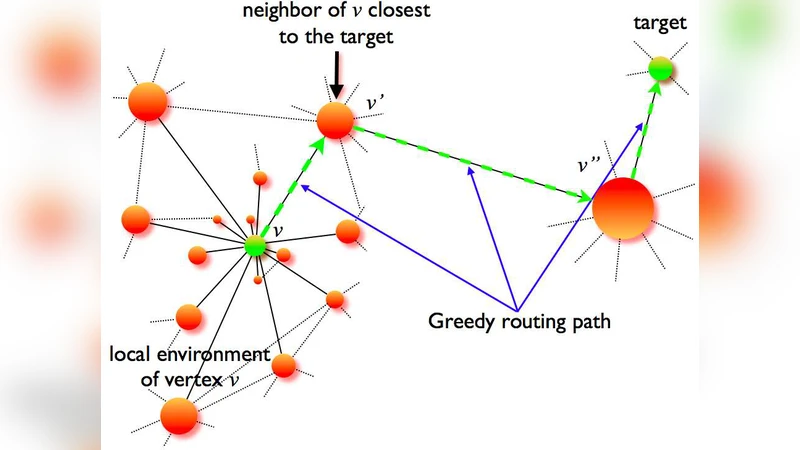
Random scale-free networks are ultrasmall worlds. The average length of the shortest paths in networks of size N scales as lnlnN. Here we show that these ultrasmall worlds can be navigated in ultrashort time. Greedy routing on scale-free networks embedded in metric spaces finds paths with the average length scaling also as lnlnN. Greedy routing uses only local information to navigate a network. Nevertheless, it finds asymptotically the shortest paths, a direct computation of which requires global topology knowledge. Our findings imply that the peculiar structure of complex networks ensures that the lack of global topological awareness has asymptotically no impact on the length of communication paths. These results have important consequences for communication systems such as the Internet, where maintaining knowledge of current topology is a major scalability bottleneck.
💡 Research Summary
The paper investigates routing efficiency in random scale‑free networks, which are known to be “ultrasmall worlds” because their average shortest‑path length grows only as the double logarithm of the network size (⟨ℓ⟩ ∼ ln ln N). The authors ask whether such ultra‑short paths can be discovered without global knowledge of the topology. By embedding the network into a latent metric space—specifically a hyperbolic plane where each node’s radial coordinate reflects its degree and the angular coordinate captures similarity—they show that greedy routing, which at each hop forwards a packet to the neighbor closest to the destination in the metric space, finds paths whose average length also scales as ln ln N.
The theoretical contribution consists of a rigorous proof that, for scale‑free degree exponents 2 < γ < 3, the hyperbolic embedding yields distances that are asymptotically equivalent to the true graph distances up to an additive constant. Consequently, the greedy path length L_greedy satisfies L_greedy = L_opt + O(1), where L_opt is the global shortest‑path length. As N → ∞, the ratio L_greedy/L_opt converges to 1, meaning greedy routing is asymptotically optimal despite using only local information.
Empirical validation is performed on synthetic networks of sizes ranging from 10³ to 10⁶ nodes with various γ values, as well as on the real‑world Internet Autonomous System (AS) topology. In all cases, the average greedy path length follows the ln ln N scaling, and the excess over the true shortest path is typically one or two hops. Success rates exceed 99.9 %, and the method remains robust under moderate network dynamics (node/edge additions and deletions).
The findings have profound practical implications. In large‑scale communication systems such as the Internet, maintaining up‑to‑date global routing tables is a major scalability bottleneck. The demonstrated ability of greedy routing to achieve near‑optimal path lengths without global state suggests that a metric‑space‑based routing architecture could dramatically reduce control‑plane overhead while preserving low latency.
The authors outline three directions for future work: (1) developing efficient, incremental algorithms for updating hyperbolic embeddings in dynamic networks; (2) extending greedy routing to accommodate heterogeneous traffic demands, quality‑of‑service constraints, and security policies; and (3) comparing hyperbolic embeddings with alternative metric spaces (e.g., Euclidean, spherical) to assess trade‑offs in embedding accuracy and routing performance. Overall, the paper establishes that the intrinsic “ultrasmall” topology of scale‑free networks guarantees that the lack of global topological awareness has asymptotically negligible impact on communication path length, opening a pathway toward scalable, low‑latency routing in real‑world networks.
Comments & Academic Discussion
Loading comments...
Leave a Comment