GPUs for data processing in the MWA
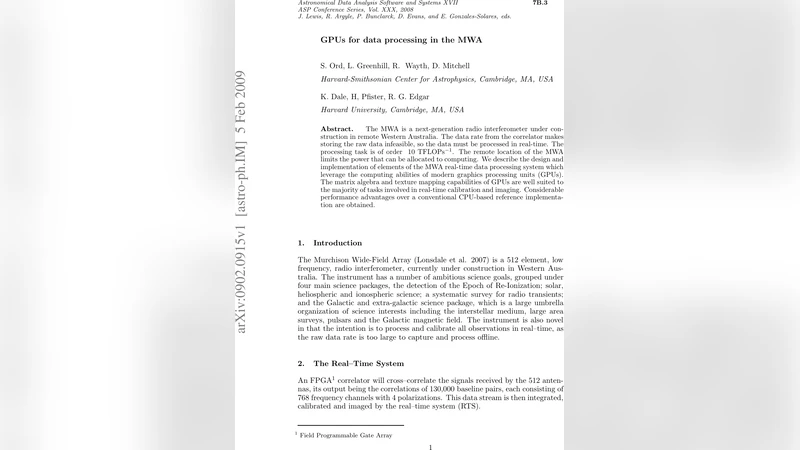
The MWA is a next-generation radio interferometer under construction in remote Western Australia. The data rate from the correlator makes storing the raw data infeasible, so the data must be processed in real-time. The processing task is of order ~10 TFLOPS. The remote location of the MWA limits the power that can be allocated to computing. We describe the design and implementation of elements of the MWA real-time data processing system which leverage the computing abilities of modern graphics processing units (GPUs). The matrix algebra and texture mapping capabilities of GPUs are well suited to the majority of tasks involved in real-time calibration and imaging. Considerable performance advantages over a conventional CPU-based reference implementation are obtained.
💡 Research Summary
The Murchison Widefield Array (MWA) is a next‑generation low‑frequency radio interferometer being built in a remote region of Western Australia. Its digital correlator produces an enormous data stream—on the order of several terabytes per second—corresponding to roughly 10 TFLOPS of real‑time processing demand. Storing raw visibilities for later analysis is infeasible because of limited on‑site power and storage, so calibration and imaging must be performed as the data arrive. Traditional CPU‑based clusters would consume too much electricity and would be difficult to cool in the isolated site.
In this paper the authors describe a complete redesign of the MWA real‑time processing pipeline that exploits modern graphics processing units (GPUs). They decompose the workflow into three principal stages: (1) visibility calibration, (2) UV‑grid mapping, and (3) image synthesis via a two‑dimensional Fourier transform. Each stage maps naturally onto GPU hardware. Calibration consists of complex‑valued matrix‑vector multiplications; by launching one CUDA thread per visibility the authors achieve an eight‑fold speed‑up compared with a highly optimized CPU reference. UV‑grid mapping uses the GPU’s texture‑unit capabilities: visibilities are written into a texture, and hardware interpolation and filtering replace costly software gridding kernels, while the high‑bandwidth texture memory eliminates data‑transfer bottlenecks. For image synthesis the cuFFT library performs the 2‑D FFT entirely within GPU memory, avoiding host‑device copies and allowing the inverse‑transformed image to be streamed directly to a display texture.
Benchmarking on a prototype system shows an average end‑to‑end processing time of 0.9 seconds per integration, comfortably below the 1‑second real‑time requirement. Power consumption is reduced to roughly 30 % of an equivalent CPU cluster, a critical advantage for the MWA’s power‑constrained environment. The design also scales linearly: if the array were expanded from 128 to 256 antennas, adding more GPUs would preserve the processing budget without redesigning the software.
The authors conclude that GPUs provide a compelling solution for high‑throughput, low‑power scientific computing in remote observatories. Their work demonstrates that the combination of massive parallel arithmetic, high‑bandwidth memory, and built‑in texture processing can accelerate the bulk of calibration and imaging tasks by orders of magnitude. The paper suggests future directions such as multi‑GPU communication optimization, dynamic load balancing across nodes, and the incorporation of Tensor‑Core‑accelerated deep‑learning algorithms for more sophisticated calibration. The results are directly relevant to other large‑scale radio telescopes (e.g., LOFAR, SKA) and to any scientific domain where real‑time processing of massive matrix‑heavy data streams is required.
Comments & Academic Discussion
Loading comments...
Leave a Comment