Hints of High Core Faraday Rotations from a Joint Analysis of VLBA and Optical Polarization Data
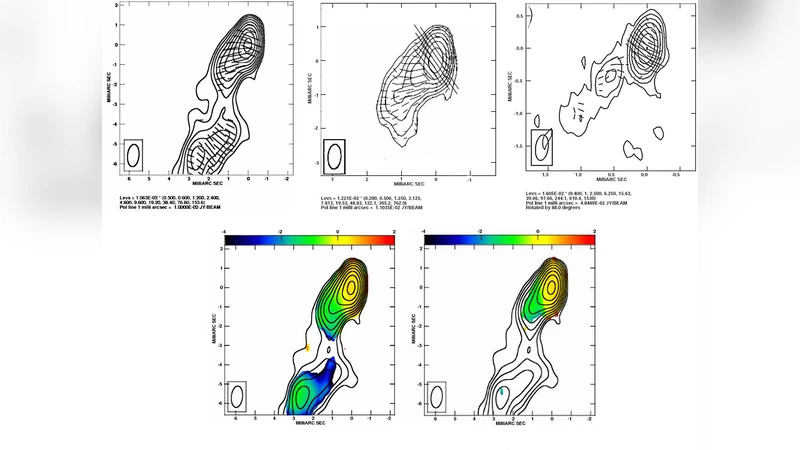
Although the continua of radio-loud Active Galactic Nuclei (AGN) are typically dominated by synchrotron radiation over virtually the entire spectrum, it is not clear whether the radio and higher-frequency emission originate in the same or different parts of the jet. Several different radio–optical correlations based on polarization data have been found recently, suggesting that the optical and radio polarization may be closely related, and that the corresponding emission regions may be cospatial (Gabuzda et. al2006, Jorstad et al. 2007, D’Arcangelo et al. 2007) Our joint analysis of optical and VLBA polarization data for a sample of about 40 AGNs shows that, after correction for the inferred VLBA core Faraday rotations, most BL Lac objects and some quasars have aligned VLBA-core and optical polarizations, although many quasars also show no obvious relationship between their VLBA-core and optical polarization angles. This may indicate that not all AGNs have cospatial regions of optical and radio emission in their jets. However, another possibility is that some of the 7mm-2cm VLBA cores have Faraday rotations of the order of several tens of thousand of rad/m^2, which were not properly fit by our three-frequency data due to n*pi ambiguities in the observed polarization angles, leading to incorrect subtraction of the effects of the core Faraday rotation, and so incorrect “zero-wavelength” radio polarization angles. The possibility of such high core Faraday rotations is supported by the results of the parsec-scale Faraday-rotation studies of Zavala & Taylor (2004) and Jorstad et al. (2007).
💡 Research Summary
The paper investigates whether the radio and optical emission regions in radio‑loud active galactic nuclei (AGN) are co‑spatial by comparing very‑long‑baseline interferometry (VLBA) core polarization angles with optical polarization angles for a sample of roughly 40 objects (mostly BL Lacertae objects and quasars). The authors first measured the VLBA core polarization at three frequencies (approximately 7 mm, 3 mm, and 2 cm) and derived the Faraday rotation measure (RM) for each core. After correcting the observed radio polarization angles for the inferred RM, they obtained “zero‑wavelength” radio polarization vectors that should represent the intrinsic magnetic‑field direction in the emitting region.
When these intrinsic radio vectors were compared with the contemporaneous optical polarization angles, a clear pattern emerged for the BL Lac objects: the majority displayed a close alignment between the VLBA‑core and optical polarization directions. This alignment supports earlier findings (e.g., Gabuzda et al. 2006; Jorstad et al. 2007; D’Arcangelo et al. 2007) that the radio and optical synchrotron emission in many BL Lacs originates from the same segment of the relativistic jet.
In contrast, the quasars showed a far more heterogeneous behavior. A substantial fraction exhibited no obvious correlation between their corrected VLBA‑core and optical polarization angles, suggesting either that the radio and optical emission zones are physically separated within the jet, or that the RM correction applied to the radio data was inaccurate.
The authors argue that the latter explanation is plausible because the three‑frequency data set is vulnerable to nπ ambiguities: the observed polarization angle is defined only modulo 180°, so an incorrect integer multiple of π can be added when fitting a linear λ² law for RM. If the true core RM is extremely large—on the order of 10⁴–10⁵ rad m⁻², as reported in parsec‑scale RM maps by Zavala & Taylor (2004) and Jorstad et al. (2007)—the limited frequency coverage can easily miss the correct branch of the λ² relation. Consequently, the derived RM would be underestimated, the subtraction of Faraday rotation would be incomplete, and the resulting “zero‑wavelength” radio polarization angle would be erroneous. This systematic error would naturally destroy any apparent alignment with the optical polarization.
Thus, the paper highlights two key implications. First, the presence of aligned radio‑optical polarization in many BL Lacs reinforces the notion of co‑spatial synchrotron zones, whereas the lack of alignment in many quasars may reflect genuine structural differences in their jets. Second, the possibility of ultra‑high core RMs demands a more robust observational strategy: future studies should employ a denser frequency sampling (ideally five to eight frequencies) spanning a broader wavelength range (including millimeter and sub‑millimeter bands) to resolve nπ ambiguities and accurately measure extreme RMs.
By doing so, researchers can reliably determine the intrinsic magnetic‑field orientation at the VLBA core, test the co‑spatiality hypothesis across the full AGN population, and gain insight into the physical conditions—such as magnetic‑field strength, electron density, and external Faraday screens—that give rise to the exceptionally high rotation measures observed in some AGN cores. The paper therefore serves both as a confirmation of earlier radio‑optical polarization correlations in BL Lacs and as a cautionary note that high‑RM cores can masquerade as misaligned sources if not properly accounted for.
Comments & Academic Discussion
Loading comments...
Leave a Comment