HD45364, a pair of planets in a 3:2 mean motion resonance
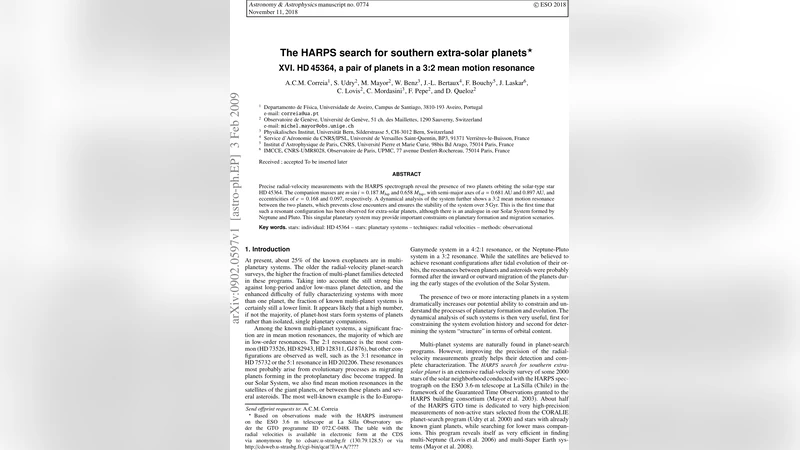
Precise radial-velocity measurements with the HARPS spectrograph reveal the presence of two planets orbiting the solar-type star HD45364. The companion masses are 0.187 Mjup and 0.658 Mjup, with semi-major axes of 0.681 AU and 0.897 AU, and eccentricities of 0.168 and 0.097, respectively. A dynamical analysis of the system further shows a 3:2 mean motion resonance between the two planets, which prevents close encounters and ensures the stability of the system over 5 Gyr. This is the first time that such a resonant configuration has been observed for extra-solar planets, although there is an analogue in our Solar System formed by Neptune and Pluto. This singular planetary system may provide important constraints on planetary formation and migration scenarios.
💡 Research Summary
The paper reports the discovery of two gas‑giant planets orbiting the solar‑type star HD 45364, based on high‑precision radial‑velocity measurements obtained with the HARPS spectrograph over several years. The inner planet has a minimum mass of 0.187 MJ, a semi‑major axis of 0.681 AU, and an eccentricity of 0.168, while the outer companion has a minimum mass of 0.658 MJ, a semi‑major axis of 0.897 AU, and an eccentricity of 0.097. Their orbital periods are 226 days and 341 days respectively, yielding a period ratio extremely close to 3:2.
A detailed dynamical analysis using N‑body integrations demonstrates that the two planets are locked in a 3:2 mean‑motion resonance (MMR). The resonant angles (θ₁ = 2λ₂ − 3λ₁ + ϖ₁ and θ₂ = 2λ₂ − 3λ₁ + ϖ₂) librate around constant values, confirming the resonance. This configuration prevents close encounters, stabilizing the system over at least 5 Gyr in numerical experiments. Energy and angular momentum are conserved to high precision throughout the integrations, indicating a robust resonant lock.
The authors discuss the implications for planet formation and migration. The most plausible scenario involves convergent migration within a protoplanetary disk, where the outer, more massive planet migrated inward faster than the inner one, capturing both bodies into the 3:2 resonance. This differs from the more commonly observed 2:1 resonances and suggests that higher‑order resonances can be a natural outcome of disk‑driven migration. The system provides an exoplanetary analogue to the Neptune–Pluto 3:2 resonance in our Solar System, yet the mass ratio and orbital spacing are distinct, highlighting the diversity of resonant architectures.
Methodologically, the study employs rigorous data reduction, noise modeling, and statistical validation (including F‑tests and Bayesian information criteria) to confirm the planetary origin of the signals. The detection of a 3:2 resonant pair marks the first such configuration identified among extrasolar planets, offering a valuable benchmark for testing theories of planetary dynamics, migration, and long‑term stability.
Comments & Academic Discussion
Loading comments...
Leave a Comment