Evolution of a Coronal Twisted Flux Rope
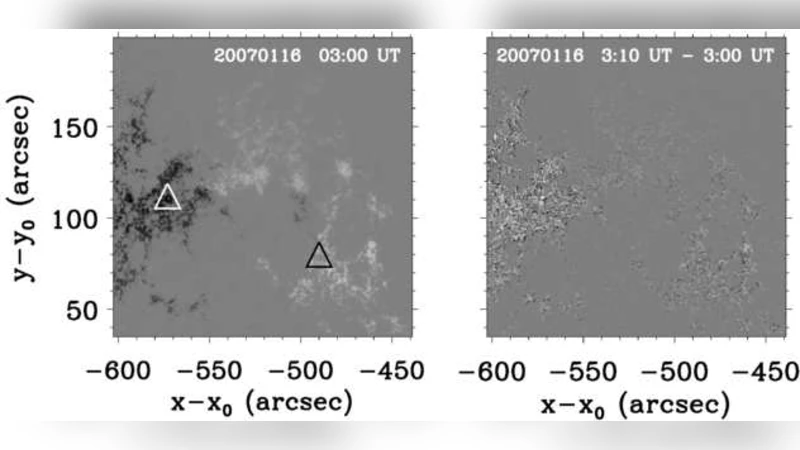
Multi-instrument observations of NOAA AR10938 on Jan. 14-18, 2007, are utilized to study the evolution of a magnetic thread system with multiple crossings suggestive of a twisted coronal flux rope. A C-class flare recorded by GOES on Jan. 16, at approximately 2:35 UT led to the brightening of the structure, that is seen in Hinode/EIS data at 2:46 UT, Hinode/XRT after 2:50 UT, and {\emph{STEREO}}/SECCHI/EUVI images at 3:30 UT. 304 {\AA} images revealed the presence of rapidly evolving, dark fibrils along the bright structure before and after the flare. A denser structure formed a few hours later and lasted for several days forming a segment of an inverse S-shaped filament. The present set of data is highly suggestive of the presence of a twisted flux rope prior to the formation of the filament segment at the same location.
💡 Research Summary
The paper presents a comprehensive multi‑instrument investigation of NOAA Active Region 10938 during 14–18 January 2007, focusing on the evolution of a magnetic thread system that exhibits multiple crossings indicative of a twisted coronal flux rope. The authors combine observations from Hinode/EIS, Hinode/XRT, STEREO/SECCHI/EUVI, and ground‑based 304 Å imaging to trace the physical state of the structure before, during, and after a modest C‑class flare recorded by GOES at approximately 02:35 UT on 16 January.
Immediately after the flare, Hinode/EIS detects enhanced high‑temperature emission lines (e.g., Fe XII, Fe XV) at 02:46 UT, demonstrating rapid heating of plasma confined within the magnetic structure. Within a few minutes, Hinode/XRT records a brightening in soft X‑rays (02:50 UT onward), confirming that the entire thread system has been filled with plasma at several million kelvin. The STEREO/SECCHI/EUVI telescopes capture the same structure in EUV channels (195 Å, 171 Å) at 03:30 UT, where the morphology shows several intertwined strands crossing each other, a hallmark of a three‑dimensional, toroidal flux rope rather than a simple arcade. The overall shape is an inverse S (or “reverse‑S”) configuration, consistent with the negative helicity typically observed in southern‑hemisphere active regions.
Simultaneously, 304 Å (He II) images reveal a system of rapidly evolving dark fibrils that run along the bright EUV/X‑ray threads both before and after the flare. These dark features are interpreted as low‑density, cooler plasma channels that become visible when the hot flux rope plasma cools and condenses, providing a direct visual proxy for the magnetic topology. The persistence of these fibrils after the flare indicates that the underlying magnetic skeleton remains intact despite the energetic disturbance.
A few hours later, a denser, cooler structure emerges along the same magnetic pathway, persisting for several days and forming a segment of an inverse‑S‑shaped filament. This transition from a hot, bright flux rope to a cool, dense filament segment illustrates the full thermodynamic evolution from a high‑temperature coronal configuration to a low‑temperature chromospheric filament. The authors argue that the filament segment is the end product of the same magnetic flux rope that was illuminated by the flare, thereby providing strong observational support for the “flux‑rope model” of filament formation.
Key insights of the study include: (1) the flux rope pre‑existed the flare and was merely rendered visible by the flare‑induced heating; (2) multi‑wavelength diagnostics allow quantitative tracking of temperature and density changes within the rope, revealing a rapid cooling sequence that leads to filament condensation; (3) the observed inverse‑S morphology aligns with the hemispheric helicity rule, reinforcing the link between large‑scale magnetic helicity and filament chirality; and (4) the continuity from a twisted coronal flux rope to a long‑lived filament segment underscores the rope’s role as a precursor to both stable filaments and eruptive coronal mass ejections.
By integrating high‑resolution spectroscopic, X‑ray, and EUV imaging data, the paper provides one of the most complete observational narratives of a coronal flux rope’s life cycle: formation, flare‑driven activation, cooling, and eventual manifestation as a filament. This work bridges the gap between competing theoretical models (flux‑rope versus sheared‑arcade) and offers a valuable template for future studies aiming to predict filament formation and CME initiation based on pre‑eruptive magnetic configurations.
Comments & Academic Discussion
Loading comments...
Leave a Comment