On the complexity of Nash dynamics and Sink Equilibria
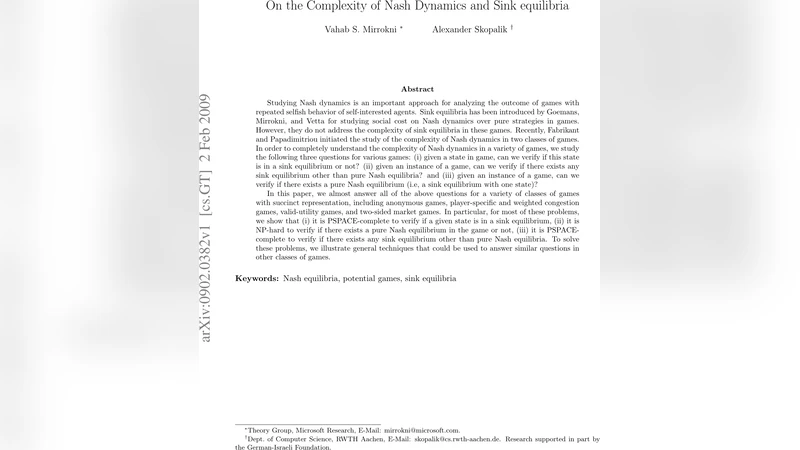
Studying Nash dynamics is an important approach for analyzing the outcome of games with repeated selfish behavior of self-interested agents. Sink equilibria has been introduced by Goemans, Mirrokni, and Vetta for studying social cost on Nash dynamics over pure strategies in games. However, they do not address the complexity of sink equilibria in these games. Recently, Fabrikant and Papadimitriou initiated the study of the complexity of Nash dynamics in two classes of games. In order to completely understand the complexity of Nash dynamics in a variety of games, we study the following three questions for various games: (i) given a state in game, can we verify if this state is in a sink equilibrium or not? (ii) given an instance of a game, can we verify if there exists any sink equilibrium other than pure Nash equilibria? and (iii) given an instance of a game, can we verify if there exists a pure Nash equilibrium (i.e, a sink equilibrium with one state)? In this paper, we almost answer all of the above questions for a variety of classes of games with succinct representation, including anonymous games, player-specific and weighted congestion games, valid-utility games, and two-sided market games. In particular, for most of these problems, we show that (i) it is PSPACE-complete to verify if a given state is in a sink equilibrium, (ii) it is NP-hard to verify if there exists a pure Nash equilibrium in the game or not, (iii) it is PSPACE-complete to verify if there exists any sink equilibrium other than pure Nash equilibria. To solve these problems, we illustrate general techniques that could be used to answer similar questions in other classes of games.
💡 Research Summary
The paper investigates the algorithmic difficulty of analyzing Nash dynamics in pure‑strategy games through the lens of sink equilibria, a concept introduced by Goemans, Mirrokni, and Vetta to capture long‑run behavior when players repeatedly play best‑response moves. While previous work defined sink equilibria and used them to bound social cost, it left open the computational questions of (i) recognizing whether a given strategy profile belongs to a sink equilibrium, (ii) determining whether any sink equilibrium exists that is not a pure Nash equilibrium (i.e., a singleton sink), and (iii) deciding whether a pure Nash equilibrium exists at all.
To answer these questions the authors focus on several succinctly represented game families: anonymous games, player‑specific and weighted congestion games, valid‑utility games, and two‑sided market games. For each class they construct a directed “best‑response graph” whose vertices are strategy profiles and whose edges correspond to unilateral best‑response moves. A sink equilibrium is a strongly connected component (SCC) with no outgoing edges; a pure Nash equilibrium is an SCC of size one.
Result (i): For almost all the considered games, deciding whether a given profile lies in a sink equilibrium is PSPACE‑complete. The proof builds a reduction from Quantified Boolean Formula (QBF). The authors encode the quantifier structure into a sequence of best‑response updates, turning the evaluation of a QBF into the question of whether a particular state can escape its SCC. Because the graph may be exponentially large, any algorithm must essentially explore the state space using only polynomial space, establishing PSPACE‑hardness, while membership in PSPACE follows from a straightforward nondeterministic search of the SCC.
Result (ii): Determining the existence of a non‑singleton sink equilibrium is NP‑hard. The reduction is from SAT: the authors design cost functions so that a satisfying assignment creates a directed cycle of profiles that forms a multi‑state SCC, whereas unsatisfiable formulas force every SCC to be a singleton (a pure Nash equilibrium). Hence, the existence of a “larger” sink equilibrium is equivalent to the formula’s satisfiability.
Result (iii): Deciding whether a pure Nash equilibrium exists (i.e., whether a singleton sink exists) is shown to be PSPACE‑complete for the same game families. The authors adapt the QBF reduction to force any sink equilibrium to be a singleton precisely when the quantified formula is true. This yields a PSPACE‑hardness proof, while containment in PSPACE is again obtained by nondeterministically guessing a profile and verifying that no outgoing best‑response edge exists.
A central technical contribution is the “configurable best‑response simulator,” a generic gadget that translates logical gates and quantifier blocks into players’ best‑response dynamics. By varying the gadget’s parameters the authors can embed the same logical structure into anonymous games, player‑specific congestion games, and market games, thereby obtaining uniform hardness results across disparate models.
The paper also discusses how structural properties of the games affect the complexity landscape. In anonymous games, symmetry can sometimes reduce the effective size of the best‑response graph, yet the reductions still produce PSPACE‑complete instances. In weighted congestion games, heterogeneous delay functions and player‑specific weights amplify the difficulty of escaping SCCs, reinforcing the PSPACE bound. For valid‑utility games, submodularity guarantees that best‑responses behave like greedy steps, but the authors show that this does not simplify the sink‑equilibrium recognition problem.
Overall, the work provides a comprehensive map of the computational barriers to analyzing Nash dynamics via sink equilibria. It demonstrates that even when a game admits a pure Nash equilibrium, verifying its existence or exploring the broader set of sink equilibria can be as hard as the most difficult problems in PSPACE. The techniques introduced—particularly the modular best‑response simulator—offer a reusable toolkit for future investigations into dynamic solution concepts in other game‑theoretic settings such as dynamic auctions, network formation, and multi‑agent reinforcement learning.
Comments & Academic Discussion
Loading comments...
Leave a Comment