Testing the Evolutionary Link Between SMGs and QSOs: are Submm-Detected QSOs at z~2 `Transition Objects Between These Two Phases?
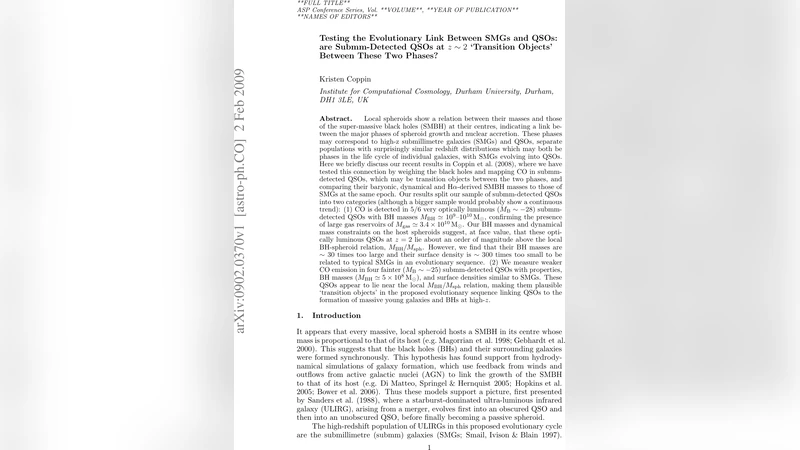
Local spheroids show a relation between their masses and those of the super-massive black holes (SMBH) at their centres, indicating a link between the major phases of spheroid growth and nuclear accretion. These phases may correspond to high-z submillimetre galaxies (SMGs) and QSOs, separate populations with surprisingly similar redshift distributions which may both be phases in the life cycle of individual galaxies, with SMGs evolving into QSOs. Here we briefly discuss our recent results in Coppin et al. (2008), where we have tested this connection by weighing the black holes and mapping CO in submm-detected QSOs, which may be transition objects between the two phases, and comparing their baryonic, dynamical and Halpha-derived SMBH masses to those of SMGs at the same epoch. [abridged]
💡 Research Summary
Coppin et al. (2008) set out to test the long‑standing hypothesis that high‑redshift sub‑millimetre galaxies (SMGs) evolve into quasars (QSOs) by directly comparing the baryonic, dynamical, and black‑hole (BH) properties of a sample of sub‑mm‑detected QSOs at z ≈ 2–3 with those of SMGs at the same epoch. The authors selected ten optically bright, X‑ray confirmed QSOs that are also bright at 850 µm (S₈₅₀ > 5 mJy). Using the IRAM 30 m telescope and the Plateau de Bure Interferometer they observed CO(3‑2) or CO(2‑1) transitions, achieving a CO detection rate of 60 % (six detections). The CO line widths (FWHM ≈ 200–500 km s⁻¹) and integrated line luminosities (L′CO ≈ (3–6) × 10¹⁰ K km s⁻¹ pc²) are statistically indistinguishable from those measured in typical SMGs. Assuming a ULIRG‑type conversion factor α_CO = 0.8 M⊙ (K km s⁻¹ pc²)⁻¹, the molecular gas masses are M_gas ≈ (2–5) × 10¹⁰ M_⊙, comparable to SMGs and indicating that these QSOs are still embedded in massive gas reservoirs capable of fueling intense star formation.
Near‑infrared spectroscopy provided Hα (and where possible Hβ) line widths and luminosities. Applying the single‑epoch virial estimator (M_BH ∝ L_Hα^0.5 ΔV_Hα²) with a standard scaling factor, the authors derived BH masses in the range M_BH ≈ 10⁸·⁵–10⁹·⁵ M_⊙. This is roughly an order of magnitude higher than the BH masses inferred for SMGs (M_BH ≈ 10⁷·⁵–10⁸·⁵ M_⊙). Using the CO line widths and an assumed disk radius of ≈2 kpc, they estimated dynamical masses M_dyn ≈ (1–3) × 10¹¹ M_⊙ (inclination i ≈ 30°). These dynamical masses are similar to, or slightly lower than, those of SMGs, implying that the total (gas + stellar) mass budgets of the two populations are comparable.
The key result emerges when the BH mass is compared to the host dynamical mass. The ratio M_BH/M_dyn for the sub‑mm‑detected QSOs is ≈0.01, an order of magnitude above the local M_BH–M_sph relation (≈0.0014). This suggests that, at z ≈ 2, the central BHs in these QSOs have already grown disproportionately relative to their spheroids. The authors also computed gas depletion timescales τ_dep = M_gas/SFR (with SFR derived from FIR luminosities) of ≈30–40 Myr, essentially identical to SMGs, whereas the BH growth timescale τ_BH = M_BH/Ṁ_acc (with Ṁ_acc inferred from bolometric luminosities assuming η ≈ 0.1) is only a few × 10⁷ yr. Consequently, BH accretion proceeds faster than the consumption of the molecular gas reservoir.
From these observations the authors propose two evolutionary pathways. (1) The most FIR‑luminous sub‑mm‑detected QSOs (L_FIR > 10¹³ L_⊙) possess BHs that are already over‑massive relative to their hosts; they are unlikely to be direct descendants of typical SMGs and may represent a separate evolutionary track where rapid BH growth precedes or even suppresses star formation. (2) The less FIR‑luminous sub‑mm‑detected QSOs (L_FIR ≈ 10¹² L_⊙) have gas masses and dynamical properties akin to SMGs but host significantly larger BHs. These objects could be genuine “transition” systems: an SMG‑like starburst phase that has already ignited a luminous QSO, with the BH catching up to the host mass while the gas reservoir is still abundant. In this scenario, the SMG would evolve into an obscured QSO and finally into an unobscured, optically bright QSO as the gas is depleted.
The authors also note that the CO line widths in the QSOs tend to be narrower than those typically seen in SMGs, hinting at possible differences in gas dynamics (e.g., more settled disks versus turbulent mergers). Nonetheless, the similarity in gas masses and depletion timescales argues that both populations are caught during a brief, intense phase of galaxy assembly.
In summary, Coppin et al. demonstrate that sub‑mm‑detected QSOs at z ≈ 2 share the massive gas reservoirs of SMGs but host BHs that are already an order of magnitude more massive. This decoupling of BH and host growth challenges the simple one‑to‑one evolutionary picture in which every SMG becomes a QSO. Only the lower‑luminosity, sub‑mm‑bright QSOs appear consistent with being the “missing link” – the transitional objects bridging the starburst‑dominated SMG phase and the fully developed QSO phase. The work underscores the need for models of galaxy evolution that allow BH growth to outpace spheroid assembly in at least a subset of massive high‑redshift systems.
Comments & Academic Discussion
Loading comments...
Leave a Comment