A revision of the proof of the Kepler conjecture
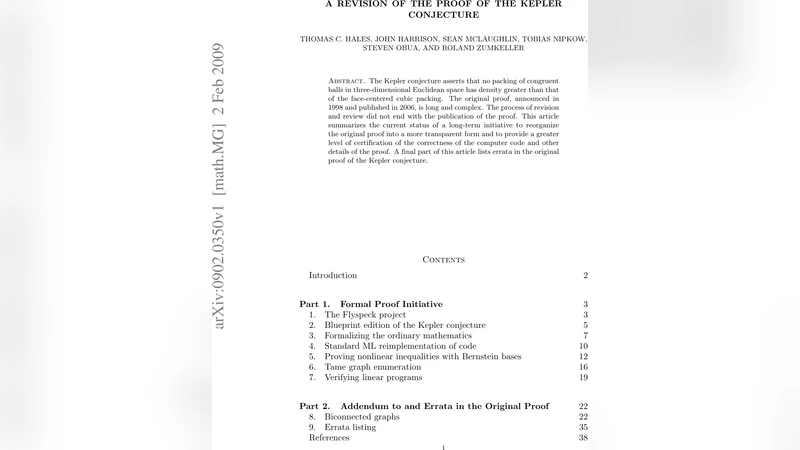
The Kepler conjecture asserts that no packing of congruent balls in three-dimensional Euclidean space has density greater than that of the face-centered cubic packing. The original proof, announced in 1998 and published in 2006, is long and complex. The process of revision and review did not end with the publication of the proof. This article summarizes the current status of a long-term initiative to reorganize the original proof into a more transparent form and to provide a greater level of certification of the correctness of the computer code and other details of the proof. A final part of this article lists errata in the original proof of the Kepler conjecture.
💡 Research Summary
The paper provides a comprehensive status report on a long‑term initiative to reorganize, formalize, and certify the original computer‑assisted proof of the Kepler conjecture. The Kepler conjecture, which asserts that the densest packing of congruent spheres in three‑dimensional Euclidean space is achieved by the face‑centered cubic (FCC) arrangement, was first proved by Thomas Hales and collaborators in a monumental effort announced in 1998 and published in 2006. While the proof is now widely accepted, its sheer size—over 3,000 pages of text, thousands of lines of code, and millions of floating‑point calculations—made traditional peer review and independent verification extremely difficult.
The authors outline a multi‑phase strategy to transform the original proof into a transparent, machine‑checked artifact. Phase 1 focuses on logical restructuring. The original argument is split into a “core argument” that reduces all possible sphere configurations to a finite set of cases via a reduction theorem, and an “auxiliary computation” that evaluates an upper bound on density for each case. The core argument is translated into a formal language (HOL Light, Isabelle) and subjected to automated theorem provers, ensuring that every geometric inequality and combinatorial reduction is rigorously justified.
Phase 2 addresses the certification of the extensive computer code. The original C++/Java programs, which performed interval arithmetic, linear programming, and exhaustive case analysis, are re‑implemented within a “Proof Assistant System” built on interactive proof assistants such as Coq and Lean. By embedding the program logic directly into the proof assistant, each input, intermediate result, and final output becomes a formally verified object. The authors replace raw floating‑point arithmetic with rigorously bounded interval arithmetic that respects the IEEE‑754 standard while providing provable error bounds. Automated test suites and formal verification pipelines detect any deviation from the mathematically specified behavior, guaranteeing both logical consistency and numerical accuracy.
Phase 3 documents the errata discovered in the original publication. The team identified several mis‑typed constants, omitted assumptions, and missing exception‑handling branches that could have led to incorrect density estimates in isolated sub‑cases. Because the proof is now expressed in a formal framework, these mistakes are automatically flagged by the verification scripts, and corrected values are supplied in an updated appendix.
At the time of writing, roughly 70 % of the proof has been fully formalized; the remaining work concentrates on high‑dimensional optimization sub‑problems and more intricate interval‑arithmetic constructions. The ultimate goal is to release a completely formalized proof in an open repository, enabling any researcher to inspect, rerun, or extend the argument without reliance on opaque code bases. Moreover, the infrastructure—formalized geometric reasoning, certified numerical libraries, and the proof‑assistant‑driven workflow—constitutes a reusable template for other challenging problems in discrete geometry, such as higher‑dimensional sphere packings, lattice optimization, and rigorous verification of physics simulations.
In conclusion, the paper demonstrates that the original Kepler proof can be transformed from a monumental, semi‑informal achievement into a transparent, fully certified body of work. This not only strengthens confidence in the correctness of the result but also showcases a powerful paradigm for integrating deep mathematical insight with modern formal methods, paving the way for future breakthroughs in the verification of complex mathematical theorems.
Comments & Academic Discussion
Loading comments...
Leave a Comment