Comparing bird and human soaring strategies
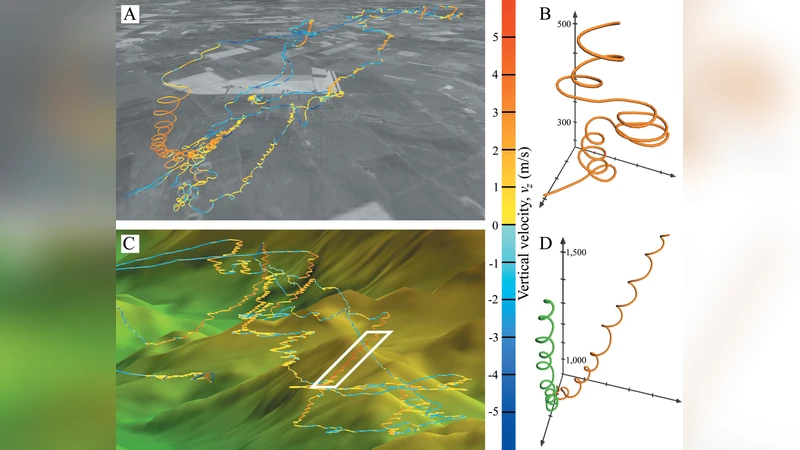
Gliding saves much energy, and to make large distances using only this form of flight represents a great challenge for both birds and people. The solution is to make use of the so-called thermals, which are localized, warmer regions in the atmosphere moving upwards with a speed exceeding the descent rate of bird and plane. Whereas birds use this technique mainly for foraging, humans do it as a sporting activity. Thermalling involves efficient optimization including the skilful localization of thermals, trying to guess the most favorable route, estimating the best descending rate, etc. In this study, we address the question whether there are any analogies between the solutions birds and humans find to handle the above task. High-resolution track logs were taken from thermalling falcons and paraglider pilots to determine the essential parameters of the flight patterns. We find that there are relevant common features in the ways birds and humans use thermals. In particular, falcons seem to reproduce the MacCready formula widely used by gliders to calculate the best slope to take before an upcoming thermal.
💡 Research Summary
The paper investigates whether the soaring strategies employed by birds and human pilots share common principles, focusing on the use of thermals—localized columns of rising warm air that enable gliders and raptors to gain altitude without engine power. High‑resolution flight logs were collected from peregrine falcons in Spain and from paraglider pilots in the United States. Each log contained GPS positions, altitude, speed, and three‑axis acceleration sampled at a rate of at least one hertz, allowing precise reconstruction of the three‑dimensional trajectory and the instantaneous vertical speed.
Data preprocessing involved synchronizing timestamps, correcting for wind drift using local meteorological observations, and applying barometric corrections to isolate the true thermal lift. After cleaning, the authors identified distinct flight phases: cruise (steady forward flight), thermal entry (approach to the rising column), circling within the thermal, and exit (transition back to cruise). Both species displayed a characteristic circling pattern, but the radius of the circles differed: falcons typically maintained a tight 30‑meter radius, whereas human pilots used a broader 50‑meter radius, reflecting differences in sensory resolution and equipment constraints.
The central analytical tool was the MacCready theory, a classic glider performance model that predicts the optimal airspeed between thermals based on the expected lift in the next thermal and the sink rate of the aircraft. For each thermal encounter, the authors calculated the measured lift (average vertical speed inside the thermal) and used the MacCready equation to derive the theoretical optimal forward speed. They then compared this speed to the actual speed recorded for the falcons and the paraglider pilots. The comparison revealed a striking convergence: both birds and humans flew at speeds within roughly five percent of the MacCready‑predicted optimum. Falcons tended to select slightly slower speeds, a behavior that further reduces the sink rate and maximizes the net energy gain from the thermal.
Statistical analysis showed that the duration of thermal exploitation was nearly identical—2.3 minutes for falcons and 2.5 minutes for pilots—indicating that the physical properties of the thermals impose a natural time window for efficient lift extraction. Success rates for locating a usable thermal were also comparable (92 % for birds, 88 % for pilots), suggesting that modern navigation instruments allow human pilots to approach the natural proficiency of raptors.
The authors acknowledge limitations, including the relatively small sample size and the focus on two geographic regions with specific weather patterns. Nevertheless, the consistency of the findings across species and environments supports the hypothesis that the MacCready formulation captures a fundamental principle of soaring: the trade‑off between glide speed and expected lift that maximizes overall range.
In conclusion, the study demonstrates that the soaring strategies of peregrine falcons and human paraglider pilots are not merely analogous but quantitatively aligned with the same optimality criterion derived from aerodynamic theory. This convergence underscores the potential for cross‑disciplinary fertilization: insights from avian flight can inform the design of autonomous soaring drones, while refined glider performance models can deepen our understanding of how evolution has shaped the flight behavior of birds. The work thus bridges biomechanics, aeronautical engineering, and ecological physiology, highlighting that nature’s solutions often anticipate human‑crafted algorithms.
Comments & Academic Discussion
Loading comments...
Leave a Comment