Talking Amongst Ourselves - Communication in the Astronomical Software Community
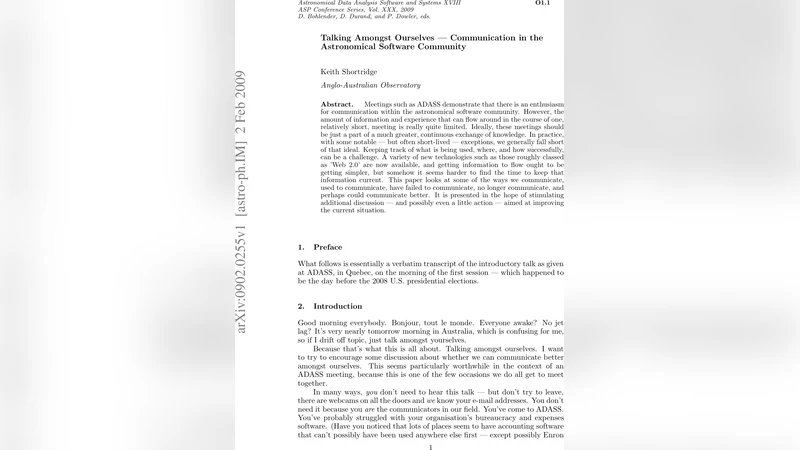
Meetings such as ADASS demonstrate that there is an enthusiasm for communication within the astronomical software community. However, the amount of information and experience that can flow around in the course of one, relatively short, meeting is really quite limited. Ideally, these meetings should be just a part of a much greater, continuous exchange of knowledge. In practice, with some notable - but often short-lived - exceptions, we generally fall short of that ideal. Keeping track of what is being used, where, and how successfully, can be a challenge. A variety of new technologies such as those roughly classed as ‘Web 2.0’ are now available, and getting information to flow ought to be getting simpler, but somehow it seems harder to find the time to keep that information current. This paper looks at some of the ways we communicate, used to communicate, have failed to communicate, no longer communicate, and perhaps could communicate better. It is presented in the hope of stimulating additional discussion - and possibly even a little action - aimed at improving the current situation.
💡 Research Summary
The paper provides a critical examination of how the astronomical software community exchanges information and collaborates, highlighting both the strengths of existing mechanisms and the systemic shortcomings that limit long‑term knowledge retention. It begins by acknowledging the pivotal role of ADASS (Astronomical Data Analysis Software and Systems) meetings, which serve as high‑visibility venues for presenting new tools, algorithms, and for face‑to‑face networking. While these conferences generate enthusiasm and disseminate cutting‑edge developments, their impact is inherently constrained: they occur only once or twice a year, attract a limited audience, and the presented material—often in the form of posters or short talks—remains difficult to access after the event. Consequently, valuable insights risk being lost, and newcomers lack a reliable archive of past discussions.
The authors then survey the current communication channels employed by the community. Code hosting platforms such as GitHub and GitLab, together with issue trackers, effectively manage source code, bug reports, and feature requests. However, non‑code knowledge—installation procedures, environment configuration, performance tuning, and user experience tips—tends to be scattered across wikis, personal blogs, and forum posts. These resources suffer from poor search‑engine optimization, irregular updates, and limited verification, reducing their trustworthiness. Legacy mailing lists and newsgroups, once vibrant, have seen participation decline because long thread histories make it hard to locate relevant information.
The paper turns to “Web 2.0” technologies—social media (Twitter, Facebook), Q&A sites (Stack Overflow), and collaborative wikis (MediaWiki, Confluence)—as potential catalysts for more fluid knowledge flow. These platforms offer real‑time notifications, tagging, and version control, theoretically simplifying information dissemination. In practice, adoption remains low due to three main barriers: (1) community members are already stretched thin and lack time to maintain external content; (2) there is no clear incentive structure rewarding the creation and upkeep of shared resources; and (3) consensus on platform choice and governance policies is lacking.
A successful counter‑example is the AstroPy project, which has built a centralized documentation site, automated build pipelines, and clear contribution guidelines. By issuing contributor badges and maintaining consistent API documentation across releases, AstroPy demonstrates a sustainable model that other astronomical software projects could emulate.
Based on this analysis, the authors propose a four‑pronged roadmap for improving communication:
-
Centralized Metadata Repository – Create a community‑wide database that records software packages, dependencies, operating systems, performance metrics, and licensing information in a structured format. This would enable efficient searching, comparison, and discovery of tools across projects.
-
Standardized Metadata Tags and Open APIs – Define a common schema and expose APIs that allow automatic harvesting of information from existing platforms (GitHub, Zenodo, ASCL). Synchronization would keep metadata current without manual effort.
-
Incentive Mechanisms for Contributors – Introduce tangible rewards such as verified badges, co‑authorship on community white papers, or analytics dashboards that showcase usage statistics. Recognizing contributions publicly would motivate sustained participation.
-
Hybrid Workshops and Online Seminars – Organize regular, blended events that combine in‑person training with live streaming and recording. Sessions would focus on emerging tools, best practices, and case studies, with all materials archived in the centralized repository for future reference.
The conclusion emphasizes that the astronomical software community is currently trapped in a “episodic and fragmented” communication paradigm. Overcoming this requires not only technical infrastructure—metadata services, APIs, and documentation pipelines—but also a cultural shift that values and rewards knowledge sharing. By implementing the proposed roadmap, the community can move toward a resilient, continuously evolving ecosystem where expertise flows freely, new developers can onboard efficiently, and the collective software heritage is preserved for generations to come.
Comments & Academic Discussion
Loading comments...
Leave a Comment