Mutation-selection balance with recombination: convergence to equilibrium for polynomial selection costs
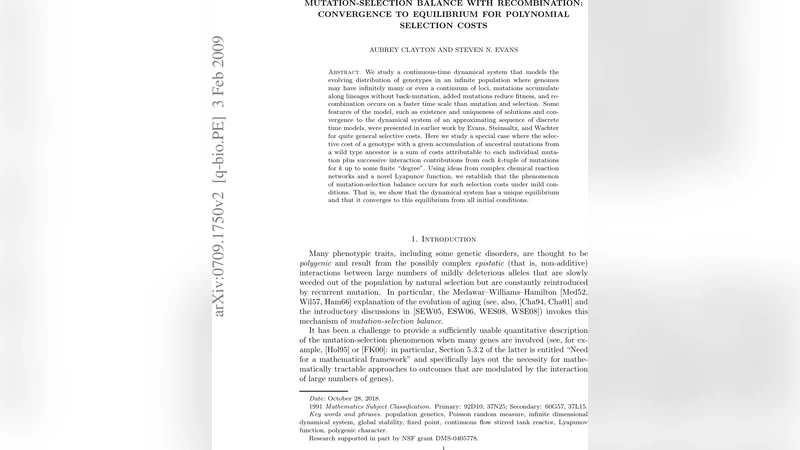
We study a continuous-time dynamical system that models the evolving distribution of genotypes in an infinite population where genomes may have infinitely many or even a continuum of loci, mutations accumulate along lineages without back-mutation, added mutations reduce fitness, and recombination occurs on a faster time scale than mutation and selection. Some features of the model, such as existence and uniqueness of solutions and convergence to the dynamical system of an approximating sequence of discrete time models, were presented in earlier work by Evans, Steinsaltz, and Wachter for quite general selective costs. Here we study a special case where the selective cost of a genotype with a given accumulation of ancestral mutations from a wild type ancestor is a sum of costs attributable to each individual mutation plus successive interaction contributions from each $k$-tuple of mutations for $k$ up to some finite ``degree’’. Using ideas from complex chemical reaction networks and a novel Lyapunov function, we establish that the phenomenon of mutation-selection balance occurs for such selection costs under mild conditions. That is, we show that the dynamical system has a unique equilibrium and that it converges to this equilibrium from all initial conditions.
💡 Research Summary
The paper investigates a continuous‑time dynamical system that describes the evolution of genotype frequencies in an infinite population where genomes may contain infinitely many (or even a continuum of) loci. Mutations occur along lineages without back‑mutation, each new mutation reduces fitness, and recombination operates on a faster time scale than mutation and selection. Earlier work by Evans, Steinsaltz, and Wachter established existence, uniqueness, and convergence of discrete‑time approximations for very general selection cost functions, but left open the question of whether a unique, globally attractive equilibrium (the classic mutation‑selection balance) exists for specific cost structures.
In this study the authors restrict the selection cost to a finite‑degree polynomial in the accumulated mutations. Concretely, if a genotype carries a set γ of ancestral mutations, the cost is expressed as
\
Comments & Academic Discussion
Loading comments...
Leave a Comment