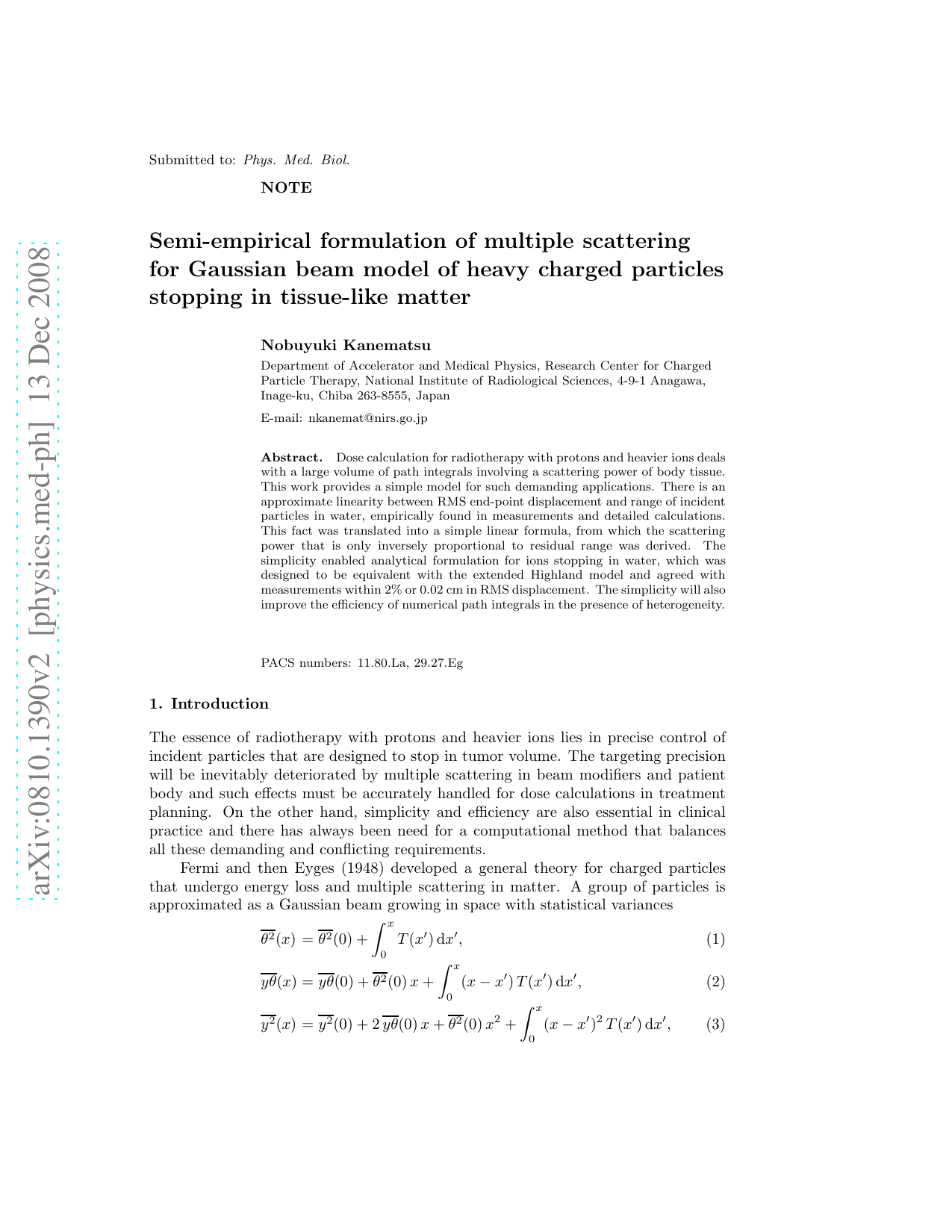
Dose calculation for radiotherapy with protons and heavier ions deals with a large volume of path integrals involving a scattering power of body tissue. This work provides a simple model for such demanding applications. There is an approximate linearity between RMS end-point displacement and range of incident particles in water, empirically found in measurements and detailed calculations. This fact was translated into a simple linear formula, from which the scattering power that is only inversely proportional to residual range was derived. The simplicity enabled analytical formulation for ions stopping in water, which was designed to be equivalent with the extended Highland model and agreed with measurements within 2% or 0.02 cm in RMS displacement. The simplicity will also improve the efficiency of numerical path integrals in the presence of heterogeneity.
Deep Dive into Semi-empirical formulation of multiple scattering for Gaussian beam model of heavy charged particles stopping in tissue-like matter.
Dose calculation for radiotherapy with protons and heavier ions deals with a large volume of path integrals involving a scattering power of body tissue. This work provides a simple model for such demanding applications. There is an approximate linearity between RMS end-point displacement and range of incident particles in water, empirically found in measurements and detailed calculations. This fact was translated into a simple linear formula, from which the scattering power that is only inversely proportional to residual range was derived. The simplicity enabled analytical formulation for ions stopping in water, which was designed to be equivalent with the extended Highland model and agreed with measurements within 2% or 0.02 cm in RMS displacement. The simplicity will also improve the efficiency of numerical path integrals in the presence of heterogeneity.
The essence of radiotherapy with protons and heavier ions lies in precise control of incident particles that are designed to stop in tumor volume. The targeting precision will be inevitably deteriorated by multiple scattering in beam modifiers and patient body and such effects must be accurately handled for dose calculations in treatment planning. On the other hand, simplicity and efficiency are also essential in clinical practice and there has always been need for a computational method that balances all these demanding and conflicting requirements.
Fermi and then Eyges (1948) developed a general theory for charged particles that undergo energy loss and multiple scattering in matter. A group of particles is approximated as a Gaussian beam growing in space with statistical variances
(1)
y 2 (x) = y 2 (0) + 2 yθ(0) x + θ 2 (0)
where x is the longitudinal position and y and θ are the projected particle position and angle. The original Fermi-Eyges theory adopted purely Gaussian approximation (Rossi and Greisen 1948) with (projected) scattering power
where E s = m e c 2 2π/α ≈ 15.0 MeV is a constant, X 0 is the radiation length of the material, and z, p, and v are the charge, the momentum, and the velocity of the particles. The Fermi-Rossi formula (4) totally ignores effects of large-angle single scattering (Hanson et al 1951) and was found to be inaccurate (Wong et al 1990).
Based on formulations by Highland (1975Highland ( , 1979) ) and Gottschalk et al (1993), Kanematsu (2008b) proposed a scattering power with correction for the singlescattering effect, although within the Gaussian approximation,
where ℓ =
x 0 dx ′ /X 0 (x ′ ) is the radiative path length. Although it would be difficult to calculate integrals (1)-(3) because of the embedded integral in the ℓ terms, Kanematsu (2008b) further derived an approximate formula for the RMS displacement of incident ions at the end point in homogeneous matter as
where m/m p is the ion mass in units of the proton mass, R 0 is the expected in-water range on the incidence, ρ S is the stopping-power ratio of the matter relative to water, and κ = 1.08 and λ = 4.67 × 10 -4 are constants.
Despite the complex involvement of variable R 0 in (6), Kanematsu (2008b) found the σ y0 -R 0 relation for ions in water to be very linear. In fact, Preston and Kohler of Harvard Cyclotron Laboratory knew the linear relation and derived universal curve
x/R 0 for relative growth of RMS displacement σ y = (y 2 ) 1/2 in homogeneous matter in an unpublished work in 1968. Starting with the empirical linear relation, this work is aimed to develop a simple and general multiple-scattering model to improve efficiency of numerical heterogeneity handling and to enable further analytical beam modeling.
Linear approximation σ y0 ∝ R 0 for homogeneous systems greatly simplifies (6) to
where X 0w = 36.08 cm is the radiation length of water, X 0w /(ρ S X 0 ) is the scattering/stopping ratio of the material relative to water, and R 0 /ρ S is the geometrical range. Equation ( 7) was calibrated to (6) for water at R 0 = X 0 .
Equation y 2 = σ 2 y0 at the end point x = R 0 /ρ S associates ( 3) and ( 7) as
to lead to another scattering power
where f mz is the particle-type-dependent factor. The scattering power is inherently applicable to any heterogeneous system by numerical integral of ( 1)-(3).
We examined these Fermi-Rossi (4), extended Highland (5), and linear-displacement (9) models with unpublished measurements by Phillips (Hollmark et al 2004), those by Preston and Kohler (Kanematsu 2008b), and Molière-Hanson calculations by Deasy (1998). We took growths of RMS displacement σ y (x) with depth x for R 0 = 29.4 cm protons, R 0 = 29.4 cm helium ions, and R 0 = 29.7 cm carbon ions in water and RMS end-point displacements σ y0 (R 0 ) for them with varied incident range R 0 .
For a point mono-directional ion beam with in-water range R 0 incident into homogeneous matter with constant ρ S and X 0 , equations ( 1)-( 3) are analytically integrated to
as a function of residual range R = R 0 -ρ S x at distance x. Equation ( 12) in fact reduces to the universal curve by Preston and Kohler.
A radiation field at a given x position can be effectively or virtually modeled with a source, ignoring the matter (ICRU-35 1984). The effective extended source is at x e = xyθ(x)/θ 2 (x), where y 2 would be minimum in vacuum. The virtual point source is at x v = xy 2 (x)/yθ(x), from which radiating particles would form a field of equivalent divergence. Similarly, the effective scattering point is at
, at which a point-like scattering would cause equivalent RMS angle and displacement (Gottschalk et al 1993). calculations within either 2% or 0.02 cm, while the Fermi-Rossi model overestimated the RMS displacements by nearly 10%. Figure 1(c) shows an end-point shape of a pencil beam measured by Preston and Kohler for R 0 = 11.4 cm protons in water and curves estimated by Fermi-Rossi and the present formulations
…(Full text truncated)…
This content is AI-processed based on ArXiv data.