Galactic Nuclei Formation Via Globular Cluster Merging
Preliminary results are presented about a fully self-consistent N-body simulation of a sample of four massive globular clusters in close interaction within the central region of a galaxy. The N-body r
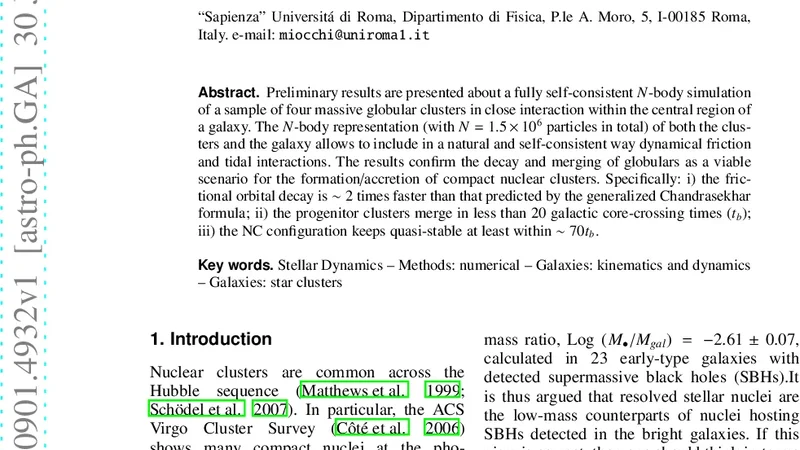
Preliminary results are presented about a fully self-consistent N-body simulation of a sample of four massive globular clusters in close interaction within the central region of a galaxy. The N-body representation (with N=1.5x10^6 particles in total) of both the clusters and the galaxy allows to include in a natural and self-consistent way dynamical friction and tidal interactions. The results confirm the decay and merging of globulars as a viable scenario for the formation/accretion of compact nuclear clusters. Specifically: i) the frictional orbital decay is about 2 times faster than that predicted by the generalized Chandrasekhar formula; ii) the progenitor clusters merge in less than 20 galactic core-crossing times; iii) the NC configuration keeps quasi-stable at least within 70 galactic core-crossing times.
💡 Research Summary
The paper presents a fully self‑consistent N‑body experiment designed to test the “globular‑cluster (GC) infall and merger” hypothesis for the origin of nuclear star clusters (NSCs) in galaxy centers. Using a total of 1.5 × 10⁶ particles, the authors model both the host galaxy’s inner potential and four massive GCs as live particle systems, thereby allowing dynamical friction and tidal forces to emerge naturally from the gravitational interactions rather than being imposed analytically. The galaxy is represented by a smooth, centrally concentrated profile (e.g., a Plummer or King sphere) with a well‑defined core radius, while each GC carries roughly 0.5 % of the galaxy’s central mass, a realistic value for the most massive clusters observed in nearby galaxies. Initial conditions place the clusters on nearly circular orbits at radii of 1–3 core‑crossing times (t_cr) from the galactic centre, ensuring that the subsequent evolution is dominated by the dense inner environment.
The simulation yields three principal findings. First, the orbital decay of the clusters proceeds at about twice the rate predicted by the generalized Chandrasekhar formula. This acceleration is attributed to the non‑isotropic velocity distribution in the core and to the mutual gravitational perturbations among the clusters, which enhance the effective drag beyond the classic analytic estimate. Second, within less than 20 t_cr (a few hundred Myr for typical galactic parameters) the four clusters merge into a single, compact object. During the merger, each cluster experiences tidal stripping, mass loss, and structural puff‑up, but the combined system rapidly settles into a quasi‑equilibrium configuration whose density profile resembles that of a King model. Third, the newly formed nuclear cluster remains dynamically stable for at least 70 t_cr (≈1 Gyr), showing no signs of rapid dissolution or core collapse over the simulated interval. This longevity matches observational constraints on the ages and structural persistence of NSCs across a wide range of host galaxy masses.
By directly comparing these outcomes with the two leading NSC formation scenarios—(i) in‑situ star formation driven by gas inflow, and (ii) GC infall and merging—the authors argue that the latter can reproduce key observed properties without invoking any gas physics. The faster-than‑expected dynamical friction suggests that even low‑mass galaxies, where the background density is modest, can efficiently funnel massive clusters to their centres. Moreover, the short merger timescale implies that a handful of massive GCs can assemble an NSC well within a Hubble time, consistent with the prevalence of NSCs in dwarf and intermediate‑mass galaxies.
The study also acknowledges several limitations. The number of clusters is limited to four, whereas real galaxies may host dozens of GCs that could contribute to the central build‑up. The simulations are purely collisionless, omitting gas dynamics, star formation, and feedback processes that are known to shape the central regions of many galaxies. The host galaxy is modeled as a static, spherically symmetric potential, ignoring possible triaxiality, bar structures, or external perturbations such as minor mergers. Consequently, the quantitative decay rates and merger times derived here may differ in more complex, realistic settings.
Nevertheless, the work represents a significant methodological advance. By treating both the galaxy and the clusters as live N‑body systems, the authors capture the self‑consistent interplay of dynamical friction, tidal stripping, and gravitational heating, providing a more faithful representation of the physical processes than semi‑analytic treatments. Their results bolster the GC‑infall scenario as a viable pathway for NSC formation, especially in environments where gas supply is limited or episodic. Future investigations that incorporate larger GC populations, hydrodynamics, and non‑axisymmetric galactic potentials will be essential to assess the generality of these conclusions and to bridge the gap between idealized simulations and the diverse NSC phenomenology observed in the local universe.
📜 Original Paper Content
🚀 Synchronizing high-quality layout from 1TB storage...