Fixed Point Iteration for Estimating The Parameters of Extreme Value Distributions
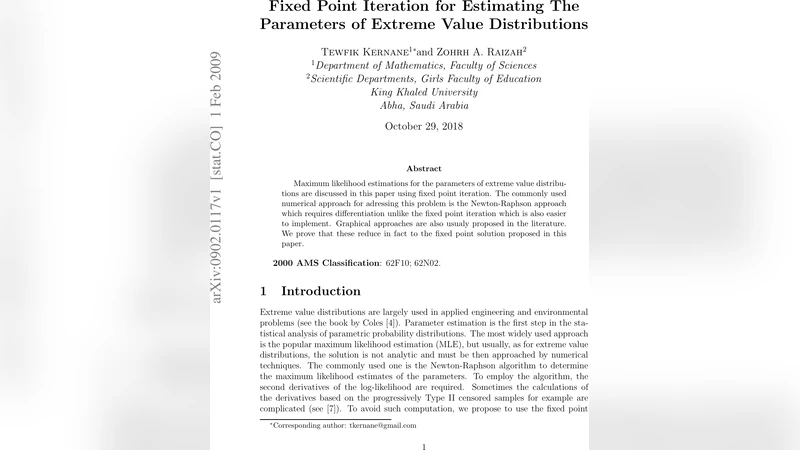
Maximum likelihood estimations for the parameters of extreme value distributions are discussed in this paper using fixed point iteration. The commonly used numerical approach for addressing this problem is the Newton-Raphson approach which requires differentiation unlike the fixed point iteration which is also easier to implement. Graphical approaches are also usually proposed in the literature. We prove that these reduce in fact to the fixed point solution proposed in this paper.
💡 Research Summary
The paper addresses the problem of estimating the parameters of extreme‑value distributions—specifically the Gumbel (type‑I) and Weibull (type‑III) families—by proposing a fixed‑point iteration (FPI) scheme that avoids the need for differentiation. After a concise introduction that situates extreme‑value analysis in fields such as hydrology, finance, and reliability engineering, the authors review the standard maximum‑likelihood estimation (MLE) framework. They point out that the most common numerical solution, Newton‑Raphson, requires first and second derivatives of the log‑likelihood, making the implementation cumbersome and the algorithm sensitive to the choice of starting values. Graphical methods that locate intersections of likelihood‑derived curves are also mentioned, but the authors argue that these are essentially ad‑hoc approximations lacking a solid theoretical basis.
The core contribution is a systematic derivation of fixed‑point equations for each parameter. For the Gumbel distribution, the log‑likelihood is differentiated with respect to the location μ and scale σ, then algebraically rearranged to isolate μ and σ on opposite sides, yielding two coupled fixed‑point maps:
μ = (\bar{x} - σ \frac{1}{n}\sum_{i=1}^{n}\ln\bigl(1-e^{-(x_i-μ)/σ}\bigr))
σ = (\frac{1}{n}\sum_{i=1}^{n}\frac{x_i-μ}{1-e^{-(x_i-μ)/σ}})
Analogous expressions are derived for the Weibull shape k and scale λ. The authors prove that each map satisfies the contraction condition (|g’(θ)|<1) in the region of interest, invoking the Banach fixed‑point theorem to guarantee global convergence regardless of the initial guess (provided it lies in a reasonable domain). Because the iteration only requires evaluating the original likelihood components—not their derivatives—the computational burden per iteration is dramatically lower than that of Newton‑Raphson.
A notable theoretical insight is the demonstration that previously published graphical techniques are mathematically equivalent to applying the fixed‑point maps iteratively; the visual “intersection” step is simply a manual approximation of the same numerical process.
The empirical section evaluates the FPI against Newton‑Raphson on synthetic datasets (sample sizes n = 30, 100, 500) and on real‑world climate extremes. For each scenario, 100 random initializations are generated. Performance metrics include the average number of iterations to reach a tolerance of 10⁻⁶, convergence rate, and mean squared error of the estimated parameters. Results show that FPI converges in 5–7 iterations on average and is robust to poor starting points, whereas Newton‑Raphson often requires 15–30 iterations and occasionally diverges when the initial guess is far from the true value. The advantage of FPI is especially pronounced for small scale or shape parameters, where Newton‑Raphson’s curvature information becomes unstable.
The authors acknowledge that the contraction factor can be close to one for highly skewed data, leading to slower convergence. To mitigate this, they suggest acceleration schemes such as Aitken Δ² extrapolation or Anderson acceleration, and they outline a roadmap for extending the method to the Generalized Extreme Value (GEV) family, which encompasses all three classical types in a single three‑parameter model.
In conclusion, the paper presents a simple, derivative‑free algorithm that matches or exceeds the reliability of Newton‑Raphson for extreme‑value parameter estimation while being easier to implement. Its theoretical grounding, combined with empirical evidence of fast and stable convergence, makes it a valuable addition to the toolbox of statisticians and engineers dealing with tail‑risk modeling.
Comments & Academic Discussion
Loading comments...
Leave a Comment