Kinematic Fitting in the Presence of ISR at the ILC
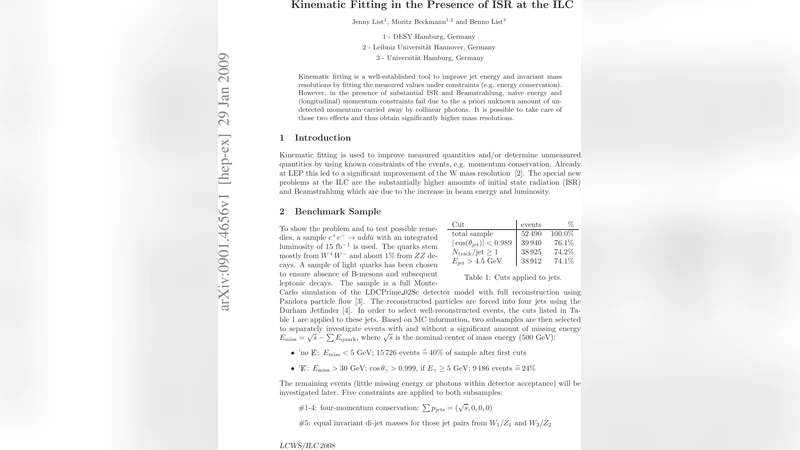
Kinematic fitting is a well-established tool to improve jet energy and invariant mass resolutions by fitting the measured values under constraints (e.g. energy conservation). However, in the presence of substantial ISR and Beamstrahlung, naive energy and (longitudinal) momentum constraints fail due to the a priori unknown amount of undetected momentum carried away by collinear photons. It is possible to take care of those two effects and thus obtain significantly higher mass resolutions.
💡 Research Summary
This paper addresses a critical challenge for precision measurements at the International Linear Collider (ILC): the presence of substantial initial‑state radiation (ISR) and Beamstrahlung, which carry away unknown amounts of energy and longitudinal momentum in the form of collinear photons. Traditional kinematic fitting techniques rely on hard constraints such as total energy and momentum conservation and on equal‑mass constraints for di‑jet pairs. When ISR and Beamstrahlung are significant, these constraints become inconsistent with the measured jet four‑vectors, leading to poor fit convergence and biased invariant‑mass reconstructions.
The authors propose a simple yet effective solution: model the combined effect of ISR and Beamstrahlung as a single fictitious photon. The photon’s transverse momentum components (pₓ, p_y) are fixed to zero because the radiation is predominantly along the beam axis, while its longitudinal component p_z is treated as a free fit parameter. The measured value of p_z is set to zero with a large Gaussian uncertainty (σ = 100 GeV) to allow the fit to absorb the missing momentum. This approach retains all hard constraints (energy‑momentum conservation and equal‑mass di‑jet constraints) while adding one additional degree of freedom that can compensate for the invisible radiation.
The study uses a full Monte‑Carlo simulation of the LDCPrime 02Sc detector model at √s = 500 GeV. Events of the type e⁺e⁻ → u d̄ d ū are generated with an integrated luminosity of 15 fb⁻¹. After particle‑flow reconstruction (Pandora) and jet clustering (Durham), four‑jet events are selected with basic quality cuts (|cosθ_jet| < 0.98, at least one track per jet, jet energy > 4.5 GeV). The sample is split into two subsamples based on the missing energy E_miss = √s – ΣE_quark: (i) “no E/” with E_miss < 5 GeV (≈40 % of events) and (ii) “E/” with E_miss > 30 GeV and a hard ISR photon (≈24 % of events).
For each subsample the authors perform two fits:
- The conventional 4‑jet hypothesis, imposing four‑momentum conservation (four constraints) and equal di‑jet masses (one constraint) – a total of five constraints.
- The 4‑jet + photon hypothesis, which adds the photon p_z as a free parameter, effectively providing six variables constrained by the same five equations.
All three possible jet‑pairings are tested, and the combination with the highest fit probability (and di‑jet masses within 50–110 GeV) is retained.
Results for the “E/” subsample are striking. The pure 4‑jet fit fails to converge in the majority of events because the energy‑conservation constraint cannot be satisfied; the fit probability distribution is essentially zero. In contrast, the 4‑jet + photon fit converges for about 79 % of events, and the fitted photon energy closely matches the true missing energy from ISR/Beamstrahlung (as shown by a strong correlation plot). Most importantly, the invariant‑mass distribution of the di‑jet system, which is biased high and broadened in the 4‑jet fit, becomes centered near the true W/Z mass and its width shrinks by roughly 1 GeV. This improvement directly enhances the ability to separate hadronic W and Z decays.
For the “no E/” subsample, where missing energy is small, both fits converge with high probability. The 4‑jet + photon fit still recovers the tiny missing momentum (up to 5 GeV) and eliminates the small mass bias observed in the pure 4‑jet fit, albeit with a modest reduction in the overall fit probability.
The study demonstrates that even a very rudimentary photon parametrization (single p_z variable, large Gaussian error) can effectively absorb ISR/Beamstrahlung effects, preserve hard constraints, and substantially improve mass resolution. The authors acknowledge that the convergence rate for the 4‑jet + photon fit could be further enhanced by refining the photon model (e.g., allowing multiple photons, using realistic ISR/Beamstrahlung spectra, adopting non‑Gaussian uncertainties) and by improving jet‑energy scaling. They also plan to extend the method to other quark flavours, compare it with soft‑constraint approaches, and develop a dedicated treatment for ISR photons that are actually measured in the detector.
In summary, the paper provides a practical methodology for incorporating ISR and Beamstrahlung into kinematic fits at the ILC. By treating the invisible radiation as an additional fit object rather than discarding the energy‑conservation constraint, the authors achieve a measurable gain in di‑jet mass resolution (≈1 GeV) and a higher fit convergence rate, paving the way for more precise measurements of W/Z boson properties and other processes where accurate reconstruction of hadronic final states is essential.
Comments & Academic Discussion
Loading comments...
Leave a Comment