On d-dimensional d-Semimetrics and Simplex-Type Inequalities for High-Dimensional Sine Functions
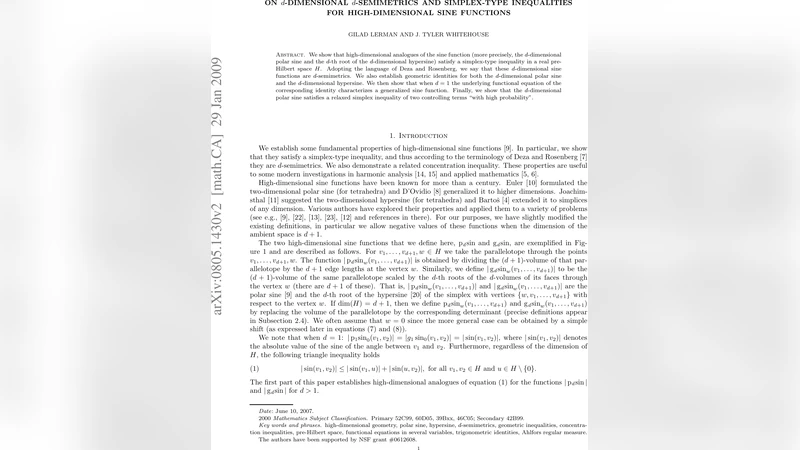
We show that high-dimensional analogues of the sine function (more precisely, the d-dimensional polar sine and the d-th root of the d-dimensional hypersine) satisfy a simplex-type inequality in a real pre-Hilbert space H. Adopting the language of Deza and Rosenberg, we say that these d-dimensional sine functions are d-semimetrics. We also establish geometric identities for both the d-dimensional polar sine and the d-dimensional hypersine. We then show that when d=1 the underlying functional equation of the corresponding identity characterizes a generalized sine function. Finally, we show that the d-dimensional polar sine satisfies a relaxed simplex inequality of two controlling terms “with high probability”.
💡 Research Summary
The paper investigates two families of high‑dimensional analogues of the ordinary sine function—namely the d‑dimensional polar sine and the d‑th root of the d‑dimensional hypersine—and proves that both satisfy a simplex‑type inequality in any real pre‑Hilbert space. The authors adopt the terminology of Deza and Rosenberg and call any function that fulfills such an inequality a “d‑semimetric”. After introducing the precise definitions, the polar sine of vectors (v_{1},\dots ,v_{d}) is defined as the norm of their exterior product divided by the product of their lengths, i.e. (\sin_{d}(v_{1},\dots ,v_{d})=|v_{1}\wedge\cdots\wedge v_{d}|/(|v_{1}|\cdots|v_{d}|)). The hypersine is the d‑th root of the ratio between the volume of the parallelotope spanned by the same vectors and the product of their lengths: (\operatorname{hyp}{d}(v{1},\dots ,v_{d})=(\operatorname{Vol}(v_{1},\dots ,v_{d})/(|v_{1}|\cdots|v_{d}|))^{1/d}). Both quantities lie in (
Comments & Academic Discussion
Loading comments...
Leave a Comment