On The Pairwise Weakly Lindelof Bitopological Spaces
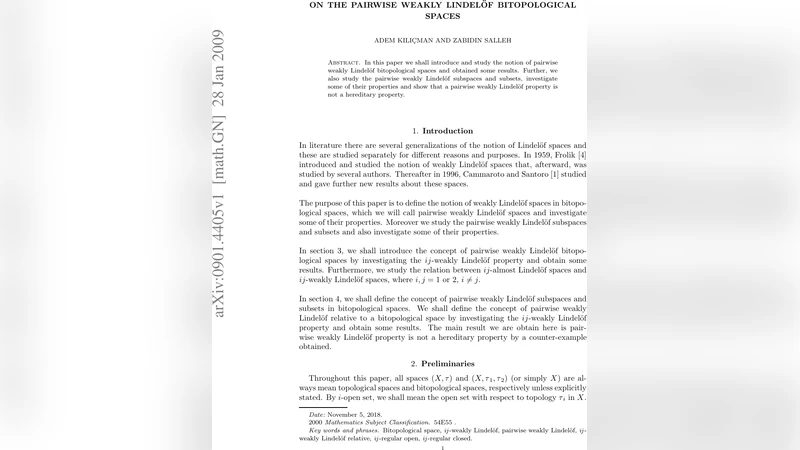
In this paper we introduce and study the notion of pairwise weakly Lindelof bitopological spaces and obtain some results. Further, we also study the pairwise weakly Lindelof subspaces and subsets, investigate some of their properties and show that a pairwise weakly Lindelof property is not a hereditary property.
💡 Research Summary
The paper introduces a novel notion in the theory of bitopological spaces—pairwise weakly Lindelöf (PW‑Lindelöf) spaces. A bitopological space ((X,\tau_{1},\tau_{2})) is called PW‑Lindelöf if for every open cover (\mathcal{U}{i}) of (X) with respect to each topology (\tau{i}) there exists a countable subfamily (\mathcal{V}{i}\subseteq\mathcal{U}{i}) whose union still covers (X). This definition relaxes the classical pairwise Lindelöf condition (which requires a finite subcover) and therefore creates a strictly larger class of spaces.
The authors first establish basic properties of PW‑Lindelöf spaces. They prove that if a bitopological space is PW‑Lindelöf then each of its component topologies is weakly Lindelöf in the ordinary sense. Moreover, when the two topologies are comparable (e.g., (\tau_{1}\subseteq\tau_{2}) or vice‑versa), the PW‑Lindelöf property forces the finer topology to inherit the weakly Lindelöf character as well. Several examples are constructed to show that the converse fails when the topologies are unrelated.
A substantial part of the work is devoted to subspaces and subsets. The paper distinguishes between a “PW‑Lindelöf subspace” (the induced bitopology on a subset remains PW‑Lindelöf) and a “PW‑Lindelöf subset” (the subset can be covered by countable families of (\tau_{1})- and (\tau_{2})-open sets, without requiring the induced bitopology to be PW‑Lindelöf). The authors give necessary and sufficient conditions for a subset to be PW‑Lindelöf, notably that it must admit simultaneous countable covers in both topologies that are compatible with each other.
Crucially, the paper demonstrates that the PW‑Lindelöf property is not hereditary. By constructing a concrete bitopological space—typically (\mathbb{R}) equipped with the standard topology (\tau_{1}) and a finer topology (\tau_{2}) obtained by adding all irrational singletons—the authors show that the whole space is PW‑Lindelöf while a natural subspace (for instance, the set of rational numbers) fails to be weakly Lindelöf in one of the induced topologies. This counter‑example underscores that countable subcovers that work globally may become insufficient when restricted to a subspace, a phenomenon absent in the classical Lindelöf setting.
The final section discusses potential applications and future directions. The authors suggest that PW‑Lindelöf spaces could interact fruitfully with concepts such as pairwise continuity, bitopological filters, and non‑standard topologies (e.g., the fine‑coarse topology). They also propose investigating the exact relationships among PW‑Lindelöf, weakly Lindelöf, and Lindelöf properties under various topological operations (product, sum, and inverse topologies).
Overall, the paper provides a thorough foundation for the study of pairwise weakly Lindelöf bitopological spaces, establishes their basic behavior, clarifies the limits of hereditary transfer, and opens several avenues for further research in the broader landscape of bitopology.
Comments & Academic Discussion
Loading comments...
Leave a Comment