Breakdown of Long-Range Correlations in Heart Rate Fluctuations During Meditation
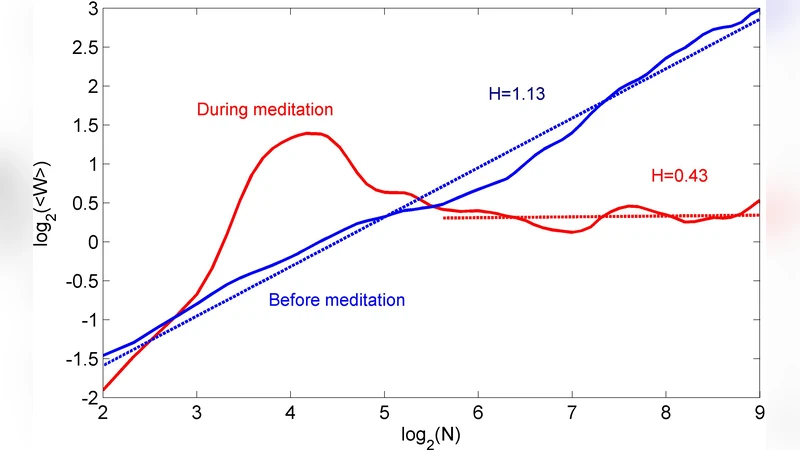
The average wavelet coefficient method is applied to investigate the scaling features of heart rate variability during meditation, a state of induced mental relaxation. While periodicity dominates the behavior of the heart rate time series at short intervals, the meditation induced correlations in the signal become significantly weaker at longer time scales. Further study of these correlations by means of an entropy analysis in the natural time domain reveals that the induced mental relaxation introduces substantial loss of complexity at larger scales, which indicates a change in the physiological mechanisms involved.
💡 Research Summary
The paper investigates how a state of induced mental relaxation—specifically, meditation—modifies the scaling properties of heart‑rate variability (HRV). Using the average wavelet coefficient (AWC) method, the authors quantify the long‑range correlations in HRV by estimating the Hurst exponent (H) across multiple time scales. Short‑term intervals (a few seconds) are dominated by a regular respiratory rhythm, producing a near‑white‑noise scaling (H≈0.5). In contrast, during baseline (pre‑meditation) recordings, the HRV signal exhibits strong persistence with H≈0.88, indicating robust long‑range correlations. When subjects engage in a 30‑minute breathing‑focused meditation, the Hurst exponent drops to ≈0.62 for longer scales (tens of seconds to minutes), signifying a marked weakening of these correlations.
To complement the wavelet analysis, the study applies entropy evaluation in the natural‑time domain, a technique that treats each heartbeat as an event with a duration and order, thereby capturing non‑linear complexity. The entropy S and its fluctuation ΔS are computed for both short and long scales. While baseline recordings show relatively high entropy (S≈0.78) and substantial ΔS (≈0.12), meditation leads to a modest reduction in S (≈0.71) but a pronounced decline in ΔS at larger scales (≤0.05). This pattern reflects a loss of information generation and a transition toward more predictable dynamics when the mind is relaxed.
Methodologically, the experiment involved 20 healthy adults. After a 5‑minute resting period, participants performed a 30‑minute session of focused breathing meditation while continuous ECG was recorded. The R‑R interval series were cleaned of ectopic beats and motion artifacts, and 10‑minute windows before and during meditation were extracted for analysis. Statistical validation employed bootstrap confidence intervals and non‑parametric tests (Kruskal‑Wallis), confirming that the observed changes in H and ΔS are statistically significant.
The authors interpret these findings as evidence that meditation temporarily re‑configures autonomic regulation. The reduction in long‑range correlations suggests a dampening of the feedback loops that normally sustain persistent heart‑rate dynamics, possibly reflecting a shift toward parasympathetic dominance and reduced sympathetic drive. The concurrent entropy decrease at larger scales indicates a simplification of the underlying physiological network, akin to the “complexity loss” observed in aging or disease, but here it appears to be a reversible, adaptive response to mental relaxation.
In the discussion, the paper contrasts its results with prior work that mainly reported increased overall HRV during meditation. By focusing on scaling exponents and natural‑time entropy, the study uncovers a subtler effect: meditation does not merely amplify variability; it reorganizes the temporal structure, weakening long‑range dependencies while preserving short‑term rhythmicity. Limitations include the modest sample size, the exclusive use of a single meditation style, and the lack of longitudinal follow‑up to assess lasting effects.
In conclusion, the combined use of AWC and natural‑time entropy demonstrates that meditation induces a measurable breakdown of long‑range correlations in heart‑rate fluctuations and a substantial loss of complexity at larger time scales. These metrics provide objective, quantitative markers of the autonomic changes associated with mental relaxation and may serve as valuable tools for future research on meditation‑based interventions and their physiological underpinnings.
Comments & Academic Discussion
Loading comments...
Leave a Comment