Conical Winds from the Disk-Magnetosphere Boundary
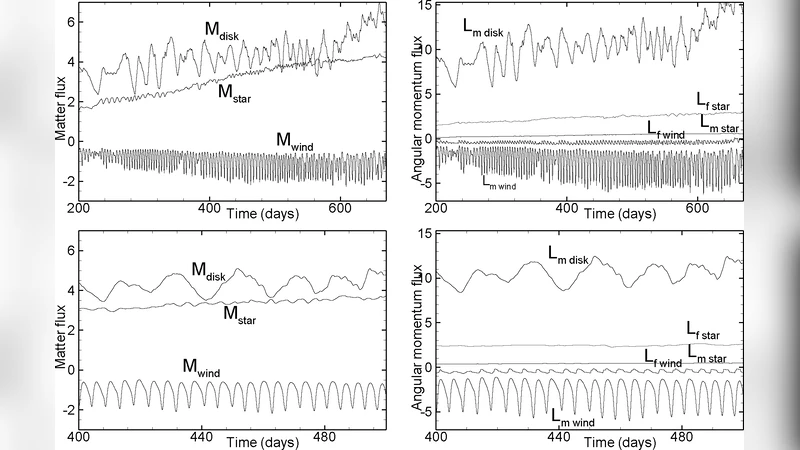
A new type of wind - a conical wind - has been discovered in axisymmetric magnetohydrodynamic simulations of the disk-magnetosphere interaction in cases where the magnetic field of the star is bunched into an X-type configuration. Such a configuration arises if the effective viscosity of the disk is larger than the effective diffusivity, or if the accretion rate in the disk is enhanced. Conical outflows flow from the inner edge of the disk into a narrow shell with half-opening angle of 30-45 degrees. The outflow carries about 0.1-0.3 of the disk mass accretion rate and part of the disk’s angular momentum. The conical winds are driven by the gradient of the magnetic pressure which exists above the disk due to the winding of the stellar magnetic field. Exploratory 3D simulations show that conical winds are symmetric about rotation axis of the disk even if the magnetic dipole is significantly misaligned with the disk’s rotation axis. Conical winds appear around stars of different periods. However, in the case of a star in the “propeller” regime, an additional - much faster component appears: an axial jet, where matter is accelerated up to very high velocities at small distances from the star by magnetic pressure force above the surface of the star. The simulations are done in dimensionless units and are applicable to a variety of the disk-accreting magnetized stars: young stars, white dwarfs, neutron stars, and possibly black holes. For the case of young stars, conical winds and axial jets may appear in different cases, including Class I young stars, classical T Tauri stars, and EXors. In EXors periods of enhanced accretion may lead to the formation of conical winds which correspond to the outflows observed from these stars.
💡 Research Summary
This paper reports the discovery of a new type of outflow – the “conical wind” – that arises in axisymmetric magnetohydrodynamic (MHD) simulations of the interaction between an accretion disk and the magnetosphere of a star. The key condition for the formation of this wind is that the stellar magnetic field becomes compressed into an X‑type configuration at the inner edge of the disk. Such a configuration naturally develops when the effective viscosity (ν) of the disk exceeds its effective magnetic diffusivity (η), i.e., ν/η > 1, or when the mass accretion rate through the disk is temporarily enhanced. In these circumstances the disk material drags and twists the stellar field lines, winding them above the disk and creating a strong vertical gradient of magnetic pressure (B²/8π).
The magnetic‑pressure gradient acts as a lifting force on the gas located just above the disk inner rim. The gas is expelled into a narrow shell whose half‑opening angle is 30–45°, forming a conical structure that expands outward while remaining roughly axisymmetric. The mass flux carried by the conical wind amounts to 10–30 % of the disk’s mass accretion rate, and a comparable fraction of the disk’s angular momentum is removed. Because the acceleration is magnetic‑pressure driven rather than centrifugal, the wind speed is comparable to, or modestly exceeds, the local Keplerian velocity at the launch radius.
When the star rotates fast enough that its corotation radius lies inside the disk truncation radius (the “propeller” regime), an additional, much faster component appears: an axial jet. This jet is launched from the stellar surface itself, where the twisted magnetic field produces an even larger magnetic‑pressure gradient. The jet accelerates matter to velocities several times higher than those in the conical wind and remains tightly collimated along the rotation axis.
Three‑dimensional simulations were performed to test the robustness of the conical wind against misalignment between the stellar dipole axis and the disk rotation axis. Even with a substantial tilt, the wind retains its axisymmetric conical shape, indicating that the X‑type field geometry imposed by the disk dominates over the initial dipole orientation.
The simulations are carried out in dimensionless units, allowing straightforward scaling to a wide variety of astrophysical objects: young low‑mass stars (Class I protostars, classical T Tauri stars, EXors), white dwarfs, neutron stars, and possibly accreting black holes. For young stars, the authors argue that conical winds can explain the observed wide‑angle outflows in Class I objects, the more collimated jets in classical T Tauri stars, and the episodic, enhanced outflows seen during EXor outbursts when the accretion rate spikes. In the propeller regime, which may be relevant for rapidly rotating neutron stars or magnetic white dwarfs, the coexistence of a conical wind and a high‑speed axial jet offers a natural explanation for the simultaneous presence of moderate‑velocity winds and ultra‑fast, high‑energy ejecta observed in some systems.
The physical picture emerging from this work can be summarized in four steps: (1) a high ν/η ratio or an accretion burst forces the stellar magnetic field into an X‑type configuration at the disk inner edge; (2) the disk’s differential rotation winds the field lines, building up toroidal magnetic pressure above the disk; (3) the resulting magnetic‑pressure gradient lifts and accelerates gas into a conical wind; (4) if the star is in the propeller regime, the same twisted field above the stellar surface drives an even stronger pressure gradient that launches a fast, narrowly collimated axial jet.
These findings extend and complement earlier wind models such as the Blandford‑Payne magnetocentrifugal wind and the X‑wind scenario. By emphasizing magnetic‑pressure acceleration rather than centrifugal forces, the conical wind model provides a unified framework that can accommodate a broad range of observed outflow morphologies and velocities across different classes of accreting, magnetized objects. The work thus offers a significant step toward a comprehensive theory of disk‑driven outflows in magnetized astrophysical systems.
Comments & Academic Discussion
Loading comments...
Leave a Comment