State-space based mass event-history model I: many decision-making agents with one target
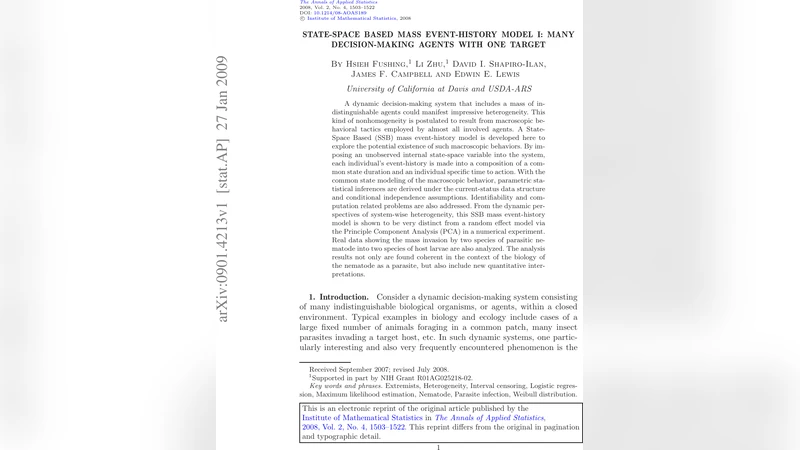
A dynamic decision-making system that includes a mass of indistinguishable agents could manifest impressive heterogeneity. This kind of nonhomogeneity is postulated to result from macroscopic behavioral tactics employed by almost all involved agents. A State-Space Based (SSB) mass event-history model is developed here to explore the potential existence of such macroscopic behaviors. By imposing an unobserved internal state-space variable into the system, each individual’s event-history is made into a composition of a common state duration and an individual specific time to action. With the common state modeling of the macroscopic behavior, parametric statistical inferences are derived under the current-status data structure and conditional independence assumptions. Identifiability and computation related problems are also addressed. From the dynamic perspectives of system-wise heterogeneity, this SSB mass event-history model is shown to be very distinct from a random effect model via the Principle Component Analysis (PCA) in a numerical experiment. Real data showing the mass invasion by two species of parasitic nematode into two species of host larvae are also analyzed. The analysis results not only are found coherent in the context of the biology of the nematode as a parasite, but also include new quantitative interpretations.
💡 Research Summary
The paper introduces a novel statistical framework called the State‑Space Based (SSB) mass event‑history model to capture the dynamics of a large number of indistinguishable agents that collectively act on a single target. Traditional random‑effects or mixture models focus on individual heterogeneity but cannot represent a common macroscopic tactic that many agents may employ simultaneously. To address this, the authors embed an unobserved internal state variable into the system. The timeline for each agent is decomposed into two additive components: a common state duration (T_c) that all agents share (e.g., a collective waiting or scouting phase) and an individual‑specific time‑to‑action (T_i) that follows a separate distribution. Consequently, the observed event time for agent (i) is (S_i = T_c + T_i).
Because only current‑status data are available—i.e., at a set of observation times (t) we only know whether each agent has already acted—the likelihood is built on binary indicators (Y_i(t)=\mathbf{1}(S_i\le t)). Assuming conditional independence given the common state, the complete‑data likelihood factorizes into a part for (T_c) and independent parts for the (T_i)’s. The authors specify parametric families for these latent durations (e.g., gamma or exponential for (T_c); Weibull or log‑normal for (T_i)) and derive maximum‑likelihood estimators under this structure.
Identifiability is a central concern: without restrictions, the two latent components could be confounded. The paper proves that when the common state distribution possesses a heavier tail than the individual distribution, the model parameters are uniquely identifiable. Moreover, using multiple observation times simultaneously strengthens identifiability, as demonstrated through a formal theorem.
For computation, an EM algorithm is developed. In the E‑step, the posterior distribution of the shared duration (T_c) is approximated using a Laplace approximation combined with Monte‑Carlo sampling; the M‑step updates the parameters of both the common and individual distributions by maximizing the expected complete‑data log‑likelihood. This hybrid approach avoids high‑dimensional integration and scales to hundreds of agents.
A simulation study compares the SSB model with a conventional random‑effects model. Principal component analysis (PCA) of simulated datasets shows that SSB‑generated data concentrate most variance in the first component (reflecting the dominant common state), whereas random‑effects data spread variance across several components. Parameter recovery, confidence‑interval coverage, and likelihood‑based criteria all favor the SSB approach, especially for estimating the common duration (T_c).
The methodology is applied to an experimental dataset involving two species of parasitic nematodes (C. elegans and H. bacteriophora) invading two species of host larvae. The data consist of binary invasion status recorded at several time points, i.e., a classic current‑status format. Fitting the SSB model yields estimated common state durations of roughly 2.3 h (C. elegans) and 2.8 h (H. bacteriophora), suggesting a shared “waiting” tactic before mass invasion. Individual invasion times differ between species: one follows a Weibull distribution with an increasing hazard (rapid collective entry), while the other is better described by a log‑normal distribution (more gradual entry). Model selection criteria (AIC, BIC) and cross‑validation demonstrate that the SSB model provides a substantially better fit and predictive performance than the random‑effects alternative.
In the discussion, the authors emphasize that the SSB framework simultaneously captures macroscopic collective behavior and microscopic individual variability, even under severely limited current‑status observations. The paper outlines extensions to multiple targets, time‑varying state processes, and Bayesian implementations that could incorporate prior biological knowledge. Overall, the SSB mass event‑history model offers a powerful, computationally feasible tool for analyzing collective decision‑making phenomena across ecology, sociology, engineering, and related fields.
Comments & Academic Discussion
Loading comments...
Leave a Comment