Angular Momentum and the Formation of Stars and Black Holes
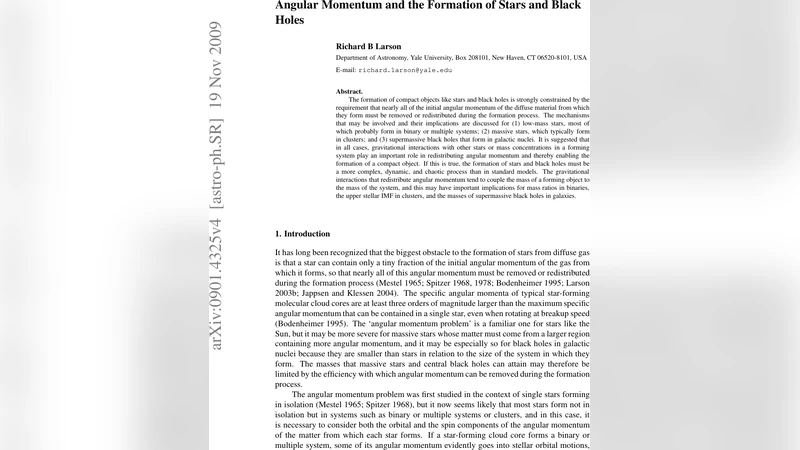
The formation of compact objects like stars and black holes is strongly constrained by the requirement that nearly all of the initial angular momentum of the diffuse material from which they form must be removed or redistributed during the formation process. The mechanisms that may be involved and their implications are discussed for (1) low-mass stars, most of which probably form in binary or multiple systems; (2) massive stars, which typically form in clusters; and (3) supermassive black holes that form in galactic nuclei. It is suggested that in all cases, gravitational interactions with other stars or mass concentrations in a forming system play an important role in redistributing angular momentum and thereby enabling the formation of a compact object. If this is true, the formation of stars and black holes must be a more complex, dynamic, and chaotic process than in standard models. The gravitational interactions that redistribute angular momentum tend to couple the mass of a forming object to the mass of the system, and this may have important implications for mass ratios in binaries, the upper stellar IMF in clusters, and the masses of supermassive black holes in galaxies.
💡 Research Summary
The paper tackles the long‑standing angular‑momentum problem that confronts the formation of compact objects—stars of all masses and supermassive black holes (SMBHs). A diffuse, rotating cloud must shed or redistribute almost all of its initial angular momentum before it can collapse into a compact object; otherwise centrifugal support halts the infall. While magnetic braking, viscous torques, and radiation pressure have been invoked in classic models, the author argues that gravitational interactions dominate across the full mass spectrum.
For low‑mass stars, observations show that the majority belong to binary or higher‑order multiple systems. The paper explains that during the fragmentation of a prestellar core, two or more protostellar embryos form in close proximity. Their mutual gravitational torques exchange orbital and spin angular momentum, while some of the gas is flung into circumbinary disks or expelled in outflows. This process naturally reduces the spin of each embryo, allowing one to become the primary star while the companion may remain a low‑mass star, brown dwarf, or planetary‑mass object. The resulting mass‑ratio distribution in binaries, and the prevalence of close pairs, are thus direct consequences of angular‑momentum redistribution via gravity.
Massive stars, by contrast, arise in dense stellar clusters where hundreds to thousands of protostars coexist. In such environments, N‑body dynamics, dynamical friction, and collective gravitational waves in the gas act together. Close encounters between massive protostars and surrounding low‑mass members transfer orbital energy into the gas, creating strong torques that drain angular momentum from the massive protostellar cores. Simultaneously, the turbulent cluster potential drives non‑axisymmetric instabilities in the surrounding accretion flows, further enhancing angular‑momentum loss. This chaotic, highly interactive setting enables massive stars to accrete large amounts of mass on short timescales, explaining the observed top‑heavy initial mass function (IMF) in clusters and the tendency of massive stars to reside near cluster centers.
For SMBHs, the situation is even more extreme. Galactic nuclei host bars, spiral inflows, and often multiple massive clumps or secondary black holes. The paper highlights three gravitational mechanisms: (1) large‑scale non‑axisymmetric torques from bars and spiral arms that funnel gas inward; (2) dynamical friction between a massive black‑hole seed and surrounding stars or dense gas clouds, which extracts angular momentum from the inflowing material; and (3) mergers of black‑hole binaries or massive gas clumps, where the orbital decay releases vast amounts of angular momentum into the surrounding medium. These processes channel gas efficiently to the central parsec, allowing the black hole to grow in proportion to the host galaxy’s velocity dispersion, thereby reproducing the empirical M–σ relation.
A unifying theme emerges: gravitational torques—whether from binary companions, cluster members, or galactic‑scale structures—are the primary agents that couple the mass of a forming compact object to the mass of its surrounding system. This coupling has several far‑reaching implications. It can set the typical mass ratios in binary stars, shape the upper end of the stellar IMF in clusters, and enforce the tight correlation between SMBH mass and host‑galaxy properties. Consequently, the formation of stars and black holes is far more dynamic, chaotic, and environmentally dependent than the quasi‑static, isolated collapse models traditionally taught.
The author concludes by urging high‑resolution, multi‑physics simulations that incorporate realistic N‑body dynamics, gas thermodynamics, and feedback, together with next‑generation observational campaigns (e.g., ALMA, JWST, ELT). Such efforts will quantify the efficiency of gravitational angular‑momentum transport and test whether the proposed mechanisms can indeed account for the observed demographics of stars and supermassive black holes across cosmic time.
Comments & Academic Discussion
Loading comments...
Leave a Comment