Book Review: "Geometry of Quantum States" by Ingemar Bengtsson and Karol Zyczkowski (Cambridge University Press, 2006)
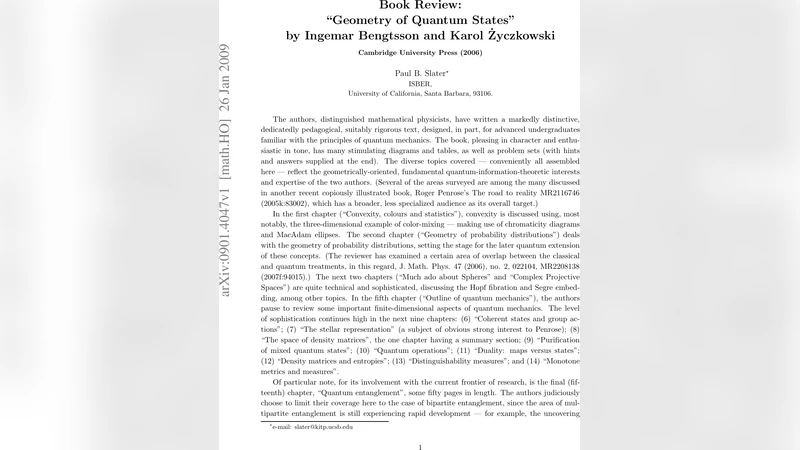
Invited book review, as submitted to the electronic database MathSciNet, of the 2006 Cambridge University Press book, “Geometry of Quantum States,” by Ingemar Bengtsson and Karol Zyczkowski
💡 Research Summary
The review offers a thorough evaluation of Ingemar Bengtsson and Karol Zyczkowski’s 2006 monograph “Geometry of Quantum States,” a work that seeks to recast the foundations of quantum mechanics in geometric language. It begins by positioning the book within the broader literature, noting that most quantum‑mechanical textbooks adopt an algebraic or operator‑centric approach, whereas this volume emphasizes the role of convex geometry, complex projective spaces, and differential‑geometric metrics. The authors’ ambition is to make the abstract structure of quantum state space accessible to both physicists and mathematicians, and the reviewer acknowledges this as a valuable and timely contribution.
The monograph is organized into three major parts. Part I (Chapters 1‑3) lays the geometric groundwork. It introduces the complex Hilbert space, the Bloch sphere representation of a single qubit, and the Fubini‑Study metric on projective Hilbert space. The reviewer praises the clear exposition, the abundance of illustrative figures, and the way physical intuition (e.g., phase evolution, Berry phase) is tied to geometric concepts.
Part II (Chapters 4‑7) focuses on the convex structure of the state space and its information‑theoretic implications. Pure states appear as extreme points of the convex set of density matrices, while mixed states occupy its interior. The authors discuss entropy, relative entropy, and various distance measures (trace distance, Bures distance) from a geometric standpoint. The review highlights the “convex hull” metaphor, which helps readers visualize how quantum channels act as affine maps preserving convexity, and how POVMs can be interpreted as points on a simplex or polytope.
Part III (Chapters 8‑12) delves into multipartite systems and entanglement geometry. Using Schmidt decomposition, the authors map bipartite pure states onto a product of lower‑dimensional projective spaces, and then describe entangled versus separable states as distinct regions of a high‑dimensional polytope. Entanglement measures such as concurrence, negativity, and entanglement of formation are re‑expressed as geometric quantities (e.g., volumes, distances to the separable set). The book also connects these ideas to operational protocols like quantum teleportation and entanglement swapping, portraying them as geodesic paths or optimal routes within the state‑space manifold.
The reviewer identifies several strengths. First, the balance between mathematical rigor and physical insight is maintained throughout; proofs are concise, and the emphasis is on intuition supported by diagrams. Second, each chapter is largely self‑contained, allowing readers to study topics non‑sequentially. Third, the inclusion of contemporary quantum‑information topics (quantum cryptography, teleportation) demonstrates the practical relevance of the geometric framework.
However, the review also points out limitations. The treatment of higher‑dimensional complex analysis (particularly in Chapter 11) proceeds rapidly and may be inaccessible to readers without a solid background in differential geometry or algebraic topology. Moreover, the book predates several major developments—such as quantum machine learning, topological quantum computing, and recent advances in resource theories—so it lacks discussion of these newer directions. Some examples are highly idealized and do not directly translate to experimental settings, which could diminish the appeal for applied researchers.
In conclusion, the reviewer rates “Geometry of Quantum States” as an essential reference for graduate students, researchers, and educators interested in a geometric perspective on quantum theory. It serves as a bridge between quantum information science and mathematical physics, offering tools that can be applied to both foundational questions and emerging technologies. While readers may need to supplement the text with more recent literature, the book’s clear exposition, rich visual material, and comprehensive treatment of state‑space geometry make it a valuable addition to the quantum‑science library.
Comments & Academic Discussion
Loading comments...
Leave a Comment