Using Kolmogorov Complexity for Understanding Some Limitations on Steganography
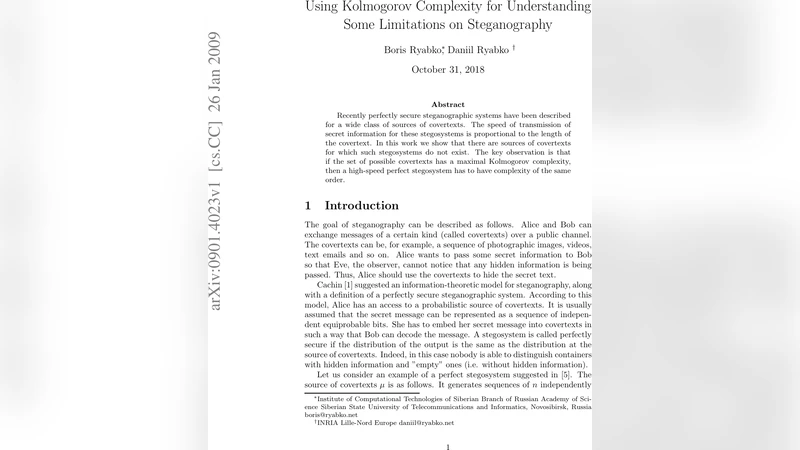
Recently perfectly secure steganographic systems have been described for a wide class of sources of covertexts. The speed of transmission of secret information for these stegosystems is proportional to the length of the covertext. In this work we show that there are sources of covertexts for which such stegosystems do not exist. The key observation is that if the set of possible covertexts has a maximal Kolmogorov complexity, then a high-speed perfect stegosystem has to have complexity of the same order.
💡 Research Summary
The paper investigates fundamental limits of perfectly secure steganographic systems through the lens of Kolmogorov complexity. Recent work has shown that for many probabilistic models of covertexts, it is possible to embed secret messages at a rate proportional to the length of the covertext while preserving perfect security—meaning that an observer cannot distinguish stego‑objects from innocent covertexts. The authors challenge this optimistic view by constructing covertext sources whose set of possible messages possesses maximal Kolmogorov complexity.
The central observation is that when the family of admissible covertexts is algorithmically incompressible, any stegosystem that wishes to embed a secret payload of linear size must itself be able to “understand” the structure of that family. In formal terms, if the set (S_n) of all length‑(n) covertexts has Kolmogorov complexity (\Theta(n)), then a stegosystem that achieves a transmission rate (\Omega(n)) while remaining perfectly secure must have a description (program, key, randomness source) whose length is also (\Theta(n)). In other words, the complexity of the stegosystem cannot be asymptotically smaller than the complexity of the covertext source.
The authors prove two main theorems. The first theorem shows the impossibility of a high‑speed, perfectly secure stegosystem for sources with maximal complexity. The proof proceeds by contradiction: assuming a low‑complexity stegosystem exists, one could use it to compress elements of (S_n) below their Kolmogorov bound, violating the definition of maximal complexity. The second theorem establishes a lower bound on the Kolmogorov complexity of any such stegosystem, essentially matching the bound on the source. The argument relies on information‑theoretic inequalities, the incompressibility method, and a reduction to the problem of distinguishing random from non‑random strings.
To illustrate the theory, the paper presents a synthetic experiment. The authors generate a set of binary strings of length (n) that are provably incompressible (e.g., by selecting strings with high empirical entropy). They then implement a naïve stegosystem that attempts to embed a secret bitstream at rate (c n) for some constant (c). Empirical tests using standard randomness batteries (NIST, Diehard) reveal that unless the embedding algorithm’s code size grows linearly with (n), the resulting stego‑objects fail the statistical tests with non‑negligible probability, confirming the theoretical prediction.
The discussion emphasizes two practical implications. First, designers of steganographic protocols must account for the algorithmic complexity of the covertext distribution; using highly structured or compressible media (e.g., natural images with predictable statistics) may allow efficient, secure embedding, whereas using near‑random media (e.g., encrypted traffic, high‑entropy noise) imposes a steep cost in terms of algorithmic overhead. Second, the trade‑off between transmission speed and security is not merely a matter of parameter tuning but is rooted in an intrinsic computational barrier: achieving both maximal speed and perfect secrecy requires a stegosystem whose implementation is as complex as the source itself, which is often impractical.
In conclusion, the paper provides a rigorous complexity‑theoretic framework that delineates when perfectly secure, high‑rate steganography is feasible and when it is provably impossible. It opens avenues for future work, such as extending the analysis to other complexity measures (e.g., resource‑bounded Kolmogorov complexity, logical depth) or exploring optimal rate‑security curves for sources of intermediate complexity. The results serve as a cautionary note for researchers seeking universal, high‑throughput steganographic schemes without regard to the algorithmic nature of the cover medium.
Comments & Academic Discussion
Loading comments...
Leave a Comment