Modeling long-term longitudinal HIV dynamics with application to an AIDS clinical study
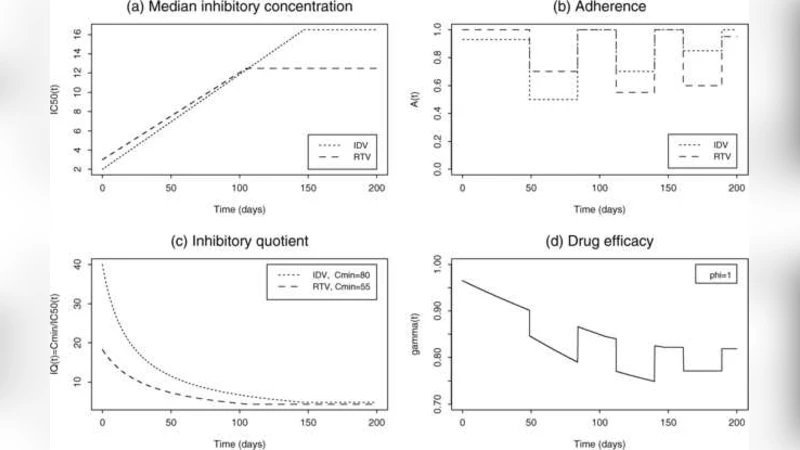
A virologic marker, the number of HIV RNA copies or viral load, is currently used to evaluate antiretroviral (ARV) therapies in AIDS clinical trials. This marker can be used to assess the ARV potency of therapies, but is easily affected by drug exposures, drug resistance and other factors during the long-term treatment evaluation process. HIV dynamic studies have significantly contributed to the understanding of HIV pathogenesis and ARV treatment strategies. However, the models of these studies are used to quantify short-term HIV dynamics ($<$ 1 month), and are not applicable to describe long-term virological response to ARV treatment due to the difficulty of establishing a relationship of antiviral response with multiple treatment factors such as drug exposure and drug susceptibility during long-term treatment. Long-term therapy with ARV agents in HIV-infected patients often results in failure to suppress the viral load. Pharmacokinetics (PK), drug resistance and imperfect adherence to prescribed antiviral drugs are important factors explaining the resurgence of virus. To better understand the factors responsible for the virological failure, this paper develops the mechanism-based nonlinear differential equation models for characterizing long-term viral dynamics with ARV therapy. The models directly incorporate drug concentration, adherence and drug susceptibility into a function of treatment efficacy and, hence, fully integrate virologic, PK, drug adherence and resistance from an AIDS clinical trial into the analysis. A Bayesian nonlinear mixed-effects modeling approach in conjunction with the rescaled version of dynamic differential equations is investigated to estimate dynamic parameters and make inference. In addition, the correlations of baseline factors with estimated dynamic parameters are explored and some biologically meaningful correlation results are presented. Further, the estimated dynamic parameters in patients with virologic success were compared to those in patients with virologic failure and significantly important findings were summarized. These results suggest that viral dynamic parameters may play an important role in understanding HIV pathogenesis, designing new treatment strategies for long-term care of AIDS patients.
💡 Research Summary
The paper addresses a critical gap in HIV research: existing viral dynamics models are limited to short‑term (≤ 1 month) observations and cannot capture the complex interplay of factors that drive long‑term virologic outcomes under antiretroviral (ARV) therapy. To overcome this limitation, the authors develop a mechanism‑based nonlinear differential‑equation framework that explicitly incorporates three time‑varying determinants of treatment efficacy—drug concentration (pharmacokinetics, PK), patient adherence, and drug susceptibility (resistance). The core efficacy function is defined as ε(t)=Emax·C(t)·A(t)/
Comments & Academic Discussion
Loading comments...
Leave a Comment