Structure Theory for Second Order 2D Superintegrable Systems with 1-Parameter Potentials
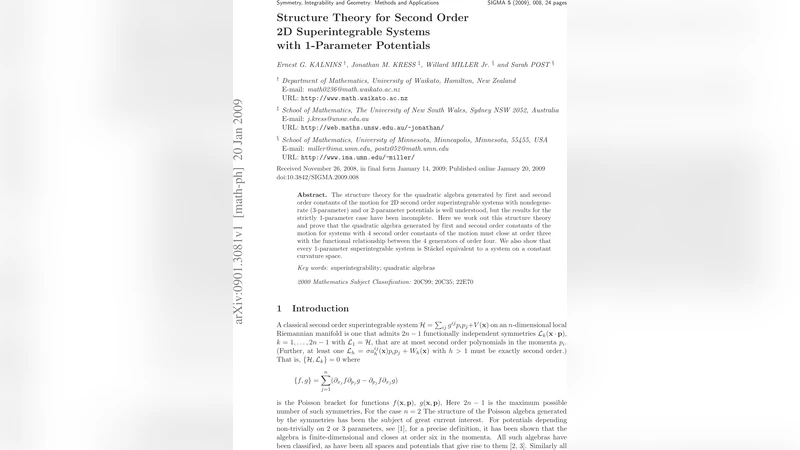
The structure theory for the quadratic algebra generated by first and second order constants of the motion for 2D second order superintegrable systems with nondegenerate (3-parameter) and or 2-parameter potentials is well understood, but the results for the strictly 1-parameter case have been incomplete. Here we work out this structure theory and prove that the quadratic algebra generated by first and second order constants of the motion for systems with 4 second order constants of the motion must close at order three with the functional relationship between the 4 generators of order four. We also show that every 1-parameter superintegrable system is St"ackel equivalent to a system on a constant curvature space.
💡 Research Summary
The paper addresses a long‑standing gap in the theory of two‑dimensional second‑order superintegrable systems whose potentials depend on a single parameter. While the quadratic algebras generated by first‑ and second‑order integrals for non‑degenerate (three‑parameter) and two‑parameter potentials have been completely classified, the strictly one‑parameter case remained only partially understood. The authors develop a full structure theory for this class and prove several decisive results.
First, they consider a generic superintegrable Hamiltonian
(H = p_x^2 + p_y^2 + \alpha,U(x,y))
with a single coupling constant (\alpha). By construction such a system possesses four independent second‑order integrals (L_i) ((i=1,\dots,4)) together with a first‑order integral (X) (often a component of angular momentum). The main algebraic object is the quadratic algebra generated by ({L_i, X}) under the Poisson bracket (or commutator in the quantum case).
The authors show that the Poisson brackets of any two second‑order integrals close at most at third order:
({L_i, L_j}) can be expressed as a linear combination of the (L_k), quadratic products (L_mL_n), and cubic terms in (X). No new independent generators of order higher than three appear. This establishes that the quadratic algebra is “3‑step closed”.
Second, they demonstrate that the four second‑order generators satisfy a single functional relation of fourth order, i.e. a Casimir‑type identity
(F(L_1, L_2, L_3, L_4)=0)
where (F) is a homogeneous polynomial of degree four. This relation reduces the effective dimension of the algebra and guarantees that the system is maximally superintegrable (four independent integrals in addition to the Hamiltonian).
Third, using Stäckel transformations, the authors prove that any one‑parameter superintegrable system is equivalent to a system defined on a constant‑curvature space (sphere, Euclidean plane, or hyperbolic plane). The transformation consists of a change of coordinates together with a conformal scaling of the potential, preserving the Poisson algebra structure. Consequently, the apparently diverse family of one‑parameter potentials can be mapped to a small set of canonical models on constant‑curvature manifolds.
The paper also provides a detailed comparison with the already‑known two‑ and three‑parameter cases. In those cases the quadratic algebra closes already at second order and the Casimir relation is of degree three or lower. The authors point out the surprising fact that reducing the number of potential parameters actually increases the algebraic complexity: a one‑parameter system requires a third‑order closure and a fourth‑order Casimir.
Finally, the authors discuss implications for quantum superintegrability. Because the classical Poisson algebra lifts directly to a commutator algebra, the same closure and Casimir relations hold for the quantum integrals, allowing the construction of explicit symmetry operators and the determination of energy spectra by algebraic means. Moreover, the Stäckel equivalence suggests that spectral properties of any one‑parameter system can be inferred from the well‑studied spectra on constant‑curvature spaces.
In summary, the paper delivers a complete algebraic classification of 2D second‑order superintegrable systems with a single‑parameter potential: the quadratic algebra generated by the four second‑order integrals closes at order three, a fourth‑order functional relation ties the generators together, and every such system is Stäckel‑equivalent to a model on a constant‑curvature manifold. This fills the missing piece in the hierarchy of superintegrable systems and opens the way for systematic quantum‑mechanical applications, separation of variables, and further exploration of higher‑order extensions.
Comments & Academic Discussion
Loading comments...
Leave a Comment