Statistics of Centroids of Velocity
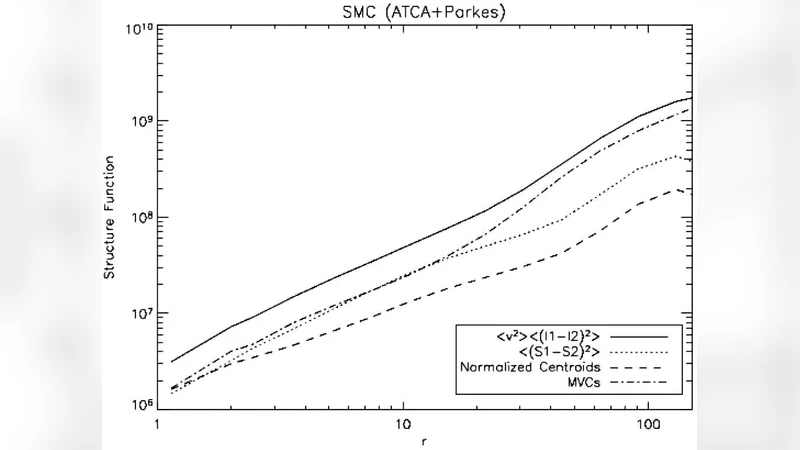
We review the use of velocity centroids statistics to recover information of interstellar turbulence from observations. Velocity centroids have been used for a long time now to retrieve information about the scaling properties of the turbulent velocity field in the interstellar medium. We show that, while they are useful to study subsonic turbulence, they do not trace the statistics of velocity in supersonic turbulence, because they are highly influenced by fluctuations of density. We show also that for sub-Alfv'enic turbulence (both supersonic and subsonic) two-point statistics (e.g. correlation functions or power-spectra) are anisotropic. This anisotropy can be used to determine the direction of the mean magnetic field projected in the plane of the sky.
💡 Research Summary
The paper provides a comprehensive review of the use of velocity centroids as a diagnostic tool for interstellar turbulence. Velocity centroids are defined as the intensity‑weighted first moment of a spectral line, (C(\mathbf{x})=\int v I(v,\mathbf{x}),dv / \int I(v,\mathbf{x}),dv). Under the idealised assumptions that (i) density and velocity fluctuations are statistically independent and (ii) density variations are modest, the power spectrum of the centroid field reproduces the true velocity power spectrum, preserving the same scaling exponent.
Through a series of magnetohydrodynamic (MHD) simulations covering a wide range of sonic Mach numbers ((M_s)) and Alfvénic Mach numbers ((M_A)), the authors demonstrate two distinct regimes. In sub‑sonic turbulence ((M_s<1)) density fluctuations are weak; consequently centroid statistics (structure functions, correlation functions, and power spectra) accurately trace the underlying velocity field. The measured spectral slope matches the expected Kolmogorov value (≈‑11/3) or Burgers value (≈‑2) depending on the driving. In contrast, for supersonic turbulence ((M_s\gg1)) shock compression creates large density contrasts. The centroid becomes heavily weighted by density, leading to a “density‑velocity mixed” signal. The resulting power spectrum is significantly shallower (often ≈‑1.5) and no longer reflects the true velocity scaling. This effect grows rapidly when the density contrast exceeds a factor of ten.
The paper also investigates the influence of magnetic fields. In sub‑Alfvénic conditions ((M_A<1)) the mean magnetic field imposes anisotropy on the turbulent cascade. Two‑point statistics computed parallel and perpendicular to the field show reduced power along the field direction and enhanced power across it. In Fourier space the iso‑contours of the centroid power spectrum become elongated ellipses whose major axis aligns with the projected mean magnetic field. By measuring this anisotropy, one can infer the direction of the magnetic field projected onto the plane of the sky without recourse to polarimetric data. This technique is especially valuable for regions where high‑resolution polarization measurements are unavailable.
A comparative discussion places centroid analysis alongside other spectral‑line techniques such as Velocity Channel Analysis (VCA) and Velocity Coordinate Spectrum (VCS). While VCA/VCS can separate density and velocity contributions in supersonic regimes, they require high spectral resolution and more elaborate data handling. Centroids, by contrast, are computationally cheap and work well with lower‑resolution data, but their reliability degrades in the supersonic, high‑density‑contrast regime. The authors therefore recommend a pragmatic workflow: estimate the sonic and Alfvénic Mach numbers from ancillary data (e.g., line widths, Zeeman measurements), then decide whether centroids are appropriate (sub‑sonic, sub‑Alfvénic) or whether VCA/VCS should be employed (supersonic).
The paper validates the theoretical findings with observational examples, including HI 21 cm and CO molecular line maps. In regions identified as sub‑sonic, centroid power spectra exhibit slopes close to the Kolmogorov value, while in known supersonic clouds the spectra are noticeably flatter. Anisotropy analyses of the Orion Nebula centroid map recover a magnetic‑field orientation consistent with independent polarization studies, confirming the practical utility of the method.
In summary, velocity centroids constitute a powerful, low‑cost tool for probing turbulence when (1) the flow is sub‑sonic, ensuring minimal density contamination, and (2) the magnetic field is strong enough to produce measurable anisotropy. In supersonic, highly compressible environments, density fluctuations dominate the centroid signal, and alternative techniques such as VCA or VCS become necessary. The authors advocate a combined approach, using centroids for quick diagnostics and anisotropy measurements, and resorting to more sophisticated spectral‑line analyses when the physical conditions demand it.
Comments & Academic Discussion
Loading comments...
Leave a Comment