Nonlinear Fast Magnetoacoustic Wave Propagation in the Neighbourhood of a 2D magnetic X-point: Oscillatory Reconnection
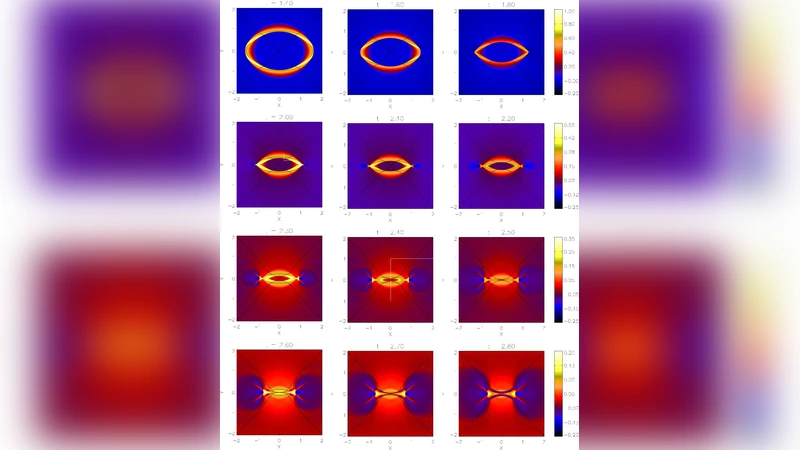
This paper extends the models of Craig & McClymont (1991) and McLaughlin & Hood (2004) to include finite $\beta$ and nonlinear effects. We investigate the nature of nonlinear fast magnetoacoustic waves about a 2D magnetic X-point. We solve the compressible and resistive MHD equations using a Lagrangian remap, shock capturing code (Arber et al. 2001) and consider an initial condition in $ {\bf{v}}\times{\bf{B}} \cdot {\hat{\bf{z}}}$ (a natural variable of the system). We observe the formation of both fast and slow oblique magnetic shocks. The nonlinear wave deforms the X-point into a ‘cusp-like’ point which in turn collapses to a current sheet. The system then evolves through a series of horizontal and vertical current sheets, with associated changes in connectivity, i.e. the system exhibits oscillatory reconnection. Our final state is non-potential (but in force balance) due to asymmetric heating from the shocks. Larger amplitudes in our initial condition correspond to larger values of the final current density left in the system. The inclusion of nonlinear terms introduces several new features to the system that were absent from the linear regime.
💡 Research Summary
This paper extends the classic linear models of magnetic reconnection at a two‑dimensional (2D) X‑point by incorporating finite plasma β and full nonlinear dynamics. The authors solve the compressible, resistive magnetohydrodynamic (MHD) equations with the Lagrangian‑remap shock‑capturing code LARE2D (Arber et al. 2001). The initial perturbation is introduced as a Gaussian profile in the invariant quantity v × B · ẑ, which directly excites fast magnetoacoustic motions while preserving the solenoidal condition of the magnetic field.
The simulations reveal a multi‑stage evolution. First, the incoming fast wave reaches the X‑point and deforms the null into a cusp‑like geometry. Because the wave amplitude is finite, nonlinear steepening generates both fast and slow oblique shocks. The fast shock compresses the magnetic field and creates a thin, high‑current sheet, while the slow shock produces strong plasma compression and asymmetric heating.
Second, the current sheet collapses horizontally, reaching a critical thickness at which magnetic tension forces re‑orient the sheet vertically. This transition is accompanied by a rapid release of magnetic energy, conversion into plasma heating, and a change in magnetic connectivity.
Third, the system does not settle into a static configuration. Instead, the current sheet repeatedly flips between horizontal and vertical orientations, producing a sequence of alternating current sheets. This behavior constitutes “oscillatory reconnection”: the magnetic topology oscillates, the reconnection rate pulses, and each cycle leaves behind a distinct pattern of heated plasma and residual current.
Fourth, after several oscillations the system approaches a quasi‑steady state that is non‑potential yet in force balance. The final state retains a finite current density and pressure gradients because the asymmetric shock heating prevents complete relaxation to a potential field. Importantly, the magnitude of the residual current scales with the initial wave amplitude: larger amplitudes generate thinner sheets, higher peak currents, and stronger asymmetries.
Key physical insights include:
- Nonlinear wave–current coupling – Finite‑amplitude fast waves can self‑generate both fast and slow shocks, leading to simultaneous magnetic compression and plasma heating.
- Current‑sheet dynamics – The sheet undergoes a rapid horizontal‑to‑vertical collapse, driven by magnetic tension, and then oscillates due to the interplay of magnetic pressure, plasma pressure, and resistive diffusion.
- Oscillatory reconnection mechanism – The alternating orientation of current sheets produces a periodic reconnection process, which may explain observed pulsations in solar flare ribbons and magnetospheric substorms.
- Amplitude and β dependence – Higher β enhances compressibility, strengthening the slow‑shock component and the resulting asymmetric heating; larger initial amplitudes increase the final residual current, suggesting a pathway for energy storage in post‑flare loops.
The study bridges the gap between idealized linear null‑point models and realistic solar/space plasma conditions. By demonstrating that nonlinear fast magnetoacoustic waves can drive oscillatory reconnection and leave a non‑potential, heated configuration, the work provides a robust theoretical framework for interpreting observations of rapid, repetitive energy release in the solar corona, Earth’s magnetotail, and laboratory plasma experiments.
Comments & Academic Discussion
Loading comments...
Leave a Comment