Multiband imaging observations of a prominent dust lane galaxy NGC 4370
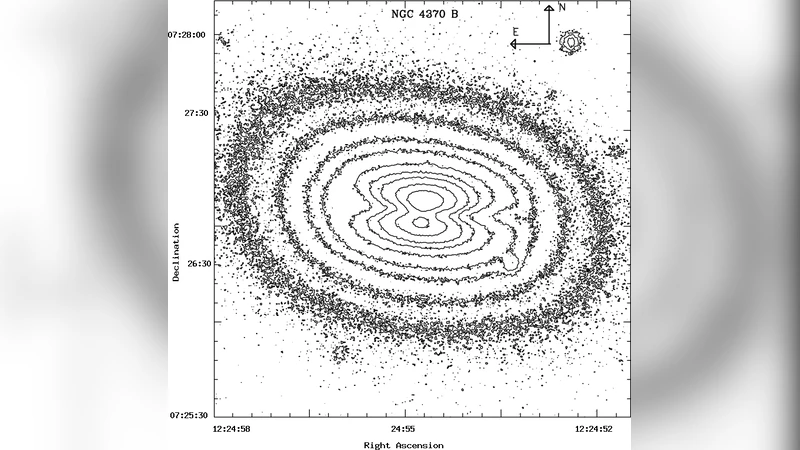
In this paper we present extinction properties of interstellar dust in a prominent dust lane galaxy NGC 4370 based on the optical broad band (BVRI) imaging observations taken from the Himalaya Chandra Telescope (HCT), Hanle and the near-IR (J,H,K$_s$) images taken from the 2MASS archive. NGC 4370 belongs to the Virgo cluster (VCC 0758) and form a non-interactive pair with NGC 4365 at 10$\arcmin$. NGC 4370 hosts a prominent dust lane running parallel to its optical major axis and is extended almost up to 1\arcmin. The extinction curve derived for NGC 4370 is found to run parallel to Galactic extinction curve, implying that the properties of dust in NGC 4370 are identical to those of the canonical grains in the Milky Way. The $R_V$ value is found to be equal to 2.85$\pm$0.05 and is consitent with the values reported for the dust lane galaxies. The total dust content of NGC 4370 estimated using optical extinction and IRAS flux densities are found to be equal to $4.4\times 10^4$ \msol and $2.0\times 10^5$ \msol, respectively. As regard to the origin of dust and ISM in this galaxy, the accumulated dust by this galaxy over its life-time is insufficient to account for the detected mass by optical means, which in turn imply that the ISM might have been acquired by the NGC 4370 through a merger like event. An attempt is also made to study the apparent spatial correspondence between the multiple phases of ISM, i.e., hot gas, warm gas and dust in this galaxy by obtaining optical emission maps from narrow band imaging and diffuse X-ray emission map obtained from the analysis of \emph{Chandra} archival data. This analysis implies a physical connection between the dust and warm gas in terms of their physical co-existence and common origin too.
💡 Research Summary
This study presents a comprehensive multi‑wavelength analysis of the prominent dust‑lane galaxy NGC 4370, a member of the Virgo Cluster located 10 arcminutes from the non‑interacting companion NGC 4365. Optical broad‑band images (B, V, R, I) were obtained with the Himalayan Chandra Telescope (HCT) at Hanle, while near‑infrared (J, H, Kₛ) data were retrieved from the 2MASS archive. In addition, narrow‑band Hα +
Comments & Academic Discussion
Loading comments...
Leave a Comment