The Diskionary: A Glossary of Terms Commonly Used for Disks and Related Objects, First Edition
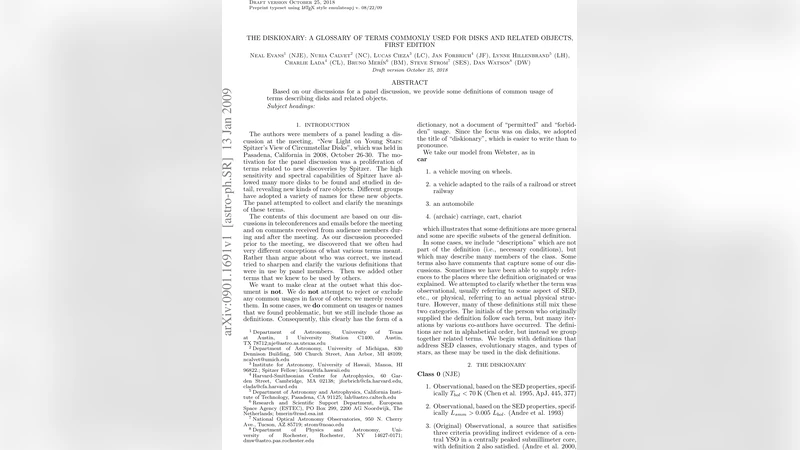
Based on a panel discussion at the meeting “New Light on Young Stars: Spitzer’s View of Circumstellar Disks”, we provide some definitions of common usage of terms describing disks and related objects.
💡 Research Summary
The paper “The Diskionary: A Glossary of Terms Commonly Used for Disks and Related Objects, First Edition” addresses a pervasive problem in the field of circumstellar disk research: the inconsistent and often ambiguous use of terminology. Stemming from a panel discussion at the conference “New Light on Young Stars: Spitzer’s View of Circumstellar Disks,” the authors compiled a systematic glossary that links each term to explicit observational signatures and quantitative thresholds. The work is organized into four main sections.
First, the authors provide a concise historical overview of disk studies, emphasizing how advances in infrared, sub‑millimeter, and high‑resolution imaging have revealed a rich variety of disk morphologies. They argue that the proliferation of new observational capabilities has outpaced the development of a coherent nomenclature, leading to confusion when comparing results across different surveys and theoretical models.
Second, the core of the paper lists the most frequently encountered terms—primordial disk, protoplanetary disk, transitional disk, pre‑transitional disk, debris disk, second‑generation disk, gas‑poor (or evolved) disk, among others. For each entry the authors give a definition anchored in measurable properties: gas‑to‑dust mass ratio, presence and size of inner cavities or gaps, spectral energy distribution (SED) shape, specific line fluxes (e.g., CO (3‑2) intensity), and typical stellar ages. For example, a “transitional disk” is defined as a system whose SED shows a pronounced dip at 10–30 µm, indicating an inner hole larger than ~10 AU, while still retaining substantial outer gas and dust. A “pre‑transitional disk” is distinguished by a narrow gap rather than a full cavity, with both inner and outer components detectable. The glossary also clarifies subtle distinctions such as “debris disk” (gas‑deficient, dust produced by collisional cascades) versus “second‑generation disk” (a debris‑like system where ongoing collisions continuously replenish small grains).
Third, the authors discuss common sources of mis‑classification and propose a set of best‑practice guidelines. They stress that authors should always cite the specific criteria used when labeling a disk, especially when the same object could plausibly fit multiple categories depending on wavelength coverage or model assumptions. The paper warns against loosely applying terms like “primordial” to disks that have already lost most of their gas, recommending instead “evolved” or “gas‑poor” for such cases.
Finally, the paper looks ahead to future observational facilities such as JWST, ELT, and next‑generation ALMA upgrades. The authors anticipate that higher spatial and spectral resolution will uncover finer sub‑structures (e.g., rings, spirals, localized pressure traps) that may demand new terminology—terms like “hybrid disk” or “photoevaporative disk” are suggested as placeholders. They propose a community‑driven process for updating the Diskionary, ensuring that it remains relevant as the field evolves.
Overall, the Diskionary serves as a reference framework that ties terminology to concrete, reproducible diagnostics. By standardizing language, it facilitates more reliable cross‑comparison of disk surveys, improves the clarity of theoretical papers, and helps avoid the propagation of ambiguous labels. The authors expect that widespread adoption of this glossary will enhance the efficiency of data interpretation, model validation, and ultimately accelerate our understanding of how circumstellar disks evolve into planetary systems.
Comments & Academic Discussion
Loading comments...
Leave a Comment