The mean width of circumscribed random polytopes
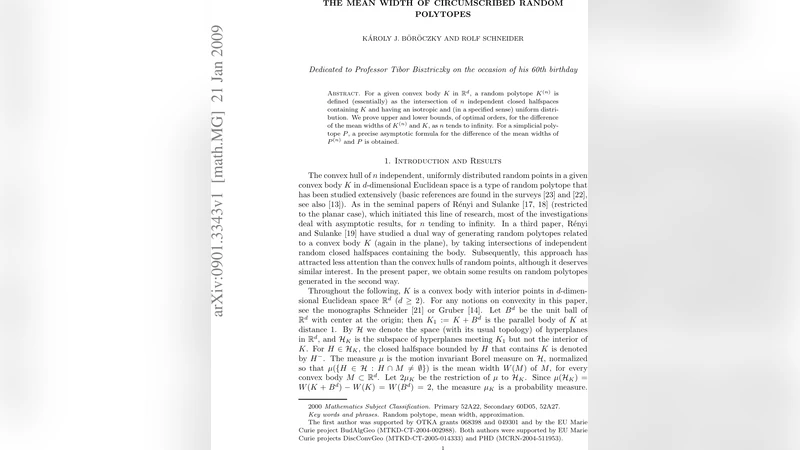
For a given convex body K in $R^d$, a random polytope $K^{(n)}$ is defined (essentially) as the intersection of $n$ independent closed halfspaces containing $K$ and having an isotropic and (in a specified sense) uniform distribution. We prove upper and lower bounds, of optimal orders, for the difference of the mean widths of $K^{(n)}$ and K, as n tends to infinity. For a simplicial polytope P, a precise asymptotic formula for the difference of the mean widths of $P^{(n)}$ and P is obtained.
💡 Research Summary
The paper investigates a “circumscribed” random polytope model, which is the natural counterpart to the well‑studied inscribed random polytope (the convex hull of random points). For a fixed convex body (K\subset\mathbb{R}^{d}) the authors consider (n) independent closed half‑spaces that contain (K). The half‑spaces are chosen with an isotropic, uniform distribution of their normal directions and a suitable distribution of the distance from the origin; the intersection of these half‑spaces is denoted by (K^{(n)}). The main geometric functional of interest is the mean width (W(\cdot)), an intrinsic volume equal to (\int_{S^{d-1}}h_{K}(u),d\sigma(u)), where (h_{K}) is the support function. The central question is how fast the expected difference (\Delta_{n}= \mathbb{E}
Comments & Academic Discussion
Loading comments...
Leave a Comment