Star Formation in HII Galaxies. Properties of the ionized gas
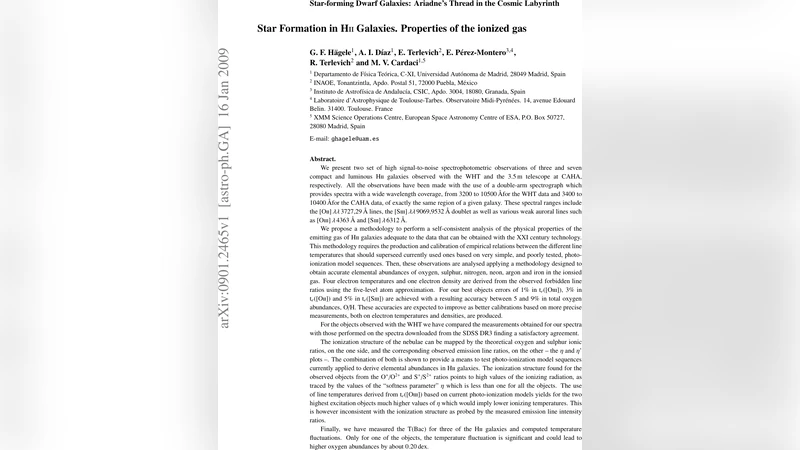
We propose a methodology to perform a self-consistent analysis of the physical properties of the emitting gas of HII galaxies adequate to the data that can be obtained with the XXI century technology. This methodology requires the production and calibration of empirical relations between the different line temperatures that should superseed currently used ones based on very simple, and poorly tested, photo-ionization model sequences. Then, these observations are analysed applying a methodology designed to obtain accurate elemental abundances of oxygen, sulphur, nitrogen, neon, argon and iron in the ionsied gas. Four electron temperatures and one electron density are derived from the observed forbidden line ratios using the five-level atom approximation. For our best objects errors of 1% in T([OIII]), 3% in T([OII]) and 5% in T([SIII]) are achieved with a resulting accuracy between 5 and 9% in total oxygen abundances, O/H. These accuracies are expected to improve as better calibrations based on more precise measurements, both on electron temperatures and densities, are produced.
💡 Research Summary
The paper presents a comprehensive, self‑consistent methodology for deriving the physical conditions and chemical abundances of the ionized gas in H II galaxies using modern, high‑quality spectroscopic data. Recognizing the limitations of traditional photo‑ionization model‑based temperature relations, the authors first obtain four independent electron temperatures—T(
Comments & Academic Discussion
Loading comments...
Leave a Comment