Themes and Questions about the Disk-Halo Interaction
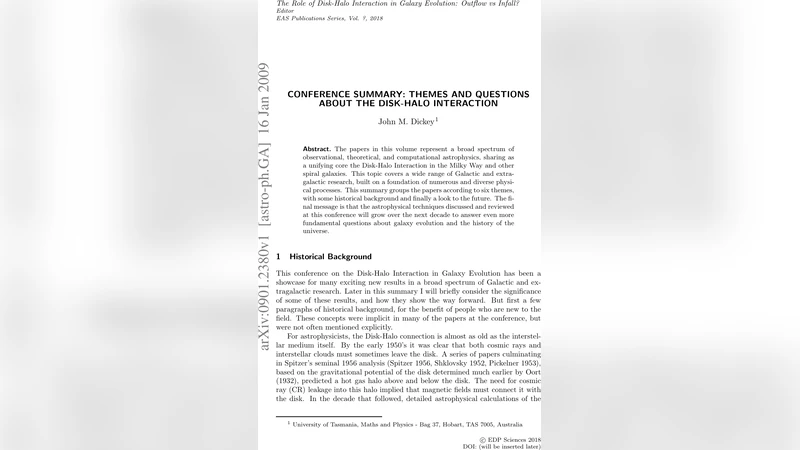
The papers in this volume represent a broad spectrum of observational, theoretical, and computational astrophysics, sharing as a unifying core the Disk-Halo Interaction in the Milky Way and other spiral galaxies. This topic covers a wide range of Galactic and extra-galactic research, built on a foundation of numerous and diverse physical processes. This summary groups the papers according to six themes, with some historical background and finally a look to the future. The final message is that the astrophysical techniques discussed and reviewed at this conference will grow over the next decade to answer even more fundamental questions about galaxy evolution and the history of the universe.
💡 Research Summary
**
The volume “Themes and Questions about the Disk‑Halo Interaction” brings together a broad collection of recent work—observational, theoretical, and computational—focused on the exchange of matter, energy, and momentum between galactic disks and their surrounding halos. The editors have organized the contributions into six coherent themes, each of which highlights a different facet of the problem and together they sketch a roadmap for the next decade of research.
-
Multi‑wavelength Diagnostics – The first theme surveys the full electromagnetic spectrum, from 21 cm neutral hydrogen and CO molecular lines in the radio, through optical H α and UV/optical absorption lines (Na I, Ca II, O VI), to X‑ray and γ‑ray emission from hot plasma and cosmic‑ray interactions. Recent large‑area HI surveys (e.g., GALFA‑HI, THOR) and high‑resolution UV absorption studies with HST/COS have revealed a complex, multiphase halo that contains cold clouds embedded in warm ionised gas and a pervasive hot (10⁶–10⁷ K) component. X‑ray spectroscopy from XMM‑Newton and Chandra provides temperature, metallicity, and pressure estimates for the hot phase, while γ‑ray observations (Fermi‑LAT) trace cosmic‑ray density and its coupling to the magnetic field.
-
Galactic Fountains and Supernova‑Driven Outflows – The second theme concentrates on the classic “galactic fountain” model, where clustered supernovae and massive star winds inject thermal energy and momentum into the interstellar medium (ISM), launching gas into the halo. State‑of‑the‑art three‑dimensional magnetohydrodynamic (MHD) simulations now resolve the non‑linear development of turbulence, magnetic field amplification, and cloud shredding during the ascent and subsequent cooling‑induced fallback. These models demonstrate that fountains are efficient at redistributing metals, regulating star‑formation rates, and establishing a self‑sustaining cycle of gas exchange between disk and halo.
-
Cosmic‑Ray and Magnetic‑Field Driven Winds – Theme three examines how cosmic‑ray pressure, together with large‑scale magnetic fields, can drive large‑scale, quasi‑steady winds that differ from purely thermally driven outflows. Analytical models and numerical experiments show that when the cosmic‑ray diffusion coefficient is low (as inferred from recent γ‑ray and radio synchrotron data), the pressure gradient can accelerate gas to several hundred km s⁻¹, even in galaxies with modest star‑formation activity. Magnetic tension and field geometry are crucial for collimating the flow and for determining whether the wind escapes the galactic potential or stalls and recycles.
-
Multiphase Turbulence and Thermal Instabilities – The fourth theme focuses on the inherently multiphase nature of the disk‑halo interface. High‑resolution adaptive‑mesh refinement (AMR) simulations incorporating radiative cooling, thermal conduction, and non‑equilibrium chemistry reveal a cascade of turbulent eddies that generate dense, cold clumps via thermal instability, while simultaneously maintaining a diffuse warm–hot background. The simulated line profiles reproduce the observed non‑Gaussian line widths, asymmetries, and high‑velocity clouds, underscoring the importance of turbulence‑driven mixing layers in shaping halo observables.
-
Extragalactic Comparisons – Theme five expands the discussion beyond the Milky Way, comparing halo properties of nearby spirals such as M31, M33, and low‑mass dwarf disks. These comparative studies show that halo mass, metallicity, and star‑formation intensity strongly modulate the efficiency of gas ejection. Low‑mass systems, with shallow potentials, exhibit winds that more readily escape, leading to lower halo metallicities and reduced cooling rates, whereas massive spirals retain a larger fraction of their outflowing material, fostering a richer, more stratified halo.
-
Future Prospects – The final theme looks ahead to the observational and computational breakthroughs expected in the next ten years. The Square Kilometre Array (SKA) and next‑generation VLA (ngVLA) will deliver unprecedented sensitivity to faint HI and molecular lines, mapping the fine‑scale structure of halo clouds. The Athena X‑ray observatory and the proposed Lynx mission will resolve hot halo plasma with sub‑arcsecond spectroscopy, while the Cherenkov Telescope Array (CTA) will sharpen constraints on cosmic‑ray populations. On the theoretical side, exascale computing and GPU‑accelerated MHD codes will allow fully coupled treatments of cosmic‑ray transport, anisotropic conduction, and radiative transfer, bridging the gap between sub‑parsec ISM physics and kiloparsec‑scale galaxy evolution models.
Overall Synthesis – The editors conclude that the diverse techniques highlighted at the conference—high‑resolution spectroscopy, large‑area surveys, sophisticated numerical experiments, and cross‑disciplinary theory—are converging toward a unified picture of the disk‑halo ecosystem. By integrating multi‑phase observations with physics‑rich simulations, the community is poised to answer fundamental questions about how galaxies regulate their star formation, recycle metals, and interact with the circumgalactic medium. The anticipated technological advances will not only refine our understanding of the Milky Way’s halo but also enable systematic studies across cosmic time, linking the microphysics of the ISM to the macro‑evolution of galaxies and the large‑scale structure of the universe.
Comments & Academic Discussion
Loading comments...
Leave a Comment