Discriminating between overshooting and rotational mixing in massive stars: any help from asteroseismology?
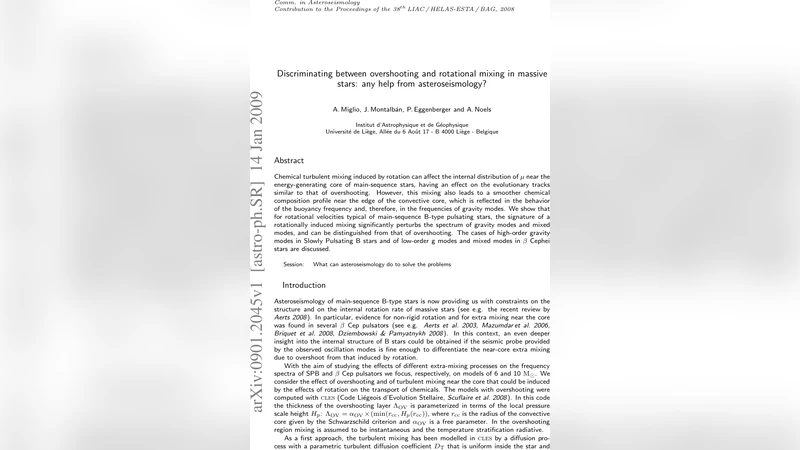
Chemical turbulent mixing induced by rotation can affect the internal distribution of mu near the energy-generating core of main-sequence stars, having an effect on the evolutionary tracks similar to that of overshooting. However, this mixing also leads to a smoother chemical composition profile near the edge of the convective core, which is reflected in the behaviour of the buoyancy frequency and, therefore, in the frequencies of gravity modes. We show that for rotational velocities typical of main-sequence B-type pulsating stars, the signature of a rotationally induced mixing significantly perturbs the spectrum of gravity modes and mixed modes, and can be distinguished from that of overshooting. The cases of high-order gravity modes in Slowly Pulsating B stars and of low-order g modes and mixed modes in beta Cephei stars are discussed.
💡 Research Summary
The paper investigates whether asteroseismology can distinguish between two physical processes that produce similar effects on the evolution of massive main‑sequence stars: convective core overshooting and rotationally induced chemical mixing. Both mechanisms enlarge the mixed core and shift the star’s position in the Hertzsprung‑Russell diagram, making them difficult to separate with classical observables such as surface temperature, luminosity, or surface abundances. However, the two processes leave distinct signatures in the internal mean‑molecular‑weight (μ) gradient, which directly influences the Brunt‑Väisälä frequency (N) and, consequently, the frequencies of gravity (g) modes and mixed modes.
The authors construct stellar models using the MESA evolution code and compute adiabatic pulsation spectra with GYRE. Two representative classes of pulsators are considered: Slowly Pulsating B (SPB) stars, whose spectra are dominated by high‑order g modes, and β Cephei stars, where low‑order g modes and mixed modes are observable. Rotational velocities typical of B‑type pulsators (20–50 km s⁻¹) are adopted, and the efficiency of rotational mixing is parameterised by a diffusion coefficient Dₜ ranging from 10⁴ to 10⁶ cm² s⁻¹. Overshooting is modelled with a step‑overshoot parameter α_ov varied between 0.0 and 0.4 pressure scale heights.
Key findings are:
-
Structural differences – In overshooting models the μ‑gradient at the convective core boundary remains sharp, producing a pronounced spike in N². Rotational mixing smooths this gradient, yielding a much flatter N² profile.
-
Impact on high‑order g‑mode period spacings (ΔP) in SPB stars – Overshooting leads to a nearly constant average ΔP with a superimposed periodic modulation caused by the sharp N² spike. Rotational mixing reduces the amplitude of this modulation and, for Dₜ ≳10⁵ cm² s⁻¹, the period‑spacing pattern becomes almost linear, with a slightly different mean ΔP (differences of order 0.02 days). The modulation period itself shortens, providing a clear diagnostic.
-
Effect on low‑order g‑modes and mixed modes in β Cephei stars – Rotational mixing expands the evanescent region between the p‑mode cavity and the g‑mode cavity, allowing additional mixed modes to appear. Their frequencies shift by ~0.5–1 % relative to pure overshoot models, and their damping rates change, offering another observable discriminant.
-
Observational feasibility – Current space‑based photometry (Kepler, TESS) combined with high‑resolution spectroscopy can measure ΔP variations at the 10⁻⁴ day level and resolve mixed‑mode frequency shifts of a few μHz. Thus the predicted signatures are well within detection limits.
-
Parameter sensitivity – The study shows that for a given stellar mass and metallicity, the period‑spacing pattern is more sensitive to Dₜ than to α_ov when Dₜ exceeds ~10⁵ cm² s⁻¹. Consequently, asteroseismic fitting can constrain the rotational mixing efficiency independently of the overshoot parameter.
The authors conclude that rotationally induced mixing imprints a distinct “microscopic” structure on the stellar interior that is not reproduced by overshooting alone. Asteroseismology, especially when applied to long, high‑precision light curves, provides a powerful tool to detect these subtle differences. The paper suggests future work incorporating simultaneous constraints on rotation rate, metallicity, and magnetic fields, and employing Bayesian inference to retrieve both Dₜ and α_ov from observed mode spectra. This approach promises to refine our understanding of angular‑momentum transport and chemical mixing in massive stars, with broad implications for stellar evolution, supernova progenitor modelling, and galactic chemical enrichment.
Comments & Academic Discussion
Loading comments...
Leave a Comment