Limits on chemical complexity in diffuse clouds: search for CH3OH and HC5N absorption
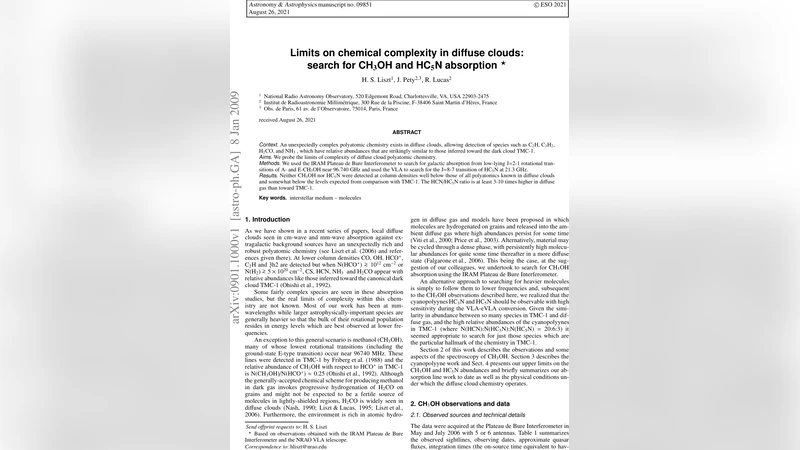
Context: An unexpectedly complex polyatomic chemistry exists in diffuse clouds, allowing detection of species such as C2H, C3H2, H2CO and NH3 which have relative abundances that are strikingly similar to those inferred toward the dark cloud TMC-1 Aims: We probe the limits of complexity of diffuse cloud polyatomic chemistry. Methods: We used the IRAM Plateau de Bure Interferometer to search for galactic absorption from low-lying J=2-1 rotational transitions of A- and E-CH3OH near 96.740 GHz and used the VLA to search for the J=8-7 transition of HC5N at 21.3 GHz. Results: Neither CH3OH nor HC5N were detected at column densities well below those of all polyatomics known in diffuse clouds and somewhat below the levels expected from comparison with TMC-1. The HCN/HC5N ratio is at least 3-10 times higher in diffuse gas than toward TMC-1. Conclusions: It is possible to go to the well once (or more) too often
💡 Research Summary
The paper investigates the upper limits of molecular complexity attainable in diffuse interstellar clouds by searching for two relatively complex organic species, methanol (CH₃OH) and the cyanopolyyne HC₅N. The motivation stems from earlier detections of several polyatomic molecules—C₂H, C₃H₂, H₂CO, NH₃—in diffuse gas, whose abundances surprisingly resemble those measured in the well‑studied dark cloud TMC‑1. This raised the question of whether even larger, more complex molecules could survive in the low‑density, UV‑permeated environments typical of diffuse clouds.
To address this, the authors employed two complementary radio facilities. The IRAM Plateau de Bure Interferometer (PdBI) was used to target the low‑lying J = 2–1 rotational transitions of both A‑ and E‑type methanol near 96.740 GHz. By selecting bright extragalactic continuum sources as background illuminators, the team maximized the absorption signal against a strong, compact continuum. Simultaneously, the Karl G. Jansky Very Large Array (VLA) observed the J = 8–7 transition of HC₅N at 21.3 GHz, again in absorption against bright continuum sources. Both observations achieved sub‑km s⁻¹ spectral resolution and rms noise levels sufficient to detect column densities an order of magnitude lower than those of previously known diffuse‑cloud polyatomics.
Data reduction followed standard interferometric calibration (bandpass, phase, flux) and imaging procedures, with particular care taken to model the hyperfine structure of the targeted lines. After co‑adding spectra from multiple sightlines, no statistically significant absorption features were found for either molecule. The authors therefore derived 3σ upper limits on the column densities: N(CH₃OH) < 2 × 10¹² cm⁻² and N(HC₅N) < 5 × 10¹¹ cm⁻². These limits are well below the column densities of other detected diffuse‑cloud species (typically 10¹²–10¹³ cm⁻²) and also fall short of the values expected if the chemistry of diffuse gas mirrored that of TMC‑1, where CH₃OH and HC₅N are observed at levels roughly five to ten times higher.
A particularly informative diagnostic is the ratio of HCN to HC₅N. In diffuse clouds the authors find HCN/HC₅N ≥ 30–100, whereas in TMC‑1 the ratio is only about 10–30. This indicates that the formation pathways that efficiently produce long carbon‑chain cyanopolyynes in dense, shielded environments are strongly suppressed in diffuse gas, likely because of the combined effects of low density, higher kinetic temperature, and pervasive ultraviolet radiation that enhances photodissociation and reduces the efficiency of ion–neutral reactions. Similarly, methanol formation is thought to proceed mainly via grain‑surface hydrogenation of CO followed by non‑thermal desorption. In diffuse clouds the grain surface area per unit volume is small, and UV photons readily photodesorb or photodissociate nascent methanol, leading to the very low abundances inferred from the observations.
The authors conclude that, while a surprisingly rich polyatomic chemistry exists in diffuse clouds, there is a clear ceiling to the complexity that can be sustained. The non‑detections of CH₃OH and HC₅N set stringent constraints on chemical models, implying that the abundance patterns observed in dense clouds cannot be directly extrapolated to the diffuse interstellar medium. The elevated HCN/HC₅N ratio further underscores the importance of environmental parameters—density, shielding, radiation field—in shaping molecular inventories.
Future work, the paper suggests, should combine even higher‑sensitivity observations (e.g., with ALMA, the next‑generation VLA) and refined astrochemical networks that incorporate grain‑surface processes, photochemistry, and turbulent diffusion. Such efforts will clarify whether the current limits are intrinsic to diffuse‑cloud chemistry or simply reflect the sensitivity thresholds of present‑day instrumentation, and will help to map the transition from simple diatomics to the more complex organics that ultimately seed star‑forming regions.
Comments & Academic Discussion
Loading comments...
Leave a Comment