Period Changes of LMC Cepheids in the OGLE and MACHO Data
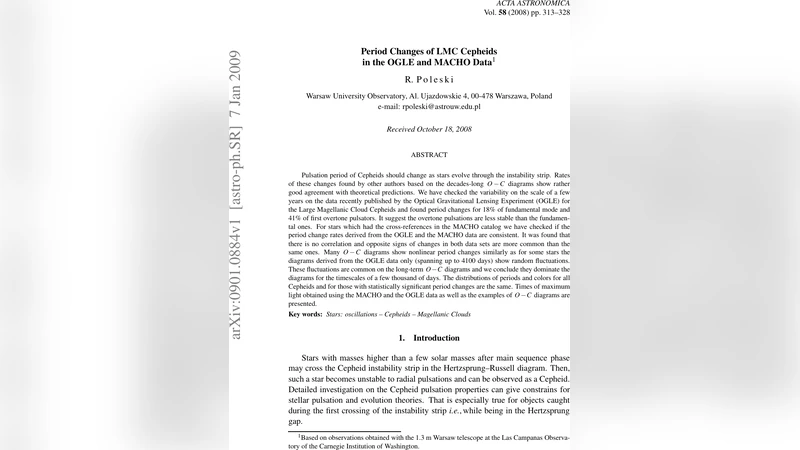
Pulsation period of Cepheids should change as stars evolve through the instability strip. Rates of these changes found by other authors based on the decades-long O-C diagrams show rather good agreement with theoretical predictions. We have checked the variability on the scale of a few years on the data recently published by the Optical Gravitational Lensing Experiment (OGLE) for the Large Magellanic Cloud Cepheids and found period changes for 18% of fundamental mode and 41% of first overtone pulsators. It suggest the overtone pulsations are less stable than the fundamental ones. For stars which had the cross-references in the MACHO catalog we have checked if the period change rates derived from the OGLE and the MACHO data are consistent. It was found that there is no correlation and opposite signs of changes in both data sets are more common than the same ones. Many O-C diagrams show nonlinear period changes similarly as for some stars the diagrams derived from the OGLE data only (spanning up to 4100 days) show random fluctuations. These fluctuations are common on the long-term O-C diagrams and we conclude they dominate the diagrams for the timescales of a few thousand of days. The distributions of periods and colors for all Cepheids and for those with statistically significant period changes are the same. Times of maximum light obtained using the MACHO and the OGLE data as well as the examples of O-C diagrams are presented.
💡 Research Summary
The paper investigates short‑term (a few years) period variations of Cepheid variables in the Large Magellanic Cloud (LMC) by analysing the publicly released photometric time‑series from the Optical Gravitational Lensing Experiment (OGLE) and the MACHO project. Cepheids are expected to show secular period changes as they evolve across the instability strip, and previous long‑baseline O‑C (Observed minus Calculated) studies have generally confirmed theoretical predictions. Here the authors ask whether detectable period changes also exist on the scale of a few thousand days, and whether the two independent data sets give consistent results.
The sample consists of all LMC Cepheids identified in the OGLE‑III catalog, separated into fundamental‑mode (F) and first‑overtone (1O) pulsators. For each star the authors constructed O‑C diagrams by comparing the observed times of maximum light with those predicted from a constant‑period ephemeris. Linear and quadratic fits were applied to the O‑C series; the statistical significance of any trend was assessed with an F‑test and χ² analysis. Only trends that passed these tests were deemed “significant”.
From the OGLE data alone, 18 % of the fundamental‑mode Cepheids and 41 % of the first‑overtone Cepheids displayed statistically significant period changes. The markedly higher fraction for 1O stars suggests that overtone pulsation is intrinsically less stable than fundamental pulsation. For the subset of stars that also appear in the MACHO catalog, the authors derived independent period‑change rates from the MACHO light curves and compared them with the OGLE results. Surprisingly, there is essentially no correlation between the two measurements; in fact, opposite signs of period change (one data set showing an increase, the other a decrease) are more common than matching signs. This lack of agreement is attributed to the relatively short and non‑overlapping time spans of the two surveys, as well as to genuine stochastic fluctuations in the pulsation period on timescales of a few thousand days.
The O‑C diagrams reveal a mixture of behaviours. While some stars exhibit a smooth, nearly linear drift consistent with evolutionary period change, many show pronounced curvature, abrupt jumps, or seemingly random scatter. Even with OGLE’s longest baseline of about 4100 days (≈11 years), random‑looking fluctuations dominate the diagrams for a substantial fraction of the sample. This indicates that on the timescale of a few thousand days, stochastic period noise outweighs the slow secular evolution predicted by stellar models.
The authors also examined whether the Cepheids with detected period changes differ in their fundamental properties. Histograms of period, mean colour (V–I), and magnitude show no significant distinction between the full Cepheid population and the subset with significant period variations. Hence, the occurrence of short‑term period noise does not appear to be confined to a particular period range or colour (temperature) interval.
In addition to the statistical analysis, the paper provides tables of times of maximum light derived independently from the MACHO and OGLE data, together with illustrative O‑C plots for representative stars. These data constitute a valuable resource for future long‑baseline O‑C studies that will combine the present measurements with historic photographic and modern space‑based observations.
Overall, the study challenges the common assumption that Cepheid periods are smoothly varying on evolutionary timescales. It demonstrates that stochastic, possibly non‑linear processes produce significant period jitter on timescales of a few years to a decade, especially for overtone pulsators. Consequently, any comparison between observed period changes and theoretical evolutionary models must account for this intrinsic noise. The work underscores the importance of long, homogeneous photometric monitoring and suggests that future surveys (e.g., LSST, Gaia) will be crucial for disentangling genuine evolutionary trends from random period fluctuations in Cepheid variables.
Comments & Academic Discussion
Loading comments...
Leave a Comment