Formation of Transient Coronal Holes during Eruption of a Quiescent Filament and its Overlying Sigmoid
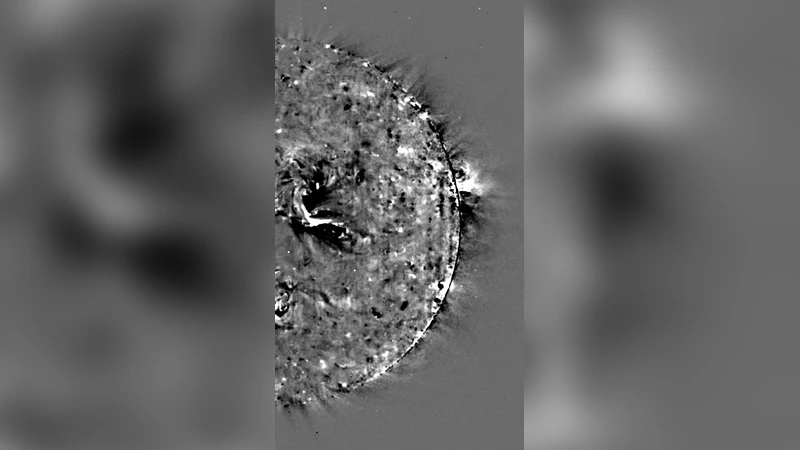
By using H$\alpha$, He I 10830, EUV and soft X-ray (SXR) data, we examined a filament eruption that occurred on a quiet-sun region near the center of the solar disk on 2006 January 12, which disturbed a sigmoid overlying the filament channel observed by the $\emph{GOES-12}$ SXR Imager (SXI), and led to the eruption of the sigmoid. The event was associated with a partial halo coronal mass ejection (CME) observed by the Large Angle and Spectrometric Coronagraphs (LASCO) on board the Solar and Heliospheric Observatory ($\emph{SOHO}$), and resulted in the formation of two flare-like ribbons, post-eruption coronal loops, and two transient coronal holes (TCHs), but there were no significantly recorded $\emph{GOES}$ or H$\alpha$ flares corresponding to the eruption. The two TCHs were dominated by opposite magnetic polarities and were located on the two ends of the eruptive sigmoid. They showed similar locations and shapes in He I 10830, EUV and SXR observations. During the early eruption phase, brightenings first appeared on the locations of the two subsequent TCHs, which could be clearly identified on He I 10830, EUV and SXR images. This eruption event could be explained by the magnetic flux rope model, and the two TCHs were likely to be the feet of the flux rope.
💡 Research Summary
The authors present a comprehensive multi‑wavelength study of a quiet‑Sun filament eruption that occurred on 12 January 2006 near the solar disk centre. Using ground‑based Hα and He I 10830 Å observations together with space‑borne EUV (SOHO/EIT) and soft X‑ray (GOES‑12 SXI) data, they trace the evolution of a filament lying beneath a coronal sigmoid. The filament slowly rises, destabilises the overlying S‑shaped magnetic structure, and ultimately erupts. Although no significant GOES X‑ray flare or Hα flare was recorded, the event produced a partial‑halo coronal mass ejection (CME) observed by LASCO, two flare‑like ribbons, a system of post‑eruption coronal loops, and—most intriguingly—two transient coronal holes (TCHs). The TCHs appear at the opposite ends of the erupting sigmoid, each rooted in magnetic fields of opposite polarity, and are clearly visible in He I 10830 Å absorption, EUV, and soft X‑ray images. Prior to the appearance of the low‑density holes, small brightenings are detected at exactly the same locations across all three wavelength regimes, suggesting that the footpoints of the erupting magnetic flux rope experience localized heating and reconnection before the rope lifts off. The authors interpret the observations within the magnetic flux‑rope framework: the sigmoid represents the twisted flux rope, the two TCHs correspond to its footpoints, and the CME is the outward expulsion of the rope’s apex. The early brightenings are attributed to reconnection at the rope’s anchors, which subsequently leads to plasma evacuation and the formation of the transient holes. The post‑eruption loop arcade is interpreted as the reconnected field lines that close behind the departing rope. By correlating the timing, morphology, and magnetic polarity of the TCHs with the CME and the overlying sigmoid, the study provides strong observational support for the flux‑rope model of CME initiation, even in events lacking classic flare signatures. The work highlights the diagnostic value of He I 10830 Å, EUV, and soft X‑ray imaging for identifying the footpoints of erupting structures and suggests that transient coronal holes can serve as early indicators of CME launch, with potential applications for space‑weather forecasting.
Comments & Academic Discussion
Loading comments...
Leave a Comment