Thermal Tides in Short Period Exoplanets
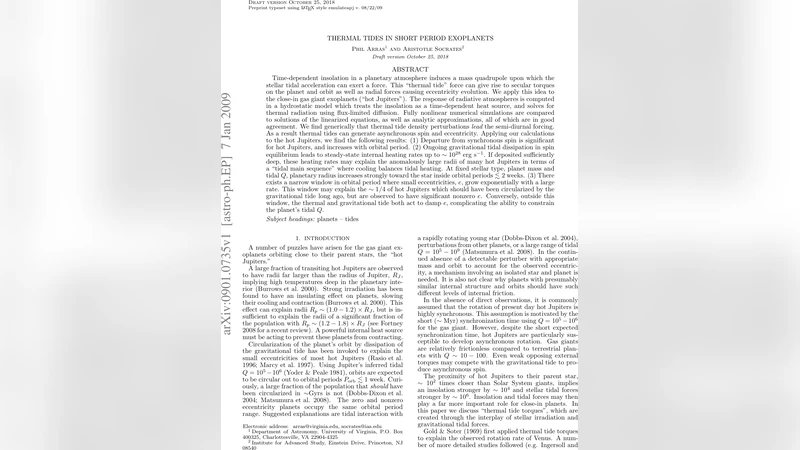
Time-dependent insolation in a planetary atmosphere induces a mass quadrupole upon which the stellar tidal acceleration can exert a force. This “thermal tide” force can give rise to secular torques on the planet and orbit as well as radial forces causing eccentricity evolution. We apply this idea to the close-in gas giant exoplanets (“hot Jupiters”). The response of radiative atmospheres is computed in a hydrostatic model which treats the insolation as a time-dependent heat source, and solves for thermal radiation using flux-limited diffusion. Fully nonlinear numerical simulations are compared to solutions of the linearized equations, as well as analytic approximations, all of which are in good agreement. We find generically that thermal tide density perturbations {\it lead} the semi-diurnal forcing. As a result thermal tides can generate asynchronous spin and eccentricity. Our results are as follows: (1) Departure from synchronous spin is significant for hot Jupiters, and increases with orbital period. (2) Ongoing gravitational tidal dissipation in spin equilibrium leads to steady-state internal heating rates up to $\sim 10^{28} {\rm erg\ s^{-1}}$. If deposited sufficiently deep, these heating rates may explain the anomalously large radii of many hot Jupiters in terms of a “tidal main sequence” where cooling balances tidal heating. At fixed stellar type, planet mass and tidal $Q$, planetary radius increases strongly toward the star inside orbital periods $\la 2$ weeks. (3) There exists a narrow window in orbital period where small eccentricities, $e$, grow exponentially with a large rate. This window may explain the $\sim 1/4$ of hot Jupiters which should have been circularized by the gravitational tide long ago, but are observed to have significant nonzero $e$.(Abridged)
💡 Research Summary
The paper investigates how time‑varying stellar irradiation—“thermal tides”—affects the spin, orbit, and internal energetics of close‑in gas giants (hot Jupiters). The authors construct a hydrostatic, one‑dimensional radiative atmosphere model in which the stellar flux is treated as a sinusoidal heat source with a semi‑diurnal frequency (twice the orbital frequency). Radiative transfer is solved using flux‑limited diffusion, allowing a seamless treatment of both optically thin upper layers and deeper, more opaque regions.
Linearizing the governing equations yields analytic expressions for the temperature and density perturbations, their amplitudes, and the phase lag relative to the forcing. Crucially, the density perturbation leads the insolation forcing, meaning that the atmospheric mass quadrupole is maximally displaced before the stellar heating peaks. This phase lead generates a torque that can drive the planet away from synchronous rotation.
To test the linear theory, the authors perform fully nonlinear time‑dependent simulations of the same atmosphere, again using flux‑limited diffusion. The numerical results match the linear predictions to within a few percent in both amplitude and phase, confirming that the simplified analytic treatment captures the essential physics even for sizable forcing amplitudes. The quadrupole moments produced are of order (10^{-7})–(10^{-5}) in units of planetary mass times radius squared.
Balancing the thermal‑tide torque against the opposing gravitational‑tidal torque yields an equilibrium spin rate that is generally asynchronous. For orbital periods shorter than about two weeks, the deviation from perfect synchrony can reach several percent, increasing with period. This asynchronous spin sustains a continuous gravitational‑tidal dissipation rate of up to (\sim10^{28},\mathrm{erg,s^{-1}}). If this energy is deposited deep enough (e.g., at pressures (\gtrsim 10^7) Pa), it can offset radiative cooling and inflate the planetary radius, providing a natural explanation for the “radius anomaly” observed in many hot Jupiters. The authors term this balance a “tidal main sequence,” wherein a planet’s cooling is exactly balanced by tidal heating, leading to a systematic increase in radius toward the star at fixed stellar type, planetary mass, and tidal quality factor (Q).
A second major result concerns orbital eccentricity. The authors identify a narrow window of orbital periods (approximately 1.5–3 days) where the thermal‑tide torque on the eccentricity exceeds the damping torque from gravitational tides. In this regime, even a tiny initial eccentricity grows exponentially, with growth rates of order (10^{-5})–(10^{-4},\mathrm{yr^{-1}}). This mechanism can maintain non‑zero eccentricities in a substantial fraction (≈ 25 %) of observed hot Jupiters, despite the expectation that gravitational tides should have circularized their orbits long ago.
Overall, the study provides a coherent framework that links four puzzling observations of hot Jupiters: (1) measurable departures from synchronous rotation, (2) inflated radii requiring an internal heat source, (3) a subset of planets retaining modest eccentricities, and (4) the dependence of these effects on orbital period. By demonstrating that thermal tides naturally produce the required torques and heating, the paper offers a compelling alternative—or complement—to purely gravitational‑tidal explanations. Limitations include the use of a one‑dimensional atmosphere (ignoring three‑dimensional circulation, jets, and wave dynamics) and the simplified treatment of how deposited tidal heat is redistributed within the planet’s interior. Future work extending the model to multi‑dimensional simulations and coupling to interior convection will be essential to fully validate the thermal‑tide hypothesis.
Comments & Academic Discussion
Loading comments...
Leave a Comment