Findings of the Joint Dark Energy Mission Figure of Merit Science Working Group
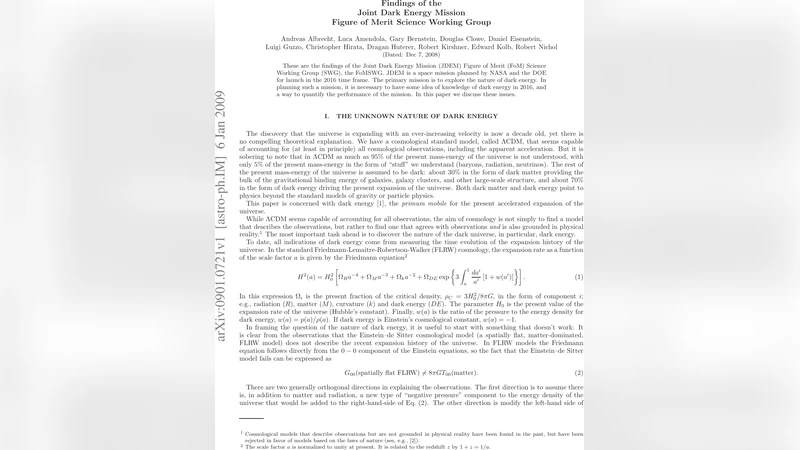
These are the findings of the Joint Dark Energy Mission (JDEM) Figure of Merit (FoM) Science Working Group (SWG), the FoMSWG. JDEM is a space mission planned by NASA and the DOE for launch in the 2016 time frame. The primary mission is to explore the nature of dark energy. In planning such a mission, it is necessary to have some idea of knowledge of dark energy in 2016, and a way to quantify the performance of the mission. In this paper we discuss these issues.
💡 Research Summary
The paper presents the final report of the Joint Dark Energy Mission (JDEM) Figure of Merit Science Working Group (FoMSWG), a body convened to assess the scientific viability of a NASA‑DOE space mission slated for launch around 2016. Its primary purpose is to define a quantitative performance metric—the Figure of Merit (FoM)—that can be used to compare mission concepts, prioritize observational strategies, and ultimately gauge how well JDEM will improve our knowledge of dark energy.
The authors begin by summarizing the state of dark‑energy constraints as of 2016. Four principal observational probes dominate the field: Type Ia supernovae (SN Ia) providing luminosity‑distance measurements, Baryon Acoustic Oscillations (BAO) giving a standard ruler in the galaxy distribution, weak gravitational lensing (WL) mapping the growth of structure, and galaxy‑cluster counts probing the mass function evolution. Each probe yields complementary information about the dark‑energy equation‑of‑state parameters w₀ (present‑day value) and wₐ (its redshift evolution). However, systematic uncertainties—photometric calibration for SN Ia, galaxy bias for BAO, point‑spread‑function modeling for WL, and mass‑observable relations for clusters—limit the precision of any single technique.
To capture the combined constraining power, the FoMSWG adopts the widely used DETF definition of FoM: the inverse of the area of the error ellipse in the w₀–wₐ plane (or equivalently the square root of the determinant of the covariance matrix). A larger FoM indicates tighter constraints on the dark‑energy dynamics. The report details the statistical framework used to compute FoM values, employing both Fisher‑matrix forecasts and full Bayesian Monte‑Carlo simulations to explore a variety of mission configurations.
A central result is the demonstration that multi‑probe synergy dramatically boosts the FoM. When SN Ia and BAO are combined, the FoM roughly triples relative to either probe alone. Adding WL and cluster data can increase the FoM by an order of magnitude, provided systematic errors are kept under control. The authors quantify how each systematic source degrades the FoM and propose concrete mitigation strategies: a network of calibrated standard stars for photometry, on‑board wavefront sensors and extensive PSF modeling for WL, and cross‑calibration of mass proxies using overlapping X‑ray, Sunyaev‑Zel’dovich, and spectroscopic data for clusters.
The paper then translates these findings into concrete mission design recommendations. First, the instrument suite should cover a broad near‑infrared band (≈1–2 µm) to enable precise SN Ia light‑curve measurements at redshifts up to z ≈ 1.7 while also providing high‑resolution imaging for WL shape measurements. Second, the survey strategy must balance depth and sky coverage: a wide‑field component (several thousand square degrees) to collect large WL and BAO samples, complemented by deeper fields (hundreds of square degrees) for high‑z supernovae and cluster studies. Third, the mission must allocate sufficient on‑board calibration hardware and ground‑segment resources to monitor and correct systematic drifts throughout the multi‑year operation.
Beyond hardware, the FoMSWG stresses the importance of a robust data‑analysis pipeline capable of jointly fitting all probes within a unified likelihood framework. This requires standardized data formats, shared simulation libraries, and coordinated analysis teams across the international community. The authors also outline policy recommendations: open data release after a short proprietary period, sustained funding for long‑term science teams, and formal partnerships with ground‑based facilities (e.g., LSST, DESI) to provide complementary spectroscopic redshifts and ancillary measurements.
In conclusion, the FoMSWG provides a clear, quantitative roadmap for maximizing the scientific return of JDEM. By defining the FoM, cataloguing current knowledge, and systematically evaluating how observational choices affect the FoM, the group shows that a well‑designed, multi‑probe space mission can improve dark‑energy constraints by an order of magnitude over the pre‑2016 baseline. The report’s recommendations on instrument wavelength coverage, survey geometry, systematic‑error control, and collaborative infrastructure form a comprehensive blueprint that, if followed, would position JDEM as a cornerstone of 2020s cosmology and a decisive step toward uncovering the physical nature of dark energy.
Comments & Academic Discussion
Loading comments...
Leave a Comment