Interpretation of the Extragalactic Radio Background
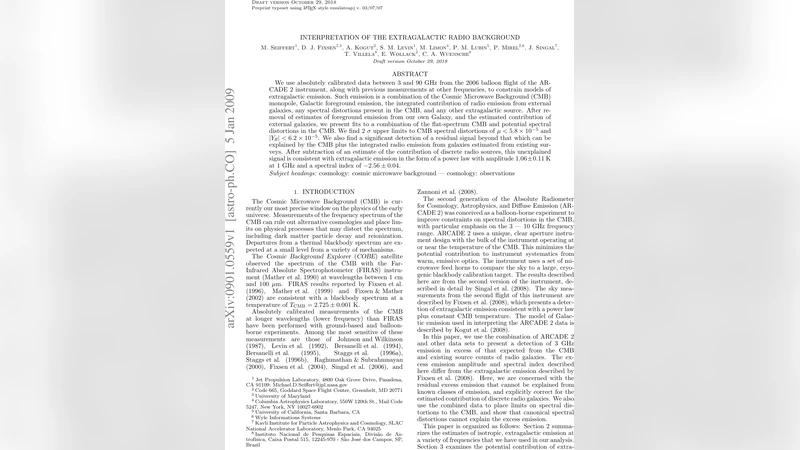
We use absolutely calibrated data between 3 and 90 GHz from the 2006 balloon flight of the ARCADE 2 instrument, along with previous measurements at other frequencies, to constrain models of extragalactic emission. Such emission is a combination of the Cosmic Microwave Background (CMB) monopole, Galactic foreground emission, the integrated contribution of radio emission from external galaxies, any spectral distortions present in the CMB, and any other extragalactic source. After removal of estimates of foreground emission from our own Galaxy, and the estimated contribution of external galaxies, we present fits to a combination of the flat-spectrum CMB and potential spectral distortions in the CMB. We find 2 sigma upper limits to CMB spectral distortions of mu < 5.8 x 10^{-5} and Y_ff < 6.2 x 10^{-5}. We also find a significant detection of a residual signal beyond that which can be explained by the CMB plus the integrated radio emission from galaxies estimated from existing surveys. After subtraction of an estimate of the contribution of discrete radio sources, this unexplained signal is consistent with extragalactic emission in the form of a power law with amplitude 1.06 \pm 0.11 K at 1 GHz and a spectral index of -2.56 \pm 0.04.
💡 Research Summary
The authors present a comprehensive analysis of the extragalactic radio background (ERB) using absolutely calibrated measurements from the 2006 ARCADE 2 balloon flight covering the 3–90 GHz frequency range, supplemented by earlier data at lower and higher frequencies. Their goal is to disentangle the observed sky brightness into five principal components: (1) the Cosmic Microwave Background (CMB) monopole, (2) Galactic foreground emission (synchrotron and free‑free radiation), (3) the integrated contribution of known radio galaxies derived from existing source counts, (4) possible spectral distortions of the CMB (μ‑type and free‑free Y‑type), and (5) any residual extragalactic emission that cannot be accounted for by the first four components.
To isolate the Galactic foreground, the authors adopt state‑of‑the‑art synchrotron and free‑free templates based on low‑frequency radio maps and modern cosmic‑ray propagation models. The contribution from known extragalactic radio sources is estimated by integrating source‑count distributions from surveys such as NVSS, SUMSS, and GB6, assuming a typical spectral index of ≈ –0.7. This yields an expected brightness of roughly 0.1 K at 1 GHz, which is subtracted from the total signal.
With the Galactic and known extragalactic components removed, the residual spectrum is fitted with a model that includes the CMB blackbody plus two possible distortion terms: a μ‑type distortion (characterizing early‑Universe energy release that drives the photon distribution away from a pure Planck spectrum) and a free‑free (Y‑type) distortion (arising from late‑time re‑ionization processes). The fit returns 2‑σ upper limits of μ < 5.8 × 10⁻⁵ and Y_ff < 6.2 × 10⁻⁵. These limits improve upon, or at least match, the constraints previously set by COBE/FIRAS and represent some of the most stringent bounds on CMB spectral distortions to date.
Crucially, even after accounting for the allowed distortions, a significant excess remains. This excess is well described by a simple power‑law spectrum S(ν) ∝ ν^α with an amplitude of 1.06 ± 0.11 K at 1 GHz and a spectral index α = –2.56 ± 0.04. The amplitude is an order of magnitude larger than the integrated contribution from known radio galaxies, indicating the presence of an additional, previously unrecognized extragalactic radio component. The authors discuss several possible origins: (i) a population of faint, low‑frequency radio‑quiet active galactic nuclei that lie below current survey detection thresholds; (ii) diffuse synchrotron emission from large‑scale structures such as galaxy clusters or the cosmic web; (iii) exotic mechanisms like dark‑matter annihilation or decay that could inject low‑frequency photons into the intergalactic medium.
The paper emphasizes that the detection of this unexplained background has profound implications. First, it demonstrates that the current census of radio sources, even when extrapolated to very low flux densities, is insufficient to explain the observed sky brightness at GHz frequencies. Second, it highlights the need for future absolute‑calibration experiments with broader frequency coverage (e.g., PIXIE, PRISM) and for deep, wide‑field low‑frequency interferometric surveys (e.g., LOFAR, SKA‑Low) that can map the spatial distribution of the excess and test its correlation with large‑scale structure. Third, the stringent μ and Y limits provide valuable constraints on early‑Universe energy‑injection scenarios, such as decaying particles, primordial black hole evaporation, or acoustic damping, thereby informing models of inflation and reheating.
In summary, the study delivers two major results: (1) it places tight 2‑σ upper bounds on CMB spectral distortions (μ < 5.8 × 10⁻⁵, Y_ff < 6.2 × 10⁻⁵), and (2) it uncovers a robust, power‑law extragalactic radio background that cannot be explained by known Galactic emission or the integrated light from cataloged radio galaxies. This latter finding opens a new observational window on the low‑frequency Universe, motivating both theoretical work to identify plausible source populations and observational campaigns to characterize the excess with higher angular resolution and broader spectral coverage.
Comments & Academic Discussion
Loading comments...
Leave a Comment