Stellar kinematics in blue compact galaxies
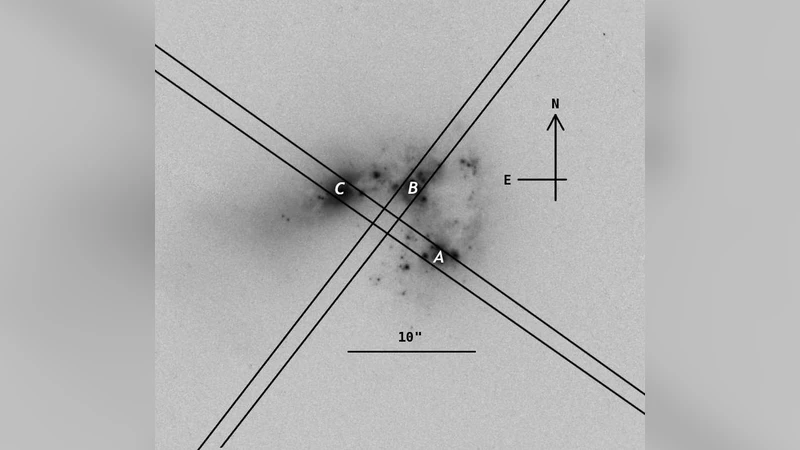
In a programme of observations of local luminous blue compact galaxies (BCGs), we are investigating kinematics by using tracers of both stars and ionized gas. Here we summarise our program and present new data on the local Lyman break galaxy analogue Haro 11. From spatially-resolved spectroscopy around the near-infrared Ca II triplet, we find that its stars and ionized gas have similar velocity fields. Our programme so far indicates however that emission line velocities can differ locally by a few tens of km/s from the Ca II values. Comparing our data to simple stellar population models, we assess which stellar population the Ca II triplet traces and its potential beyond the local universe.
💡 Research Summary
The paper presents results from a dedicated observational program aimed at probing the internal kinematics of luminous blue compact galaxies (BCGs) by simultaneously tracing the motions of stars and ionized gas. The authors focus on Haro 11, a nearby analogue of high‑redshift Lyman‑break galaxies (LBGs), and use spatially‑resolved spectroscopy around the near‑infrared Ca II triplet (λ ≈ 8500 Å) to obtain stellar velocity fields. The Ca II triplet is an attractive stellar kinematic tracer because it is strong in cool, intermediate‑age giant stars and is relatively free from contamination by the intense nebular emission that dominates the optical spectra of BCGs.
Observations were carried out with multi‑object or integral‑field spectrographs on 8‑10 m class telescopes (e.g., VLT/FLAMES, Gemini/GMOS, Keck/DEIMOS). The data were reduced with careful sky subtraction, telluric correction, and spectral fitting that separates the Ca II absorption from overlapping emission lines. Stellar velocities and velocity dispersions were extracted using cross‑correlation and penalised pixel‑fitting techniques, while gas velocities were derived from bright nebular lines such as Hα,
Comments & Academic Discussion
Loading comments...
Leave a Comment