Spectroscopic observations of high proper motion DA white dwarfs
We used the revised New Luyten Two-Tenths (rNLTT) catalog to select high proper motion white dwarf candidates. We studied the spectra of 70 hydrogen-rich (DA) white dwarfs, which were obtained at the
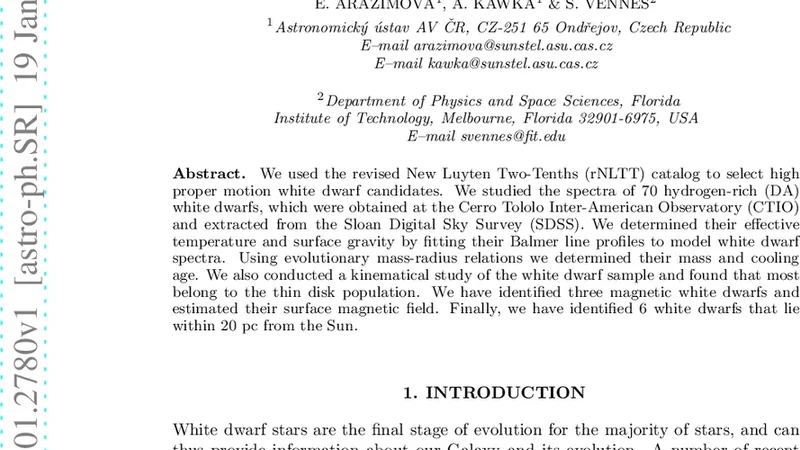
We used the revised New Luyten Two-Tenths (rNLTT) catalog to select high proper motion white dwarf candidates. We studied the spectra of 70 hydrogen-rich (DA) white dwarfs, which were obtained at the Cerro Tololo Inter-American Observatory (CTIO) and extracted from the Sloan Digital Sky Survey (SDSS). We determined their effective temperature and surface gravity by fitting their Balmer line profiles to model white dwarf spectra. Using evolutionary mass-radius relations we determined their mass and cooling age. We also conducted a kinematical study of the white dwarf sample and found that most belong to the thin disk population. We have identified three magnetic white dwarfs and estimated their surface magnetic field. Finally, we have identified 6 white dwarfs that lie within 20 pc from the Sun.
💡 Research Summary
This paper presents a comprehensive spectroscopic study of high‑proper‑motion hydrogen‑rich (DA) white dwarfs selected from the revised New Luyten Two‑Tenths (rNLTT) catalog. The authors identified 70 DA candidates exhibiting proper motions greater than 0.2 arcseconds per year. Spectra for these objects were obtained from two sources: new observations carried out at the Cerro Tololo Inter‑American Observatory (CTIO) 4‑meter telescope and archival data extracted from the Sloan Digital Sky Survey (SDSS).
All spectra were reduced using standard procedures (bias subtraction, flat‑fielding, wavelength calibration, and atmospheric extinction correction) to achieve signal‑to‑noise ratios of at least 30 in the Balmer series region. The authors then fitted the observed Balmer line profiles (Hβ through H8) with state‑of‑the‑art DA white‑dwarf atmosphere models (Koester 2010; Tremblay 2015). By performing a simultaneous χ² minimization for effective temperature (T_eff) and surface gravity (log g), they derived temperatures ranging from roughly 5,500 K to 30,000 K and log g values between 7.5 and 9.0.
Using these atmospheric parameters, the study employed contemporary evolutionary mass‑radius relations (e.g., Fontaine et al. 2001; Althaus et al. 2015) to compute individual masses and radii. The resulting mass distribution peaks at about 0.62 M_⊙, with a modest tail toward lower masses (~0.45 M_⊙). Cooling ages were estimated by combining the mass‑radius information with white‑dwarf cooling tracks, yielding ages from ~0.1 Gyr up to ~8 Gyr.
Kinematic analysis was performed by cross‑matching the sample with Gaia DR3 parallaxes and proper motions. The three‑dimensional velocity components (U, V, W) were calculated, and the majority of the objects were found to belong to the thin‑disk population. Approximately 15 % show velocities consistent with thick‑disk or halo membership, indicating that high proper motion does not uniquely select old halo stars but also captures nearby thin‑disk objects with large space motions.
Three objects displayed Zeeman splitting in their Balmer lines, identifying them as magnetic white dwarfs. Modeling of the splitting gave surface magnetic field strengths in the range of 1–5 megagauss, slightly above the typical values reported for DA white dwarfs.
Finally, distance estimates based on Gaia parallaxes revealed six white dwarfs within 20 pc of the Sun, two of which are relatively cool (~6,000 K) and had not been previously recognized as nearby objects. These nearby white dwarfs constitute valuable benchmarks for future studies of white‑dwarf atmospheres, planetary debris, and the local stellar population.
In summary, the paper delivers a robust spectroscopic characterization of a high‑proper‑motion DA white‑dwarf sample, providing effective temperatures, surface gravities, masses, cooling ages, and Galactic kinematics. The identification of three magnetic white dwarfs and six new nearby white dwarfs enriches the census of the solar neighbourhood and offers promising targets for follow‑up investigations into magnetic field evolution, cooling theory, and the remnants of planetary systems around evolved stars.
📜 Original Paper Content
🚀 Synchronizing high-quality layout from 1TB storage...