Strong Morita Equivalence of Inverse Semigroups
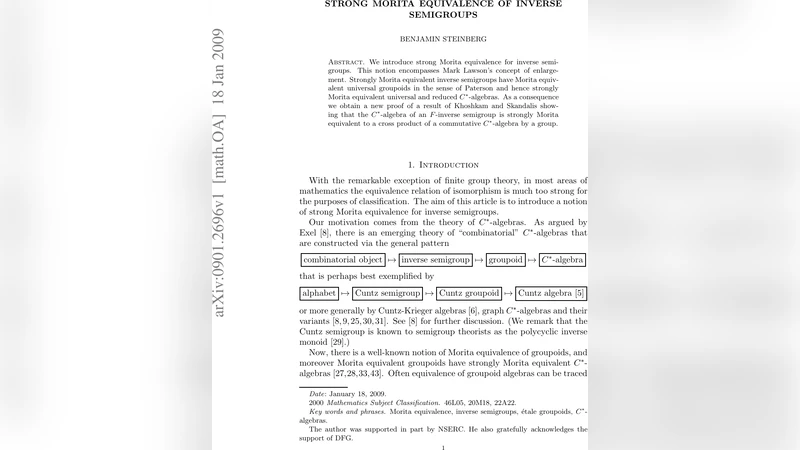
We introduce strong Morita equivalence for inverse semigroups. This notion encompasses Mark Lawson’s concept of enlargement. Strongly Morita equivalent inverse semigroups have Morita equivalent universal groupoids in the sense of Paterson and hence strongly Morita equivalent universal and reduced $C^$-algebras. As a consequence we obtain a new proof of a result of Khoshkam and Skandalis showing that the $C^$-algebra of an $F$-inverse semigroup is strongly Morita equivalent to a cross product of a commutative $C^*$-algebra by a group.
💡 Research Summary
The paper introduces a new notion of equivalence for inverse semigroups called strong Morita equivalence and develops a systematic theory that connects the algebraic structure of inverse semigroups with the analytic framework of groupoid C*‑algebras. The authors begin by recalling that inverse semigroups sit between groups and semilattices, possessing a natural partial order and a built‑in inversion operation. While Morita theory is well‑established for rings, C*‑algebras, and étale groupoids, a direct analogue for inverse semigroups has been lacking. To fill this gap, the authors define a (S,T)-bimodule M for two inverse semigroups S and T. The bimodule is required to be full on both sides (S·M = M and M·T = M) and to carry compatible inner products ⟨·,·⟩_S and ⟨·,·⟩_T whose ranges generate the respective idempotent ideals of S and T. This structure mirrors the classical bimodule used in ring Morita theory but is adapted to respect the idempotent‑semilattice structure and the involution of inverse semigroups.
With this definition, strong Morita equivalence is declared when such a bimodule exists. The authors prove that the relation is an equivalence relation (reflexive, symmetric, transitive) and that it subsumes Mark Lawson’s earlier concept of enlargement: if S is an enlargement of T, then S and T are strongly Morita equivalent. Conversely, strong Morita equivalence can be viewed as a generalisation of enlargement, allowing a broader class of semigroups to be identified as “the same” from a Morita‑theoretic perspective.
A central technical achievement is the demonstration that strong Morita equivalence of inverse semigroups induces Morita equivalence of their universal groupoids in the sense of Paterson. For an inverse semigroup S, Paterson’s universal groupoid G(S) is an étale groupoid built from the filter space of S; its objects are filters and its arrows are germs of the semigroup action. The paper constructs a (G(S), G(T))-bimodule from the original (S,T)-bimodule M, showing that the groupoids are equivalent in Renault’s sense. Consequently, the associated full and reduced C*‑algebras C*(G(S)) and C*_r(G(S)) are strongly Morita equivalent to the corresponding algebras of G(T). This lifts the purely algebraic equivalence to the analytic realm, providing a bridge between inverse semigroup theory and operator algebras.
The authors then apply the theory to F‑inverse semigroups, a well‑studied subclass where each element has a unique maximal idempotent below it. For an F‑inverse semigroup S, they identify the spectrum X of its idempotent semilattice and the maximal group image G (the quotient of S by its minimum group congruence). Using the strong Morita equivalence framework, they prove that the universal C*‑algebra C*(S) is strongly Morita equivalent to the crossed product C0(X) ⋊ G. This recovers a result originally proved by Khoshkam and Skandalis, but the new proof avoids the more intricate analysis of groupoid actions and instead relies on the algebraic bimodule construction. The result highlights that the C*‑algebra of an F‑inverse semigroup can be understood as a non‑commutative space obtained by “twisting” a commutative algebra of functions on a totally disconnected space by a discrete group action.
Beyond these core results, the paper presents several illustrative examples: enlargements, coverings, and certain reconstruction procedures all yield strongly Morita equivalent pairs. These examples demonstrate that the theory is not merely abstract but can be applied to concrete semigroups arising in dynamics, tilings, and partial symmetries.
In the concluding section, the authors outline future directions. They suggest investigating K‑theoretic invariants under strong Morita equivalence, exploring connections with partial actions and inverse semigroup C-dynamical systems*, and extending the framework to non‑étale groupoids or to quantum inverse semigroups. Overall, the paper establishes a robust Morita‑theoretic language for inverse semigroups, unifies several previously disparate concepts (enlargement, groupoid equivalence, crossed‑product descriptions), and opens a pathway for deeper interaction between semigroup theory, groupoid topology, and operator algebras.
Comments & Academic Discussion
Loading comments...
Leave a Comment