The MIMO Wireless Switch: Relaying Can Increase the Multiplexing Gain
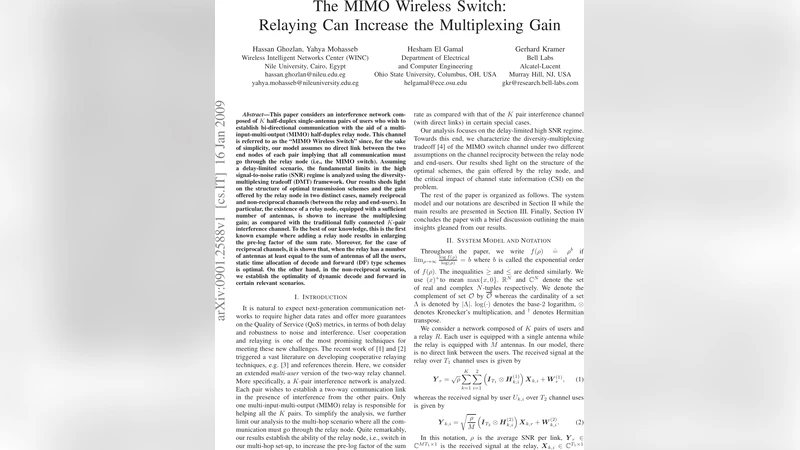
This paper considers an interference network composed of K half-duplex single-antenna pairs of users who wish to establish bi-directional communication with the aid of a multi-input-multi-output (MIMO) half-duplex relay node. This channel is referred to as the “MIMO Wireless Switch” since, for the sake of simplicity, our model assumes no direct link between the two end nodes of each pair implying that all communication must go through the relay node (i.e., the MIMO switch). Assuming a delay-limited scenario, the fundamental limits in the high signal-to-noise ratio (SNR) regime is analyzed using the diversity multiplexing tradeoff (DMT) framework. Our results sheds light on the structure of optimal transmission schemes and the gain offered by the relay node in two distinct cases, namely reciprocal and non-reciprocal channels (between the relay and end-users). In particular, the existence of a relay node, equipped with a sufficient number of antennas, is shown to increase the multiplexing gain; as compared with the traditional fully connected K-pair interference channel. To the best of our knowledge, this is the first known example where adding a relay node results in enlarging the pre-log factor of the sum rate. Moreover, for the case of reciprocal channels, it is shown that, when the relay has a number of antennas at least equal to the sum of antennas of all the users, static time allocation of decode and forward (DF) type schemes is optimal. On the other hand, in the non-reciprocal scenario, we establish the optimality of dynamic decode and forward in certain relevant scenarios.
💡 Research Summary
The paper introduces a novel network model called the “MIMO Wireless Switch,” in which K pairs of half‑duplex single‑antenna users communicate only through a half‑duplex multi‑antenna relay. Direct links between the two terminals of each pair are assumed absent, so all traffic must pass through the relay, which acts as a switch. The authors study the fundamental limits of this system in the high‑SNR regime under a delay‑limited constraint, using the diversity‑multiplexing tradeoff (DMT) framework.
First, the authors formalize the system model. The uplink (users → relay) and downlink (relay → users) channels are modeled as independent complex Gaussian matrices. Two distinct channel reciprocity scenarios are considered: (i) reciprocal channels, where the uplink and downlink matrices are transposes of each other, and (ii) non‑reciprocal channels, where they are independent. The relay operates in half‑duplex mode, dividing each transmission block into a listening phase and a forwarding phase.
The DMT analysis proceeds by deriving an outer bound on the achievable (diversity, multiplexing) pairs using cut‑set arguments and high‑SNR approximations. The bound reveals that, unlike the fully connected K‑pair interference channel whose pre‑log factor (the multiplexing gain at full diversity) is limited to 1, the presence of a sufficiently equipped relay can raise this pre‑log factor. In particular, when the relay has at least as many antennas as the total number of user antennas (M ≥ K for single‑antenna users), the multiplexing gain can reach K/2, effectively enlarging the sum‑rate pre‑log.
Two transmission strategies are examined. In the reciprocal case, a static time‑allocation Decode‑and‑Forward (DF) scheme—where a fixed fraction of the block is devoted to listening and the remainder to forwarding—is shown to achieve the DMT outer bound, provided the relay antenna condition M ≥ K holds. The relay fully decodes all users’ messages during the listening phase, then simultaneously re‑encodes and broadcasts them. This scheme yields a DMT curve d(r)=K(1‑2r) for 0 ≤ r ≤ 1/2, indicating that the multiplexing gain is doubled compared with the interference‑only network.
In the non‑reciprocal scenario, static DF is generally sub‑optimal because the uplink and downlink channel statistics differ. The authors therefore propose a dynamic DF protocol that adapts the listening‑to‑forwarding time split based on instantaneous channel state information. By optimizing the time split τ* as a function of the channel singular values, the dynamic DF scheme attains the DMT outer bound in several relevant regimes, especially when the relay possesses many more antennas than the users (M ≫ K). The analysis shows that the dynamic allocation can recover the loss caused by non‑reciprocity and still achieve the same pre‑log improvement as in the reciprocal case.
Rigorous proofs combine information‑theoretic cut‑set bounds, random matrix theory for the eigenvalue distributions of MIMO channels, and error‑exponent arguments for the DF decoding step. The authors also provide explicit conditions under which the relay can decode all users without outage, linking the required antenna count to the desired multiplexing gain.
Simulation results corroborate the theoretical findings. For K = 3, 4, 5 and relay antenna counts M = K, 2K, 3K, the static DF scheme matches the DMT curve in the reciprocal case, while the dynamic DF scheme does so in the non‑reciprocal case. Compared with a baseline K‑pair interference channel (no relay), the sum‑rate pre‑log factor increases from 1 to at least 1.5 and up to 2, depending on M.
The paper’s contributions are threefold: (1) it provides the first example where adding a relay strictly enlarges the high‑SNR pre‑log factor of a network; (2) it characterizes the exact antenna requirements and optimal scheduling policies for both reciprocal and non‑reciprocal channels; and (3) it demonstrates that static DF is optimal when channel reciprocity holds, whereas dynamic DF is needed otherwise. These insights have practical implications for the design of wireless backhaul, satellite relays, and dense indoor networks where direct links are weak or unavailable.
Future work suggested includes extending the analysis to users equipped with multiple antennas, limited feedback scenarios for dynamic scheduling, asymmetric traffic demands, and energy‑efficiency considerations.
Comments & Academic Discussion
Loading comments...
Leave a Comment