The Star Formation Histories of the M31 and M33 Spheroids
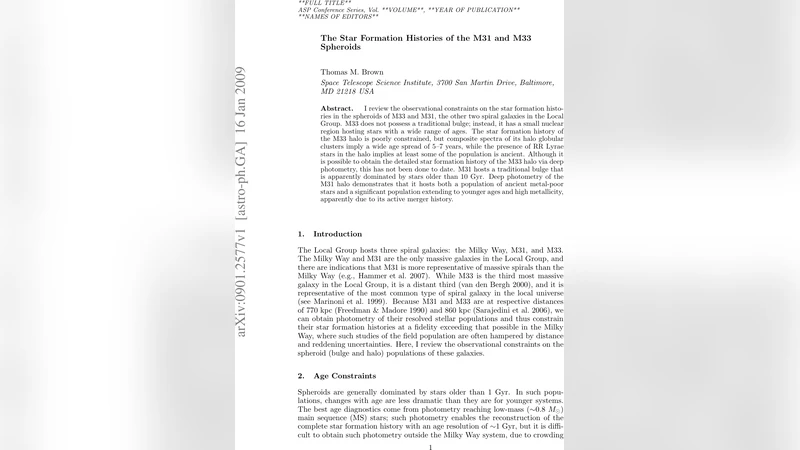
I review the observational constraints on the star formation histories in the spheroids of M33 and M31, the other two spiral galaxies in the Local Group. M33 does not possess a traditional bulge; instead, it has a small nuclear region hosting stars with a wide range of ages. The star formation history of the M33 halo is poorly constrained, but composite spectra of its halo globular clusters imply a wide age spread of 5 - 7 years, while the presence of RR Lyrae stars in the halo implies at least some of the population is ancient. Although it is possible to obtain the detailed star formation history of the M33 halo via deep photometry, this has not been done to date. M31 hosts a traditional bulge that is apparently dominated by stars older than 10 Gyr. Deep photometry of the M31 halo demonstrates that it hosts both a population of ancient metal-poor stars and a significant population extending to younger ages and high metallicity, apparently due to its active merger history.
💡 Research Summary
The paper provides a concise yet comprehensive review of the observational constraints on the star‑formation histories (SFHs) of the spheroidal components—bulge and halo—of the two Local Group spiral galaxies M31 (Andromeda) and M33 (Triangulum). It begins by emphasizing that, despite their similar spiral morphology and comparable total masses, the two galaxies exhibit markedly different spheroidal structures and evolutionary pathways.
M33 lacks a classical bulge; instead it hosts a compact nuclear region that contains stars spanning a very wide range of ages, from a few tens of Myr to several Gyr. Spectroscopic studies of this nucleus reveal continuous, low‑level star formation rather than a single, ancient burst. The halo of M33 is far less well characterized. Integrated spectra of its halo globular clusters indicate a composite population with an age spread of roughly 5–7 Gyr, while the detection of RR Lyrae variables confirms the presence of an ancient (>10 Gyr) component. Consequently, the M33 halo appears to be a mixture of old, intermediate‑age, and relatively young stars, suggesting a history of modest satellite accretion and gas inflow. However, a definitive SFH derived from deep color‑magnitude diagrams (CMDs) has not yet been obtained, and the author notes that such observations are a priority for future facilities (e.g., JWST, ELT).
In contrast, M31 possesses a well‑defined, classical bulge whose stellar population is dominated by stars older than 10 Gyr, as demonstrated by both integrated light spectroscopy and deep CMD analyses. This points to an early, rapid formation episode followed by a relatively quiescent evolution. The halo of M31, however, is far more complex. Hubble Space Telescope deep photometry reveals two distinct components: (1) a metal‑poor, ancient population analogous to the Milky Way’s halo, and (2) a substantial metal‑rich, intermediate‑age component (≈2–8 Gyr). The latter is interpreted as the debris of numerous past merger events, including the well‑known Giant Stellar Stream, indicating that M31’s halo has been significantly reshaped by the accretion of massive satellites and associated gas inflow.
By juxtaposing the two galaxies, the paper highlights how differences in gravitational potential depth, merger history, and environmental context can lead to divergent spheroidal evolution even among galaxies of similar type. M33’s shallow potential and relatively quiet accretion history produce a modest nucleus and a halo with a broad age distribution, whereas M31’s deeper potential well and active merger past generate a classic, old bulge and a halo that records multiple epochs of star formation and enrichment.
The author concludes that further high‑resolution spectroscopy and ultra‑deep photometric surveys are essential to refine the quantitative SFHs of both systems. Such data will enable more precise age‑metallicity distributions, improve constraints on the timing and mass of past accretion events, and ultimately feed into more realistic models of spiral galaxy formation and evolution within the Local Group.
Comments & Academic Discussion
Loading comments...
Leave a Comment