The quantum moment problem and bounds on entangled multi-prover games
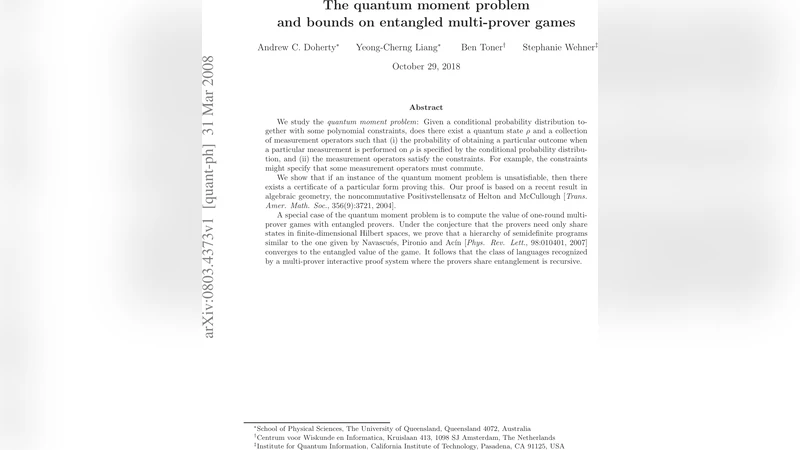
We study the quantum moment problem: Given a conditional probability distribution together with some polynomial constraints, does there exist a quantum state rho and a collection of measurement operators such that (i) the probability of obtaining a particular outcome when a particular measurement is performed on rho is specified by the conditional probability distribution, and (ii) the measurement operators satisfy the constraints. For example, the constraints might specify that some measurement operators must commute. We show that if an instance of the quantum moment problem is unsatisfiable, then there exists a certificate of a particular form proving this. Our proof is based on a recent result in algebraic geometry, the noncommutative Positivstellensatz of Helton and McCullough [Trans. Amer. Math. Soc., 356(9):3721, 2004]. A special case of the quantum moment problem is to compute the value of one-round multi-prover games with entangled provers. Under the conjecture that the provers need only share states in finite-dimensional Hilbert spaces, we prove that a hierarchy of semidefinite programs similar to the one given by Navascues, Pironio and Acin [Phys. Rev. Lett., 98:010401, 2007] converges to the entangled value of the game. It follows that the class of languages recognized by a multi-prover interactive proof system where the provers share entanglement is recursive.
💡 Research Summary
The paper introduces the “quantum moment problem” (QMP) as a unifying framework for a broad class of feasibility questions in quantum information theory. In its most general form, QMP asks whether, given a conditional probability distribution together with a set of polynomial constraints on observables, there exists a quantum state ρ and a collection of measurement operators {M_i} that (i) reproduce the prescribed probabilities and (ii) satisfy the algebraic constraints (e.g., commutation relations, projector identities, etc.). This formulation subsumes several well‑studied problems, such as the classical marginal problem, the quantum marginal problem, and, most importantly for this work, the computation of the entangled value of one‑round multi‑prover games.
The authors’ first technical contribution is a proof‑system for the unsatisfiability of QMP instances. They rely on the non‑commutative Positivstellensatz of Helton and McCullough, which states that any non‑negative non‑commutative polynomial can be expressed as a sum of squares (SOS) of other non‑commutative polynomials, possibly plus weighted sums of the given constraints. Such an SOS representation serves as a certificate that the original QMP instance has no solution, because the positivity of the polynomial is guaranteed under any quantum realization that respects the constraints. Consequently, if an instance is unsatisfiable, there exists a certificate of a specific algebraic form.
To turn this existence result into a computational tool, the authors observe that bounding the degree (or size) of the SOS certificate yields a semidefinite program (SDP). Searching for a certificate of a given size is exactly an SDP feasibility problem. By increasing the degree bound one obtains a hierarchy of SDPs, each providing a tighter infeasibility certificate. This hierarchy is structurally similar to the Navascués‑Pironio‑Acín (NPA) hierarchy, but it is derived from the general non‑commutative Positivstellensatz and therefore applies to any set of polynomial constraints, not only those arising from the usual “projective measurement” model.
The second major contribution is the application of this hierarchy to entangled multi‑prover games. In such a game, a verifier sends classical questions to two (or more) provers who share an entangled quantum state. After receiving their questions, each prover performs a local measurement on his/her share and returns a classical answer. The winning probability of the provers can be written as a linear functional of the moments ⟨A_s B_t⟩, where A_s and B_t are the measurement operators associated with the provers’ questions. Thus, determining whether the provers can achieve a winning probability at least p is exactly a QMP instance with the additional constraint that all Alice operators commute with all Bob operators. Under the finite‑dimensional assumption, commutation is equivalent to the existence of a tensor‑product decomposition H = H_A ⊗ H_B, which is the standard model for entangled provers.
The authors show that, assuming the optimal strategy can be realized with finite‑dimensional operators, the SDP hierarchy converges to the entangled value ω*(G) of the game G. More precisely, the hierarchy converges to the “field‑theoretic value” ω_f(G), defined as the supremum of winning probabilities achievable with possibly infinite‑dimensional commuting operators. Under the finite‑dimensional conjecture, ω_f(G) = ω*(G), and therefore the hierarchy yields the exact entangled value in the limit. This result settles a long‑standing open question about the computability of entangled game values for general games.
A direct corollary is that the class MIP* (languages having multi‑prover interactive proofs with entangled provers) is recursive: given a description of a game, one can run the SDP hierarchy until the upper and lower bounds meet within any desired precision, thereby deciding membership. The authors also define a related class MIP_f, where the tensor‑product requirement is replaced by the commutation requirement; this class is likewise recursive.
To demonstrate the practicality of their method, the paper presents explicit SOS certificates for two non‑trivial examples. The first is the I₃₃₂₂ Bell inequality, a well‑known inequality whose quantum bound was previously known only numerically; the authors construct a low‑degree SOS proof that reproduces the best known bound. The second example is a multi‑prover non‑local game introduced by Yao et al.; again, a compact SOS certificate is produced, illustrating that the hierarchy can handle genuinely multipartite scenarios.
In summary, the paper establishes a powerful algebraic framework (the quantum moment problem) for reasoning about quantum correlations, provides a concrete SDP hierarchy based on the non‑commutative Positivstellensatz, proves convergence of this hierarchy to the entangled value of general multi‑prover games under a natural finite‑dimensional assumption, and derives important complexity‑theoretic consequences, notably the recursiveness of MIP*. The work bridges quantum information, computational complexity, and real algebraic geometry, opening new avenues for both theoretical analysis and algorithmic computation of quantum non‑locality.
Comments & Academic Discussion
Loading comments...
Leave a Comment