Projectional entropy and the electrical wire shift
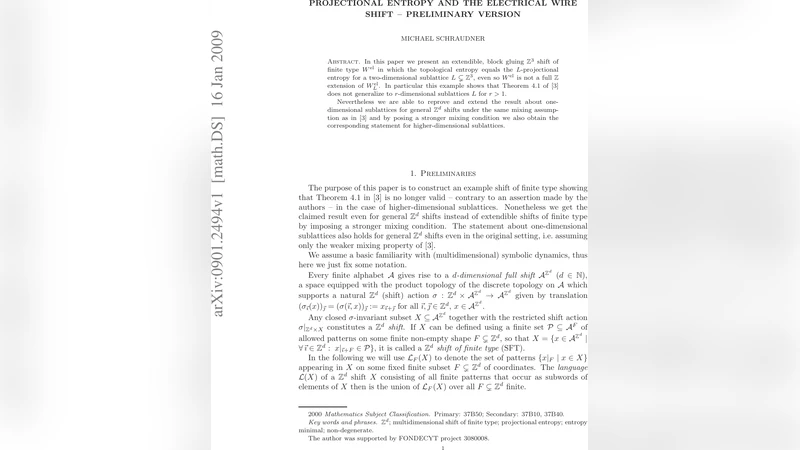
In this paper we present an extendible, block gluing $\mathbb Z^3$ shift of finite type $W^{\text{el}}$ in which the topological entropy equals the $L$-projectional entropy for a two-dimensional sublattice $L:=\mathbb Z \vec{e}_1+\mathbb Z\vec{e}_2\subsetneq\mathbb Z^3$, even so $W^{\text{el}}$ is not a full $\mathbb Z$ extension of $W^{\text{el}}_L$. In particular this example shows that Theorem 4.1 of [3] does not generalize to $r$-dimensional sublattices $L$ for $r>1$. Nevertheless we are able to reprove and extend the result about one-dimensional sublattices for general (non-SFT) $\mathbb Z^d$ shifts under the same mixing assumption as in [3] and by posing a stronger mixing condition we also obtain the corresponding statement for higher-dimensional sublattices.
💡 Research Summary
The paper investigates the relationship between topological entropy and projectional entropy for multidimensional shift spaces, focusing on the case where the underlying lattice is ℤ³. The authors construct a concrete counterexample, the “electrical wire shift” denoted W^el, which is a shift of finite type (SFT) on ℤ³ that satisfies two strong mixing properties: extendibility (any finite pattern can be extended to a global configuration) and block‑gluing (any two sufficiently separated finite blocks can be joined by a globally admissible configuration).
The shift is defined by imposing a “wire” constraint on each horizontal layer (the ℤe₁+ℤe₂ plane). Within a layer, wires may not intersect, which yields a two‑dimensional SFT that is well‑understood. Between layers, however, wires are allowed to continue freely, giving the full three‑dimensional system its extendibility and block‑gluing character.
When the system is projected onto the two‑dimensional sublattice L = ℤe₁ + ℤe₂, the resulting subshift W^el_L coincides with the planar wire SFT. Consequently the projectional entropy h_proj(L, W^el) equals the topological entropy h_top(W^el). This equality would, in the one‑dimensional setting, trigger the conclusion of Theorem 4.1 in the cited work
Comments & Academic Discussion
Loading comments...
Leave a Comment