Weakly exact categories and the snake lemma
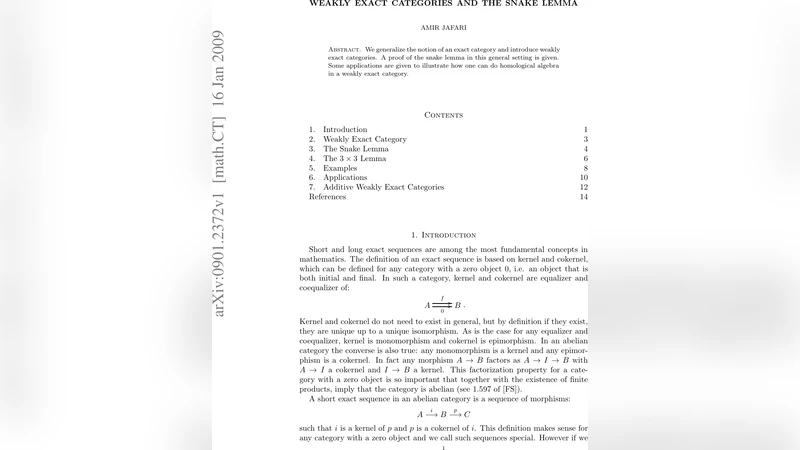
We generalize the notion of an exact category and introduce weakly exact categories. A proof of the snake lemma in this general setting is given. Some applications are given to illustrate how one can do homological algebra in a weakly exact category.
💡 Research Summary
The paper introduces a new categorical framework called a “weakly exact category,” which relaxes the stringent axioms of Quillen’s exact categories while preserving enough structure to carry out the fundamental constructions of homological algebra. The authors begin by motivating the need for such a generalization: many naturally occurring categories—such as categories of subobjects, submodules, or subgroups—do not possess all kernels and cokernels required by the classical definition of exactness, yet they still exhibit enough exact‑like behavior to support diagram‑chasing arguments.
A weakly exact category is defined by three core axioms. First, a distinguished class of morphisms, called exact morphisms, is closed under composition and consists of morphisms that are simultaneously monic and epic in a weakened sense. Second, for any exact morphism (f), both an image and a coimage exist, and there is a natural isomorphism between them (the “image–coimage” axiom). This replaces the usual kernel–cokernel pair while still providing a canonical factorization of (f). Third, pullbacks and pushouts of exact morphisms exist and preserve exactness (the “stability” axiom). Together these axioms guarantee that short exact sequences can be formed without demanding the existence of all kernels and cokernels.
The authors demonstrate that this notion subsumes several familiar settings. Every abelian category, and consequently every exact category, is trivially weakly exact. More interestingly, the category whose objects are submodules of a fixed module and whose morphisms are inclusions satisfies the axioms: images and coimages are given by intersections and generated submodules, while pullbacks and pushouts correspond to intersections and sums, respectively. An analogous example is the category of subgroups of a group. These examples illustrate that the new framework captures many “partial” exact situations that were previously outside the reach of classical homological methods.
The central technical achievement is a proof of the snake lemma in any weakly exact category. The classical snake lemma relies on the existence of kernels, cokernels, and the exactness of rows and columns in a commutative diagram. In the weak setting, the authors replace kernels and cokernels with images and coimages, using the image–coimage isomorphism to construct the connecting morphism. Pullback and pushout stability ensure that the necessary diagrammatic constructions remain exact. The proof proceeds by (1) factoring each horizontal and vertical morphism through its image and coimage, (2) forming the appropriate pullback and pushout squares to align the factorizations, (3) defining the connecting morphism via the universal property of the pullback, and (4) verifying exactness at each term by checking that the image of one map coincides with the kernel (in the weak sense) of the next. The result is a long exact sequence that mirrors the classical snake lemma, showing that the essential diagram‑chasing argument survives the weakening of the axioms.
From the snake lemma, the paper derives the five lemma, nine lemma, and the construction of long exact sequences of homology associated to short exact sequences of chain complexes, all within the weakly exact context. Moreover, the authors outline how one can define Ext and Tor functors by using projective or injective resolutions that exist in many weakly exact categories (for instance, when the underlying ambient category is abelian). They sketch a “weak derived category” built from chain complexes modulo homotopy, and suggest that a triangulated structure can be imposed using the long exact sequences supplied by the snake lemma.
The final sections discuss potential extensions. The authors note that while weak exactness does not require additivity, many homological constructions benefit from an additive structure; thus they propose studying “additive weakly exact categories.” They also hint at applications to non‑commutative geometry, where subobject categories naturally arise, and to representation theory, where categories of filtered modules often fail to be exact but are weakly exact.
In summary, the paper provides a robust generalization of exact categories, proves that the snake lemma—a cornerstone of homological algebra—holds in this broader setting, and demonstrates that a substantial portion of the classical homological toolkit can be transplanted to weakly exact categories. This opens the door to systematic homological investigations in contexts previously considered too “inexact” for standard methods.
Comments & Academic Discussion
Loading comments...
Leave a Comment