We investigate the spatial asymptotics of decaying solutions of the Toda hierarchy and show that the asymptotic behaviour is preserved by the time evolution. In particular, we show that the leading asymptotic term is time independent. Moreover, we establish infinite propagation speed for the Toda lattice.
Deep Dive into On the Spatial Asymptotics of Solutions of the Toda Lattice.
We investigate the spatial asymptotics of decaying solutions of the Toda hierarchy and show that the asymptotic behaviour is preserved by the time evolution. In particular, we show that the leading asymptotic term is time independent. Moreover, we establish infinite propagation speed for the Toda lattice.
Since the seminal work of Gardner et al. [9] in 1967 it is known that completely integrable wave equations can be solved by virtue of the inverse scattering transform. In particular, this implies that short-range perturbations of the free solution remain short-range during the time evolution. This raises the question to what extend spatial asymptotical properties are preserved during time evolution. In [1], [2] (see also [13]) Bondareva and Shubin considered the initial value problem for the Korteweg-de Vries (KdV) equation in the class of initial conditions which have a prescribed asymptotic expansion in terms of powers of the spatial variable. As part of their analysis they obtained that the leading term of this asymptotic expansion is time independent. Inspired by this intriguing fact, the aim of the present paper is to prove a general result for the Toda equation which contains the analog of this result plus the known results for short-range perturbation alluded to before as a special case.
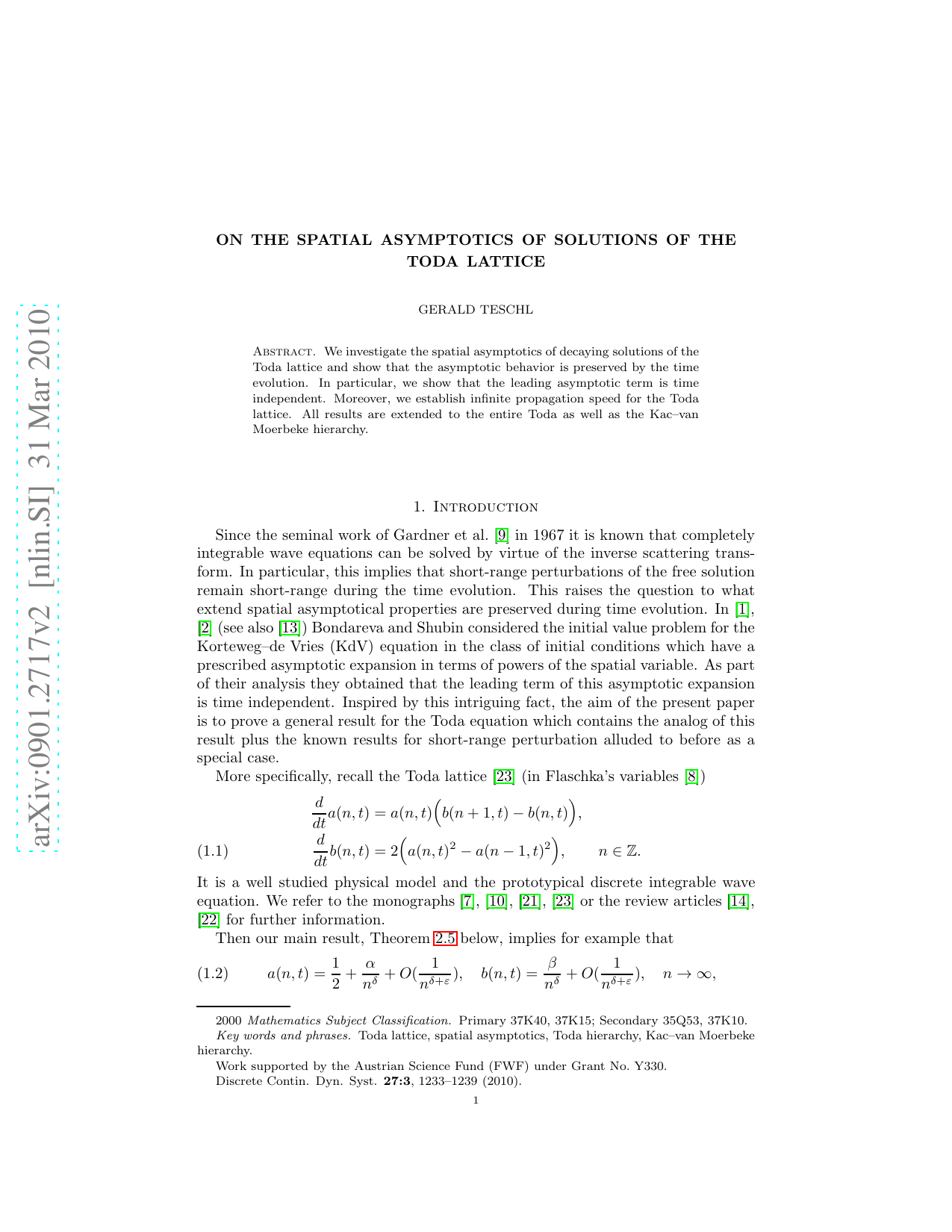
More specifically, recall the Toda lattice [23] (in Flaschka’s variables [8])
It is a well studied physical model and the prototypical discrete integrable wave equation. We refer to the monographs [7], [10], [21], [23] or the review articles [14], [22] for further information.
Then our main result, Theorem 2.5 below, implies for example that
for all t ∈ R provided this holds for the initial condition t = 0. Here α, β ∈ R and δ ≥ 0, 0 < ε ≤ 1.
A few remarks are in order: First of all, it is important to point out that the error terms will in general grow with t (see the discussion after Theorem 2.5 for a rough time dependent bound on the error). An analogous result holds for n → -∞. Moreover, there is nothing special about the powers n -δ , which can be replaced by any bounded sequence which, roughly speaking, does decay at most exponentially and whose difference is asymptotically of lower order. Finally, similar results hold for the Ablowitz-Ladik equation. However, since the Ablowitz-Ladik system does not have the same difference structure some modifications are neccessary and will be given in Michor [17].
To set the stage let us recall some basic facts for the Toda lattice. We will only consider bounded solutions and hence require Hypothesis H. 2.1. Suppose a(t), b(t) satisfy
First of all, to see complete integrability it suffices to find a so-called Lax pair [16], that is, two operators H(t), P (t) in ℓ 2 (Z) such that the Lax equation
is equivalent to (1.1). Here ℓ 2 (Z) denotes the Hilbert space of square summable (complex-valued) sequences over Z. One can easily convince oneself that the right choice is Theorem 2.2. Let P (t) be a family of bounded skew-adjoint operators, such that t → P (t) is differentiable. Then there exists a family of unitary propagators U (t, s) for P (t), that is,
Moreover, the Lax equation (2.1) implies
As pointed out in [19], this result immediately implies global existence of bounded solutions of the Toda lattice as follows: Considering the Banach space of all bounded real-valued coefficients (a(n), b(n)) (with the sup norm), local existence is a consequence of standard results for differential equations in Banach spaces. Moreover, Theorem 2.2 implies that the norm H(t) is constant, which in turn provides a uniform bound on the coefficients of H(t),
Hence solutions of the Toda lattice cannot blow up and are global in time (see [21, Sect. 12.2] for details):
However, more can be shown. In fact, when considering the inverse scattering transform for the Toda lattice it is desirable to establish existence of solutions within the Marchenko class, that is, solutions satisfying
for all t ∈ R. That this is indeed true was first established in [20] and rediscovered in [11] using a different method. Furthermore, the weight 1 + |n| can be replaced by an (almost) arbitrary weight function w(n).
Lemma 2.4. Suppose a(n, t), b(n, t) is some bounded solution of the Toda lattice (1.1) satisfying (2.7) for one t 0 ∈ R. Then
holds for all t ∈ R, where w(n) ≥ 1 is some weight with sup n (| w(n+1) w(n
Moreover, as was demonstrated in [5] (see also [6]), one can even replace |a(n, t)-
, where ā(n, t), b(n, t) is some other bounded solution of the Toda lattice. See also [12], where similar results are shown.
This result shows that the asymptotic behavior as n → ±∞ is preserved to leading order by the Toda lattice. The purpose of this paper is to show that even the leading term is preserved (i.e., time independent) by the time evolution. Set
Then one has the following result:
) < ∞ and fix some 1 ≤ p ≤ ∞. Suppose a 0 , b 0 and ã0 , b0 are bounded sequences such that
Suppose a(t), b(t) is the unique solution of the Toda lattice (1.1) corresponding to the initial conditions
Then this solution is of the form
Proof. The Toda equation (1.1) implies the differential equation
for (ã, b). Since our requirement for w(n) implies that the shift operators are continuous with respect to the norm .
…(Full text truncated)…
This content is AI-processed based on ArXiv data.