A Lower Bound on the Capacity of Wireless Erasure Networks with Random Node Locations
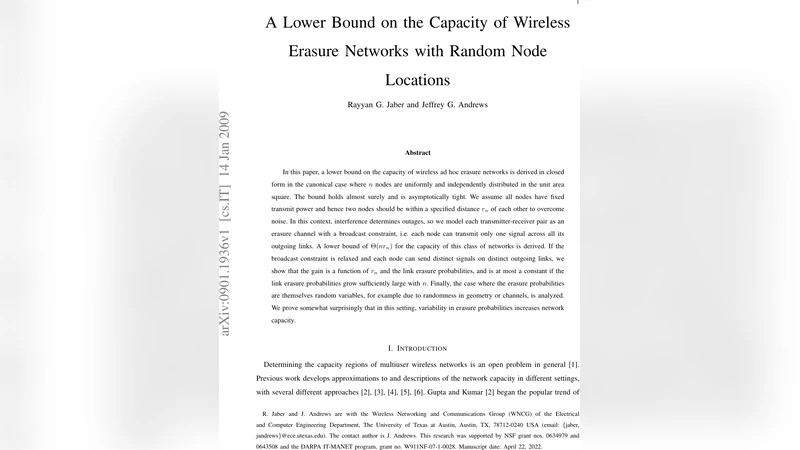
In this paper, a lower bound on the capacity of wireless ad hoc erasure networks is derived in closed form in the canonical case where $n$ nodes are uniformly and independently distributed in the unit area square. The bound holds almost surely and is asymptotically tight. We assume all nodes have fixed transmit power and hence two nodes should be within a specified distance $r_n$ of each other to overcome noise. In this context, interference determines outages, so we model each transmitter-receiver pair as an erasure channel with a broadcast constraint, i.e. each node can transmit only one signal across all its outgoing links. A lower bound of $\Theta(n r_n)$ for the capacity of this class of networks is derived. If the broadcast constraint is relaxed and each node can send distinct signals on distinct outgoing links, we show that the gain is a function of $r_n$ and the link erasure probabilities, and is at most a constant if the link erasure probabilities grow sufficiently large with $n$. Finally, the case where the erasure probabilities are themselves random variables, for example due to randomness in geometry or channels, is analyzed. We prove somewhat surprisingly that in this setting, variability in erasure probabilities increases network capacity.
💡 Research Summary
The paper investigates the fundamental throughput limits of wireless ad‑hoc erasure networks in which nodes are randomly placed in a unit‑square region. Each node transmits with a fixed power, which imposes a deterministic communication radius rₙ: two nodes can exchange information only if their Euclidean distance does not exceed rₙ. Within this radius, interference is the sole cause of packet loss, and the authors model every transmitter‑receiver pair as an independent binary erasure channel. A crucial system constraint is the “broadcast constraint”: a node may broadcast only a single signal that is simultaneously received (or erased) by all its neighbors. Under these assumptions the network can be represented as a random geometric graph Gₙ,ᵣₙ whose edges are erasure channels.
The first major contribution is a closed‑form lower bound on the total network capacity when the broadcast constraint is enforced. By leveraging known connectivity results for random geometric graphs, the authors show that if rₙ grows faster than (log n)/n the graph is almost surely connected and the average node degree scales as π rₙ² n. Applying the max‑flow min‑cut theorem to the resulting erasure‑channel network yields a minimum cut value proportional to the average degree, which translates into a capacity lower bound of Θ(n rₙ). This bound holds with probability one as n→∞ and is asymptotically tight because a matching upper bound can be constructed using simple routing schemes.
The second part relaxes the broadcast constraint, allowing each node to transmit distinct codewords on each outgoing edge. In this “multi‑message” setting each edge behaves as an independent erasure channel with success probability 1−ε_{ij}. The authors derive an expression for the achievable sum‑rate that depends on both rₙ and the collection of erasure probabilities. They demonstrate that when the erasure probabilities increase sufficiently fast with n (for example ε≈1−c/(n rₙ)), the gain from multi‑message transmission is bounded by a constant factor; the physical distance limitation remains the dominant bottleneck. Conversely, if erasures are relatively rare, the capacity can be amplified by a factor proportional to the average node degree.
The third and most surprising contribution examines the scenario where the erasure probabilities themselves are random variables, reflecting geometric randomness, fading, or shadowing. By treating ε_{ij} as independent draws from a distribution with mean μ and variance σ², the authors prove that the expected value of the minimum cut is larger than the minimum cut computed with the mean erasure probability (Jensen’s inequality applied to the cut function). In other words, variability in link reliability creates “capacity diversity”: occasional high‑quality links can be exploited to route traffic, raising the overall network throughput. The paper quantifies this effect and shows that the capacity increase can be significant when σ² is large, even if the average erasure probability remains high.
To validate the analytical results, extensive Monte‑Carlo simulations are performed for various network sizes, communication radii, and erasure distributions. The simulated sum‑rates closely follow the Θ(n rₙ) scaling law under the broadcast constraint and exhibit the predicted constant‑factor or diversity gains when the constraint is lifted or erasures are random. Graphical illustrations highlight the transition from connectivity‑limited to interference‑limited regimes.
In summary, the work provides a rigorous, asymptotically tight lower bound on the capacity of wireless erasure networks with random node locations, clarifies the impact of the broadcast constraint, and reveals that stochastic variations in link erasures can paradoxically improve network performance. These insights guide the design of large‑scale wireless ad‑hoc systems, suggesting that careful control of transmission range, power budgeting, and exploitation of link‑quality diversity are key levers for achieving high throughput.
Comments & Academic Discussion
Loading comments...
Leave a Comment