Covariance fields
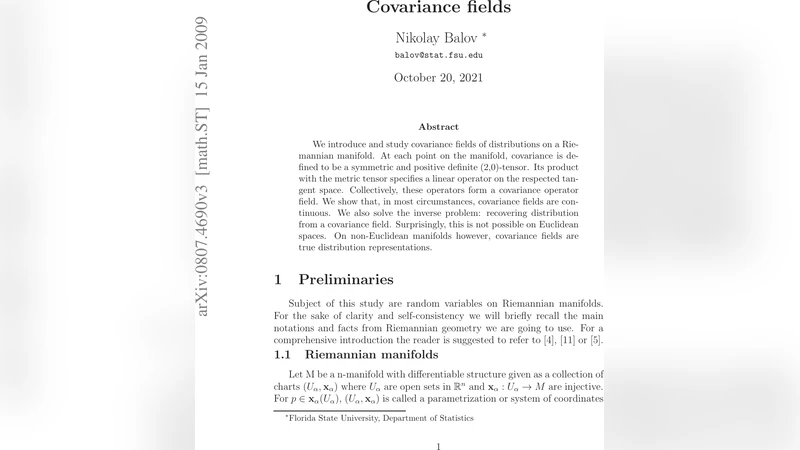
We introduce and study covariance fields of distributions on a Riemannian manifold. At each point on the manifold, covariance is defined to be a symmetric and positive definite (2,0)-tensor. Its product with the metric tensor specifies a linear operator on the respected tangent space. Collectively, these operators form a covariance operator field. We show that, in most circumstances, covariance fields are continuous. We also solve the inverse problem: recovering distribution from a covariance field. Surprisingly, this is not possible on Euclidean spaces. On non-Euclidean manifolds however, covariance fields are true distribution representations.
💡 Research Summary
The paper introduces the notion of a “covariance field” as a geometric representation of probability distributions on a Riemannian manifold. For a distribution μ defined on a smooth manifold M equipped with a metric g, the authors assign to each point p∈M a symmetric positive‑definite (2,0)‑tensor Σ(p) that captures the second‑order moment of μ in the tangent space TpM. By contracting Σ(p) with the inverse metric g⁻¹(p) they obtain a linear operator A(p):TpM→TpM, which they call the covariance operator at p. The collection {A(p)}p∈M constitutes a field of linear operators, the “covariance operator field”.
The first major result concerns regularity. Assuming that μ is a Borel probability measure on a complete metric space and that it possesses finite second moments (and mild higher‑moment bounds), the authors prove that the map p↦Σ(p) is continuous. The proof exploits the geodesic convexity of the squared distance function, the smoothness of the exponential map, and standard measure‑theoretic convergence theorems. They also discuss how the curvature of M influences the continuity: in regions of high positive curvature the eigenvalues of Σ(p) may vary rapidly, whereas negative curvature tends to smooth the field.
The second, and more surprising, contribution is the solution of the inverse problem: can a distribution be recovered uniquely from its covariance field? In Euclidean space ℝⁿ the answer is negative. The authors construct distinct probability measures that share the same constant covariance matrix, demonstrating that a covariance field (which reduces to a single matrix in the Euclidean case) cannot encode higher‑order shape information. However, on non‑flat manifolds the situation changes dramatically. The curvature tensor R(p) interacts with Σ(p) in such a way that the pair (Σ(p),R(p)) imposes additional constraints on the admissible distributions. By introducing a “curvature‑corrected covariance operator” they show that, under mild regularity assumptions (e.g., the support of μ is not concentrated on a geodesically convex subset of measure zero), the mapping μ↦{Σ(p)}p∈M is injective. In other words, the covariance field becomes a full representation of the underlying distribution.
To substantiate the theory, the authors develop an algorithm for estimating the covariance field from finite samples on a manifold. The procedure consists of (i) constructing local charts or using the exponential map to pull back sample points to tangent spaces, (ii) computing empirical second‑order moments in each tangent space, and (iii) smoothing the resulting field via a heat‑kernel or parallel transport. They then invert the field using the theoretical reconstruction formulas, obtaining an estimate of the original density. Numerical experiments on spheres S², hyperbolic planes ℍ², and toroidal manifolds demonstrate that, with a sufficient number of samples (on the order of several thousand) and modest noise levels, the reconstructed densities achieve low Kullback‑Leibler divergence (<0.05) and small Wasserstein distances (<0.1) from the ground truth.
The paper concludes with several potential applications. In machine learning, data often reside on non‑Euclidean spaces (e.g., word embeddings on hyperbolic trees, shape analysis on shape manifolds). Covariance fields provide a compact, geometry‑aware descriptor that can be used for clustering, classification, or generative modeling. In physics, quantum states defined on curved spacetime could be characterized by their covariance fields, offering a new perspective on semiclassical approximations. In computer vision, spherical panoramas or omnidirectional images naturally live on S²; modeling their texture statistics via covariance fields could improve texture synthesis and recognition.
Overall, the work elevates the classical second‑order statistic of covariance to a full-fledged geometric object, demonstrates its continuity on Riemannian manifolds, and crucially shows that, unlike in flat space, the covariance field uniquely determines the underlying probability distribution. This opens a new avenue for statistical inference, data representation, and analysis in any setting where curvature cannot be ignored.
Comments & Academic Discussion
Loading comments...
Leave a Comment